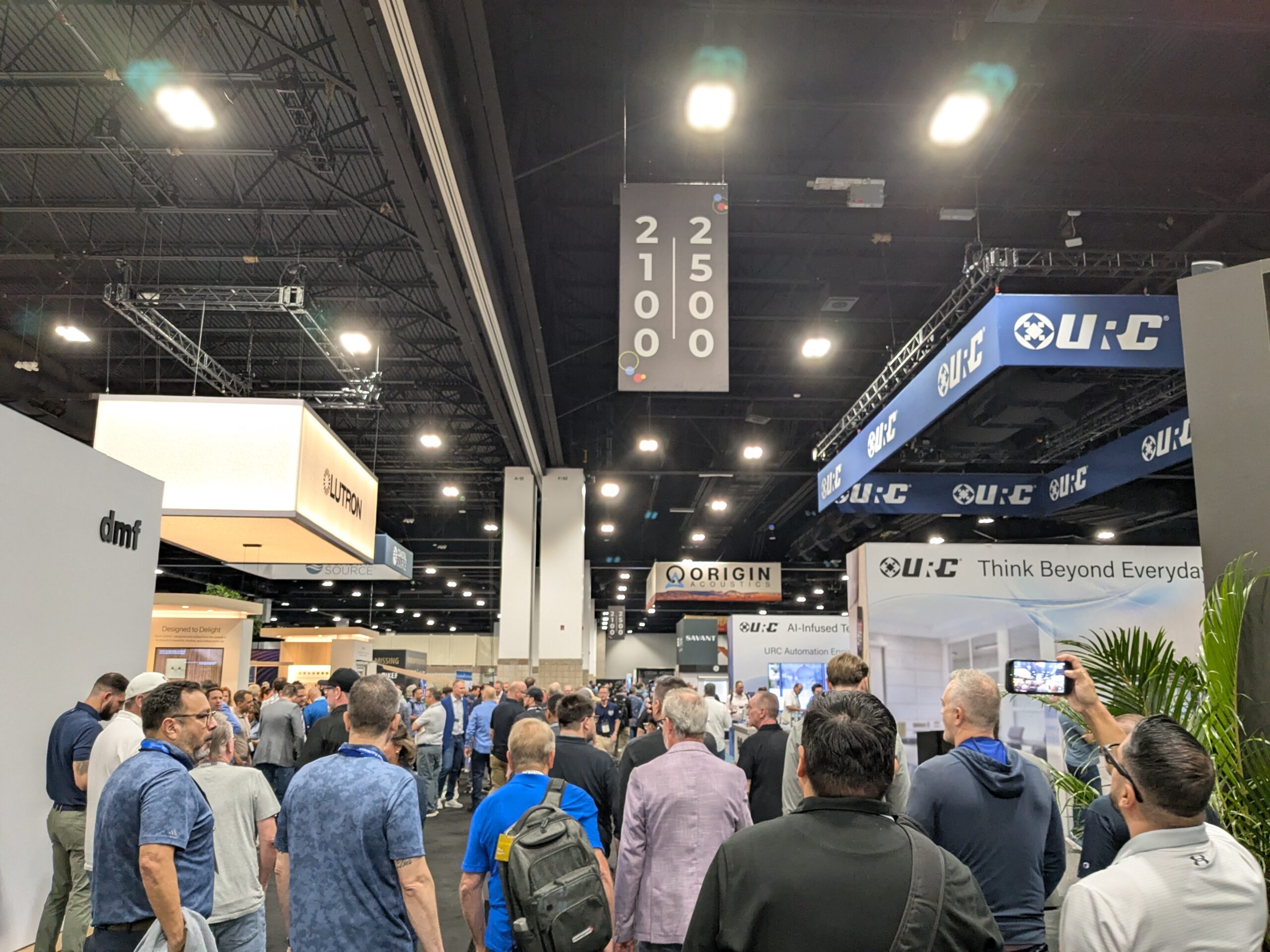
Back in 2025, CE Pro made a prediction that, given the state of the housing market at the time, retrofits and renovations could come to occupy a much larger portion of an integrator’s workload than they already do. Cut to CEDIA Expo in 2026, and as I’m touring the booths, speaking with manufacturers on what new products they’re revealing and what new challenges they’re facing, the one word I heard the most was “retrofit.”
To clarify, new construction hasn’t disappeared as a category. What is happening based on conversations with manufacturers, however, is that it’s cooling enough such that product roadmaps are beginning to pivot to address retrofit solutions.
Where Retrofit Solutions Appeared at CEDIA Expo 2026

Photo by Nick Boever
Stepping into DMF Lighting’s booth at the show, I was immediately greeted by their new advancements in retrofittable downlights. Over at Coastal Source, they had their plug-and-play landscape lighting. MOTORYSE launched at the show touting itself as one of the first pure retrofit shading and drapery brands for the channel.
Nowhere is the growing prevalence of retrofit solutions emphasized more, however, than in the wireless category, with Screen Innovations having perhaps the show’s biggest wireless innovation in its new Tri-Mesh technology, which aims to make large-scale Zigbee-based installations more feasible.
Why Retrofit Solutions Are Becoming More Prevalent
If you haven’t noticed lately, the housing market hasn’t been doing so hot. There’s a variety of reasons for that. Increased labor costs, increased material costs, increased shipping costs and mortgage rates that refuse to go down.
It’s that last one that’s been the biggest thorn in the market’s side due to the “golden handcuff” effect. Running off data from the NKBA and CEDIA, 73% of U.S. borrowers hold mortgage rates below 5% right now. The average mortgage rate in the U.S. just rose above 7%. In short: no one wants to move right now.
All this has created an environment where more people are opting to stay in place and renovate, rather than build and create. Again, we’re not saying new construction is atrophying horrifically, just enough that manufacturers, in trying to anticipate what the market is going to need the most in the next few years, are eyeballing retrofit solutions.
Following a slow summer buying season, many experts are saying the U.S. housing market is on track for one of its worst years since 2011, and all of the factors that contributed to that year are showing no signs of subsiding soon.
A Repeat of the Pandemic Renovation Boom?
It’s worth noting that this time around, things may not turn out like they did during the pandemic. While the lockdowns largely kept people in one place, the economy of that era was largely bolstered by low borrowing rates, high savings and a government stimulus to boot.
Today’s economy, though it’s forcing similar housing conditions, is a total flip in contrast. Borrowing rates keep creeping up, budgets have shrank considerably due to the rising cost of goods and services, and any chance of a government stimulus comes with an overwhelming concern that it will just reignite inflation all over again.
There are segments of the markets feeling the squeeze a lot less, but make no mistake, a squeeze is happening across the entire economy. People might still be inclined to renovate rather than move, but it’s unlikely they’re willing to shell out the same way they did during the pandemic.
Why Retrofits and Renovations May Start to Make More Sense for Integrators

Photo by Nick Boever
The D-Tools Midyear Report for 2026 showcases that while sales growth is still happening throughout the channel, it is very lopsided. Roughly one-third of integrators grew sales by 51% or more while another third saw sales decline by 21% or more. And those that did see sales growth saw it not through increasing scope or cost of projects, but instead by volume.
What this means is that people aren’t spending any more on projects than they did in 2025. Instead, dealers are just picking up more work, and if new home sales are grinding to a halt, that extra work needs to be coming from somewhere.
Truthfully, though, part of the challenge of retrofits has always come down to the fact that a lot of pro-channel equipment didn’t lend itself to these types of projects. Wireless has come a long way since the beginning, and networking has become a major backbone of the channel. This push by integrators into more retrofit/remodel work could be the push the channel has needed to develop better retrofit solutions.
The benefit there is that the companies developing these solutions are well established. Most of the retrofit solutions are retrofits themselves: versions of pre-existing SKUs that have simply been updated to handle older infrastructure better. Though, there are those like MOTORYSE’s that are brand-new to the market.
Where Integrators Will Want to Keep Tabs
One thing of note is there’s no telling how long this economy could last. Mortgage rates are projected to remain elevated for at least another two years, and economists have already begun to factor in a correction in the S&P 500 by about 20% late next year. These are not guaranteed by any stretch, but they are certainly worst-case-scenarios worth keeping in the back of one’s head.
Additionally, we’ll be interested in seeing how this move plays out for the manufacturers themselves. Will we see a meaningful increase in sales for the manufacturers that lean into the retrofit market more than others? One interesting note is that because of how flexible and easy to install retrofit solutions tend to be, there’s even the possibility that some of these products get picked up more frequently across all project types just for sheer ease of use.