Takeaways
- The Episode 4-Zone Preamp adds ADI’s Ryff audio streaming platform to the Episode series after originally being relegated to Triad products.
- Preamp has built-in integrations with Control4 and OvrC, in addition to being pairable with other preamps for extensive multiroom setups.
- New preamp requires an external amplifier to function.
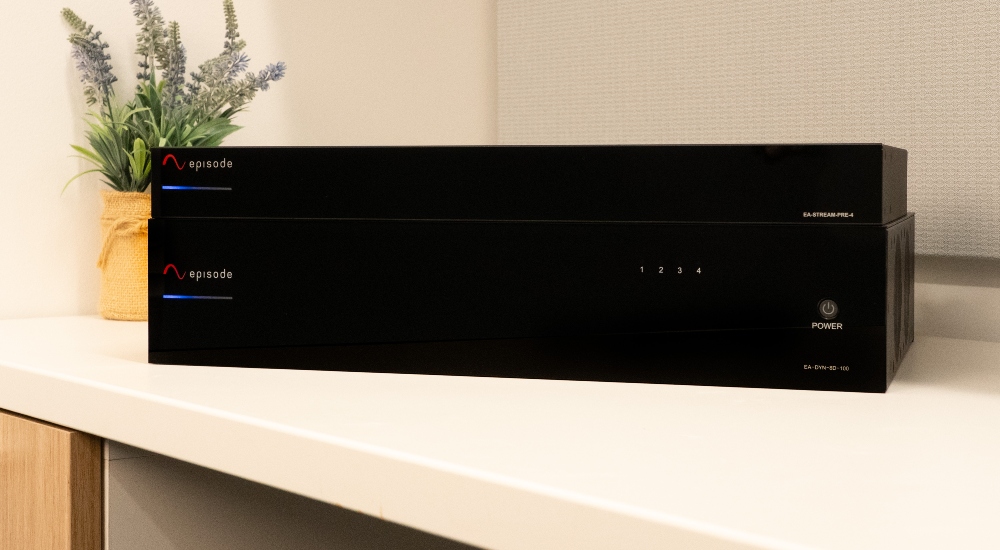
ADI just released Episode’s first Ryff-enabled streaming product in the form of a 4-zone streaming preamplifier (EA-STREAM-PRE-4). The preamp is available now for delivery through online channels and local stocking locations and marks a significant expansion of the Episode portfolio into audio streaming on the Control4 platform, though ADI says it can be leveraged as an independent audio streamer, as well.
What is Ryff?
As stated on Snap One’s website, Ryff is the streaming audio platform that powers the Control4 Listen Experience. The platform is built to provide high quality audio streaming, decoding up to a 192kHz sample rate at full 24-bit depth.
Users can also access other popular streaming services, such as Spotify, Apple Music and Qobuz, through the Ryff app and stream through Ryff-enabled audio devices. Historically, this functionality has been relegated to Triad line—specifically the Triad SA1 streaming amplifier.
Features of the Episode 4-Zone Streaming Preamp
According to specifications released by ADI, the new Episode streaming preamp takes the form factor of a 1U, rack-mountable unit. Each unit can support up to four independent audio streams, allowing it to be used in multiroom audio setups, with multiple preamp units able to be combined to further scale those systems.
Though the preamp can easily be connected into a Control4 smart home system, the fact that it comes supported by Ryff out the box means that it can also be leveraged as an audio-only solution. On top of Control4 interoperability, the preamp can also work with MoIP, OvrC and AirPlay 2, further opening system design, deployment and support options.
Working natively with the Ryff app, the unit requires no brand-specific authorization for setup or deployment. It also is designed to operate cleanly with other Ryff-enabled devices, including the Triad SA1.
How Streaming’s Popularity Shapes Audio Capabilities
Edison’s Infinite Dial study (which tracks digital media consumption across the U.S.), found that 81% of Americans age 12 and up listen to some form of digital audio. In 2023, another study conducted by Edison found that roughly 75% of adults in the U.S. listened to audio via some form of streaming service, with the average daily listening time being one hour and 49 minutes.
This popularity has led to modern audio hardware largely being judged by its ability to integrate into audio streaming services like Apple Music and Spotify.
“The market continues to shift toward reliable, high-resolution, multi-zone streaming audio without the complexity or cost of multiple single zone products,” said Mike Burratto, Sr. Director of Product Management at ADI.
Why This May Pose a Challenge to Integrators
While streaming technology has improved over time, those improvements can either go unnoticed or even seem “off” to listeners used to lower quality formats. At a launch event for the Node in October 2024, Bluesound noted this “complacency” required proactive education on the part of the integrator beyond simple demos to overcome.
Of Note for Integrators
While plenty of attention gets given to broad-spanning smart home platforms, the Episode preamp introduces some valued flexibility into an integrator’s arsenal. It’s strong enough to be able to stand on its own, but it’s never locked into that path thanks to the integration, design and support options it has.
It’s a reflection of how, even as the industry pushes towards complex, open ecosystems, simplified, standalone options are rising in popularity, both as budget-conscious solutions and as targeted lifestyle setups as homeowners pursue simplicity and convenience over all-encompassing functionality.
One thing to remember with the new Episode preamp, however, is that it does require an external amplifier to function.