Takeaways
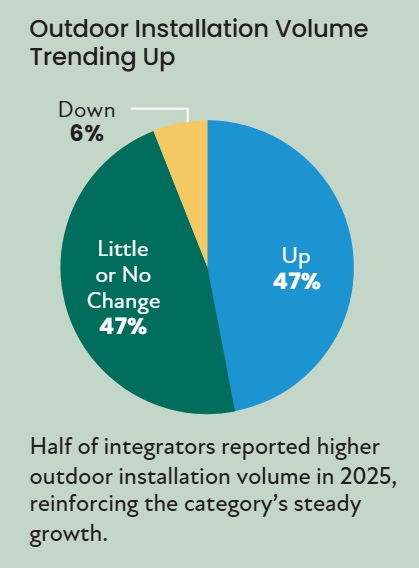
- 47% of respondents in CE Pro’s 2026 Outdoor Technology Deep Dive Survey saw the volume of installations featuring outdoor technology increasing last year.
- Integrators report outdoor technology is being adopted with the same attention to detail as interior environments
- The median outdoor project in 2025 came in at approximately $8,750 but the range between projects is broad.
The outdoor technology category continues to solidify its position as a core part of the residential integration business, according to CE Pro’s latest survey of integrators across the U.S.
CE Pro’s 2026 Outdoor Technology Deep Dive data points to a market that is not only growing, but maturing. Integrators are completing more projects, taking on broader scopes and approaching outdoor environments as full-system opportunities rather than add-ons.
Project Volume Reflects a Healthy Market
Outdoor technology work is happening at scale. The largest segment of respondents, representing 42%, reported completing 21 or more outdoor projects in 2025. The median integrator completed between 16 and 20 projects during the year.
These are not one-off installs. Most projects now include multiple systems, spanning audio, video, networking, lighting and security across a single property.
Year-over-year performance remains strong. About 47% of integrators said their outdoor project volume increased compared to 2024, while another 47% reported stable activity. Only about 5% reported declines.
Want more outdoor technology insights? Download the 2026 CE Pro Outdoor Technology Deep Dive here!
Confidence Builds for 2026
Looking ahead, the outlook remains positive. Nearly 70% of integrators expect their outdoor technology business to grow in 2026, with close to half forecasting increases of 11% or more. The median expectation falls in the 6% to 10% growth range.
“I see it growing in 2026,” says Dusty Gorski, integration designer at ListenUp. “Particularly in Colorado, where our weather can be very mild even in the winter months, people want to spend time outside.”
Regional dynamics continue to play a role, but the overall trend is consistent. In Southern California, outdoor living is effectively a year-round expectation.
“The benefit of being in Southern California is being able to have indoor-outdoor space year-round,” says Russell Gaskamp, CEO of LA Techs. “It’s exactly why I live here.”
Outdoor Becomes a Core Category
The data suggests outdoor technology is moving beyond discretionary spending and into a more foundational role within residential projects.
Integrators report that outdoor spaces are increasingly being designed with the same level of attention as interior environments. That shift is expanding both project scope and revenue potential.
The category now regularly includes not just entertainment systems, but infrastructure and control elements that extend across the property. As a result, outdoor projects are becoming more predictable contributors to annual business performance.
Pricing Reflects a Wide Range of Projects
Project costs vary significantly depending on scope. The median outdoor project in 2025 came in at approximately $8,750, but the range is broad.
A large portion of projects fall between $2,500 and $5,000, while another substantial segment lands in the $15,000 to $25,000 range. High-end installations can exceed those figures by a wide margin.
“I think our average outdoor system is probably somewhere around $30,000,” Gorski says. “And then there are those spikes where somebody has a large area and really wants to outfit it.”
These larger projects often include extensive audio systems, multiple zones, networking infrastructure and integrated control.
Cost Pressures Continue to Build
While demand remains strong, integrators are also navigating rising costs. More than half of survey respondents, 56%, expect end-user pricing to increase in 2026. Labor remains a key pressure point, particularly in high-cost markets.
“I can’t hire anybody for 20 bucks an hour anymore,” Gaskamp says. “Everybody’s really feeling the squeeze.”
Material costs and broader economic factors are also contributing to upward pricing pressure, reinforcing the importance of accurate scoping and early engagement.
Growth Driven by Expanding Opportunities
Despite those challenges, the overall tone of the market is optimistic. Integrators are finding new opportunities within outdoor projects as product categories expand and client expectations rise.
“I see a lot of peripheral sales coming in 2026 as more products hit the market,” Gorski says. “As salespeople, we’re bringing up everything we can and to be the homeowner’s advocate and make sure they’re aware of all the amenities that can be added to their home.”
That approach reflects a broader shift in how outdoor projects are positioned. Rather than reacting to client requests, integrators are proactively introducing new possibilities, from expanded audio zones to networking coverage and beyond.
A Category That’s Here to Stay
The combination of steady demand, increasing project scope and strong forward-looking confidence positions outdoor technology as one of the more reliable growth areas in the residential integration industry.
While the pace of growth may vary by region, the overall trajectory is clear. Outdoor living is no longer treated as an extension of the home. It is part of the home, and integrators are building their businesses accordingly.
Download the 2026 Outdoor Technology Deep Dive to learn more!