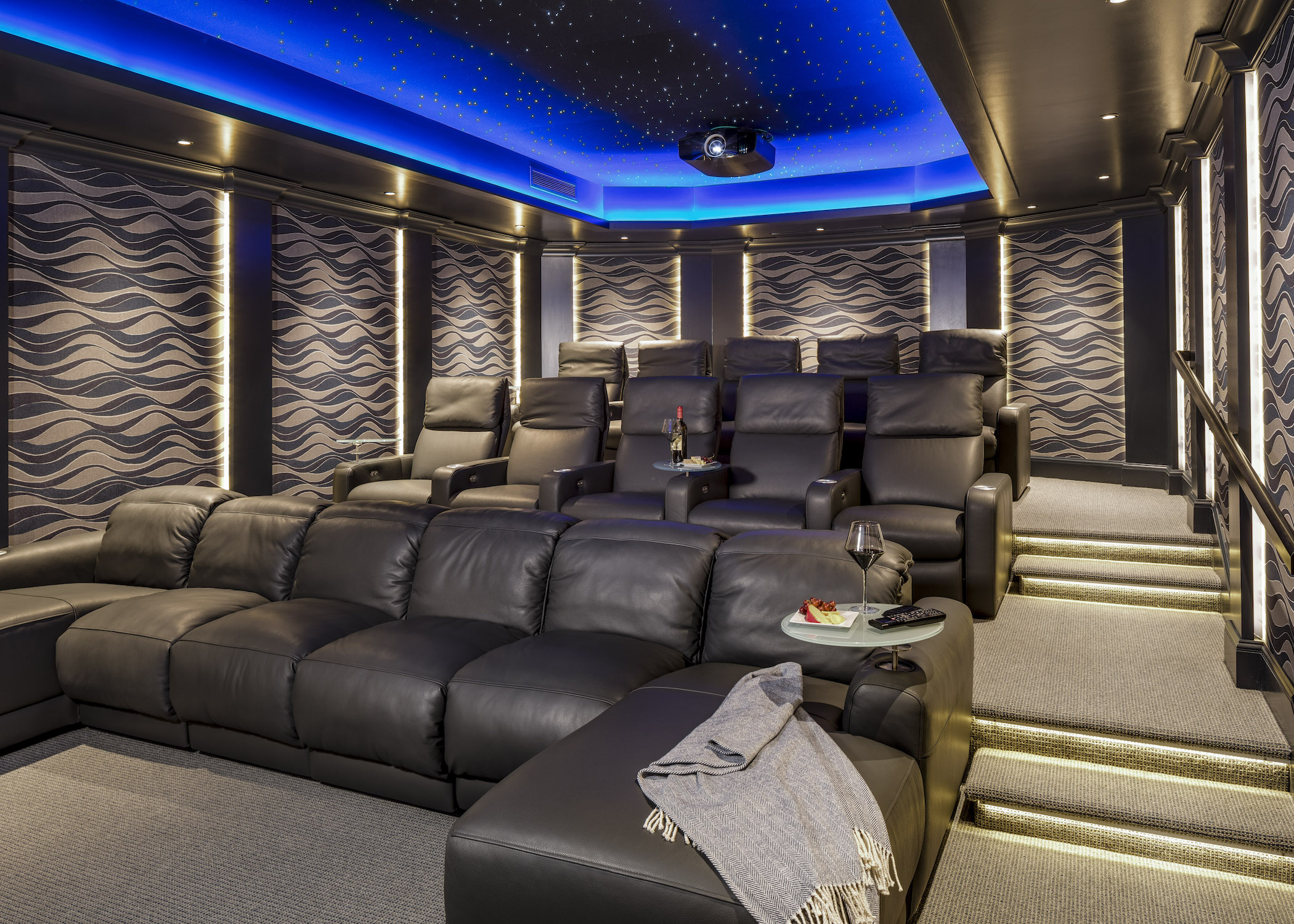
The room is dark, the screen fills the wall and the ceiling speakers put you somewhere between the movie and the sofa. In another part of the house, music follows the family from the kitchen to the patio without a hiccup. The whole thing runs from a single app. It is not a Hollywood studio. It is a home in Palm Beach, or Boston, or suburban Florida, installed by a custom integrator who has been doing this for decades and is, by most measures, doing more of it than ever.
CE Pro surveyed residential technology integrators across the country about their home entertainment business in 2025, covering everything from dedicated theaters and distributed audio to large-format video, lighting integration and the emerging role of AI-driven automation. The results paint a picture of a market that is maturing in interesting ways. The dedicated home theater is giving ground to more flexible, multipurpose spaces. Video walls are moving from commercial lobbies into living rooms. Clients are arriving educated about streaming but needing guidance on what immersive actually means. And the integrators who are thriving are the ones who figured out that the real opportunity is not any single product category, it is the lifetime of the home.
For perspective behind the numbers, CE Pro spoke with three experienced integrators: Anthony Petrone of Petrone Technology Group in Wellington, Fla.; Dan Abramson of Simple Home in Boston; and David Botknecht of HW Automation. Their markets are different and their approaches reflect those differences, but the fundamentals are consistent.
CE Pro Survey Sees Steady Confidence in Market for Home Entertainment Installations
The CE Pro survey responders are an experienced group, with nearly 57% of companies having been in business for more than 20 years, and more than two-thirds classify themselves as custom integration firms. These are established businesses with long client relationships and deep category expertise.
Revenue trends in 2025 were mixed but not discouraging. About 41% of respondents said home entertainment revenue held roughly flat year over year, and just under 18% reported a moderate decline. But 41% reported increases, with 8% seeing significant growth of 21% or more. Looking ahead, the mood shifts with more than half of respondents expecting growth over the next 12 months, with 18% forecasting significant increases.
Those surveyed indicate that large-format TV installations are clearly on the rise, with 64% of integrators reporting an increase in volume in 2026. Media rooms and multipurpose spaces are growing as well. Meanwhile, dedicated home theater installations and the use of projection systems are declining for nearly 30% of integrators. The most common average project budget falls in the $25,000 to $50,000 range, though more than 20% of respondents report averages of $100,000 or more.
For Anthony Petrone, whose Wellington-area firm has been in business 25 years, the market’s rhythm is something he has learned to read.
“This industry is kind of an up-and-down industry,” Petrone said. “You get peaks and valleys, but at the end of the year, we stay pretty consistent, and we’ve been fortunate to grow steadily over time. You learn to read the market, plan for the swings and make sure your team and your clients are taken care of regardless of where the cycle is.”
David Botknecht, whose operation spans 47 employees and three offices statewide, points to something broader driving the current momentum.
“Not a day goes by that I’m not particularly surprised about what somebody might have contracted to upgrade their home,” Botknecht said. “There’s a real energy around the home right now. People who bought three, four, five years ago and don’t want to sell, and who don’t want a new mortgage in this rate environment, they’re looking at their home and deciding to make it the best it can be. They’re investing in the experience of being there. And that translates directly into bigger entertainment budgets, more ambitious projects and clients who are genuinely excited about what technology can do for their space. That’s a meaningful driver for our business right now, and I don’t see it slowing down.”
The Dedicated Home Theater Gives Way to the Flex Space
Perhaps the single biggest structural shift in the data is the declining role of the dedicated home theater and the rise of what integrators are calling the flex space. More than 23% of survey respondents installed zero dedicated theaters in the past 12 months. Among those who did, the majority completed just one to five.
The volume lives elsewhere.
“More than 90% of our big-room installs are multipurpose rooms,” Petrone said. “The dedicated home theaters are fewer and far between. The recent upgrade trends in technology include bigger displays, in-wall subs, and distributed audio systems that don’t take up too much real estate. A lot of people don’t have a space where they can dedicate to a home theater, so they opt for a mixed-use space, or they move toward developing a more immersive environment throughout their home.”
Dan Abramson sees the same shift in Boston’s high-end market and frames it in generational terms. Clients who built dream homes 20 or 30 years ago often put a dedicated theater on the list. Younger buyers today want flexible, adaptable spaces, and as larger displays and video wall technology have begun crossing into residential price ranges, the notion of what a flex space can deliver has expanded considerably.
“It’s moving away from the home theater dedicated space and into the flex space,” Abramson said. “We’re seeing the market opening up to even bigger screens with video walls. With a flex space, you might not have a projector, but you can certainly have a video wall. And with a video wall, you can do a lot of things; gaming, simulations, not just watching TV.”
The market data on displays supports this. Large-format TVs were cited by 82% of respondents as a top video demand category, more than double the next closest category. OLED and mini-LED panels each appear in about 23% of projects, and art and design TVs were cited by nearly 39% as a demand driver. The 65- to 85-inch screen size range leads at 41%, but 33% of integrators say their most common projects involve screens 120 inches or larger.
The counterpoint comes from Botknecht, who sees something different at the highest end of his market. A client at a $2 million home recently spent more than $300,000 converting a room into a dedicated cinema.
“I think there’s more gathering going on,” he said. “I think there’s more of a desire to have a decent home theater experience. Home theaters got a little stale for a while because the big box stores may have cheapened what we as integrators were trying to do, but I think people now realize there’s a much cleaner, better and really impactful and impressive experience available to them. And they want it.”
Audio Is Everywhere, and It Starts With Wi-Fi
If there is one category that cuts across every market segment and price point in the survey, it is audio. Architectural in-ceiling speakers were cited by nearly 90% of respondents as a top-demand category, making them the most commonly specified product type by a wide margin. Outdoor landscape speakers followed at 69%, soundbars and subwoofers each at 56%, and invisible speakers at 41%. Music listening was cited by 97% of integrators as a primary distributed audio application, followed by outdoor entertainment at 72%, whole-home synchronization at 56%, and audio designed for parties and events at 54%.
What the numbers do not capture is where many of these conversations begin. In Petrone’s Wellington market, the entry point for a surprising number of engagements is not audio, it’s networking. Large equestrian properties where cell coverage is weak have made whole-property Wi-Fi coverage a functional necessity. This network and coverage have become a natural gateway to everything else.
“We’re seeing more and more clients come in asking to upgrade their Wi-Fi first,” Petrone said. “Putting access points in, making the network bigger, more robust and more reliable across the whole property. In our market, that means not just the residence but the barn, the riding arenas, the guest quarters, the whole property covered under one unified Wi-Fi umbrella.”
He added that the network conversation rarely ends there.
“Once we get in there and solve that problem, the conversation naturally expands,” he said. “It becomes, ‘Oh, can you do something with the speakers? What about the outdoor areas?’ We’ve found that networking is often the entry point into a much broader home entertainment engagement. And frankly, if the networking isn’t right, nothing else we install is going to perform the way it should.”
Abramson described what happens when that infrastructure conversation gets skipped. He recounted a call from a homeowner who had just completed a high-end condo renovation in Boston, a home that cost well over a million dollars, only to find the TVs kept freezing and video calls were dropping. The problem was outdated cabling and a modem stuffed in a kitchen cabinet, with no structured wiring plan in sight.
“The biggest challenge is trade partners and design partners that are building these homes and not taking the time to educate themselves on the infrastructure required in today’s market to support any of these entertainment needs,” he said. “You cannot replace architectural immersive audio with plug-in speakers. You cannot deliver a consistent, reliable 4K experience on Wi-Fi. And you’re not going to get immersive home theater from a soundbar. A proper home network infrastructure needs to be on par with electrical and plumbing in today’s new builds.”
Abramson sits on a National Association of Home Builders committee and raises this issue at every opportunity, pressing the case for low-voltage planning before the walls close. On the audio product side, both he and Petrone noted that clients often arrive asking for a specific brand by name rather than a performance specification; and that the integrator’s job is to educate from that starting point toward architectural speakers, properly placed subwoofers and, where the room calls for it, full Atmos configurations.
Tech That’s Moving the Needle
The technology impact rankings from the survey tell an interesting story. Dolby Atmos led by a wide margin, cited by 68% of respondents. AI-powered control and automation came in second at 34%, followed by video walls and MicroLED at 29%, with Wi-Fi 7 and spatial audio each at 26%. Technologies that were once considered commercial-only are now entering the residential market, driven by falling prices and improved installation methods.
“Why purchase a 100-inch screen when you can build a 150-inch video wall?” Botknecht said. “The little 4-by-four-inch panels interconnect seamlessly and go together like a precision Lego set. Before you know it, you have an image that will just blow your mind. And what used to cost a quarter of a million dollars can now be achieved for $60,000 to $70,000. The technology has come a long way, and the price point is finally starting to make sense for the residential market.”
Abramson sees a parallel shift in what clients are willing to seek out and pay for: a renewed interest in quality over convenience. After years in which streaming made people less attentive to how things actually sounded and looked, he described conversations at an industry conference where integrators talked about selling rooms with a light switch on the wall, a shade that drops by hand and a turntable in the corner. The ritual and feel of physical media as something streaming simply cannot replicate.
“People are remembering what it’s like to be dazzled,” Abramson said. “Streaming is so convenient that people are actually starting to crave something more intentional. There’s a ritual to putting on a record, setting a mood, being present in the experience. As more millennials build their first dream home, we’re seeing that nostalgia translate into real buying decisions. They want quality. They want performance. That appreciation kind of faded for a few years, but it’s clearly coming back.”
On the topic of AI, the survey found that nearly 69% of integrators say clients are not yet asking for AI features by name, and all three of our interviewed integrators confirmed this. But all three also noted that AI is already embedded in what they install, from automation platforms that set lighting and music scenes simultaneously to calibration tools that tune a room without a technician. Clients simply do not call it AI. The consensus is that adoption in home entertainment will follow the same path as architectural audio and lighting control: integrators will introduce clients to it before clients know to ask for it.
The Business of Home Entertainment: Service, Challenges and What’s Next
Nearly 64% of survey respondents offer service plans or recurring support. Remote monitoring and network management lead the recurring revenue categories at 64% and 61%, respectively, followed by system updates at 44% and service contracts at 31%.
Abramson made recurring revenue the centerpiece of his forward view, arguing that integrators who walk away after a system install are leaving the most durable revenue on the table.
“The biggest untapped opportunity in this business is recurring revenue,” Abramson said. “Too many integrators feel it’s expected of them to service a customer for the lifetime of their electronics without charging for it, and I understand where that instinct comes from. But no other service business operates that way. What we’re working toward is a model where clients subscribe to a level of care that keeps their systems performing beautifully over time. A modest monthly fee gives us the resources to be proactive, to catch issues before they become problems and to be genuine long-term partners in how our clients live in their homes.”
Petrone is formalizing his own recurring model through a managed services partnership that handles first-level support and escalates advanced issues to his team.
“I don’t want somebody to reach out to us at 7:00 pm on a Friday night and not be able to get a hold of anyone,” Petrone said. “So, we’ve partnered with a managed services provider that handles that first point of contact, answers basic questions and triages the issue before it ever gets to us. If the issue needs our attention, we’re looped in. If it doesn’t, the client is still taken care of. We don’t have many service calls because I believe we do great work, but having that layer of support in place means our clients are never left waiting, and our team isn’t burning out trying to be available around the clock.”
Beyond recurring revenue, the survey and interviews point to three persistent challenges:
- Unlicensed competition. The trunk slammer problem remains a persistent frustration across the industry: unlicensed installers who undercut professional integrators on price and leave clients with no warranty, no service relationship and work that frequently does not meet local licensing requirements. In many states, running wire inside a wall requires a contractor’s license, a requirement that is routinely ignored and one that undermines the credibility and pricing of legitimate firms.
- Trade partner education. The lack of low-voltage infrastructure planning in new construction is a problem no amount of skilled integration can fix after the walls close. The solution requires getting in front of architects, designers and builders early, through continuing education programs, industry associations and persistent relationship-building, and making the case that network backbone and low-voltage roughing are not optional amenities but basic requirements of a modern home.
- Labor. Finding qualified technicians remains a persistent post-COVID challenge across the industry. The work is specialized, the training pipeline is thin and the applicant pool has not kept pace with demand, leaving even well-established firms struggling to scale when business conditions call for it.
The integrators navigating those challenges most successfully share a philosophy. They got into the home early, built trust with design partners and positioned themselves not as installers of equipment but as long-term partners in how their clients live.
“We’re not just there for the life cycle of a project,” Abramson said. “We’re there for the lifetime of the home. The technology will change, the clients’ needs will evolve, their families will grow and their expectations will rise. Our job is to grow with them. When we get that right, we’re not just a vendor they called once. We become part of how they live. That’s the relationship we’re building toward, and honestly, it’s what makes this business worth doing.”