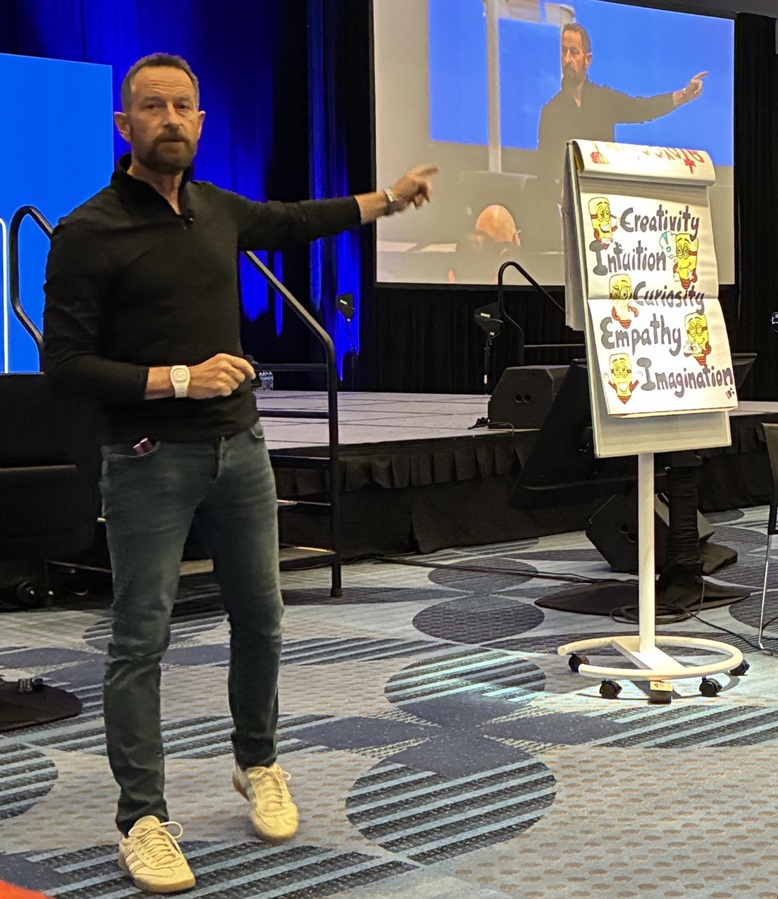
Duncan Wardle knows a little bit about innovation and creativity after spending almost six years leading those departments for none other than Disney before starting his own consulting business dedicated to those two traits in 2017. Here’s hoping the audience for his CEDIA Expo keynote were paying close attention to him.
In an energetic presentation that saw audience member interviewing each other and pretending to create some pretty unique businesses as well as drawing portraits while maintaining eye contact with their partners, among other things, Wardle dismissed the typical excuses that people use for stalled or nonexistent innovation.
“The number one killer of innovation is Western education,” Wardle told the audience, pointing to the fact that we’re routinely told there’s only one right way to solve almost any problem and one right answer to most questions. “The more expertise we have, the more we know it won’t work.
“What if you heard ‘yes, and’ instead of ‘no, because’ after every idea? That transfers ideas from ‘mine’ to ‘ours,'” he said.
Where Do Innovation and Creativity Originate?
Wardle asked the audience where they are and what they’re doing “when you get your best ideas,” with answers ranging from the shower, sleeping, in the car and more. Why don’t our best ideas come when we’re at the office?
“At work, you don’t have time to think,” said Wardle, noting that 87 percent of our brains are subconscious. He urged attendees to “be playful at the right time.”
“The biggest obstacle to creativity at work is yourself and your rivers of thinking,” said Wardle.
To boost creativity and innovation, the first step is to list the rules of a particular situation as fast as possible and the second step is to figure out the most outrageous option for each of the rules. That exercise, said Wardle, will trigger a flood of creativity and innovation.
“Most tools for innovation come from looking outside the industry,” he said. “Diversity is innovation. If someone doesn’t look like you, they won’t think like you.”
The most successful creative and innovative businesses don’t prioritize boosting the bottom line above all else, said Wardle. As an example, Disney transformed the idea of waiting in line across its theme parks by developing the Magic Band to allow people to skip lines, pay for souvenirs on the go and more.
With all that free time people had from not standing in lines all day every day at Disney parks, the company added almost $2 billion per year in new revenue, said Wardle.
“How can you solve the biggest consumer pain point? That’s what will make you more money,” he said.
Wardle notes that the lack of fresh inputs “leads to no fresh thinking” and ran down the five most employable skillsets for the next five to 10 years, even as artificial intelligence continues to take its bite out of the white-collar sector of the business world: creativity, intuition, curiosity, empath and imagination.
“They’re inherent in all of us,” said Wardle, noting that children use most of these skills before adults tell them they should stop in various ways as they get older. “You’ve just forgotten to use them. The opposite of bravery isn’t cowardice. It’s conformity.”