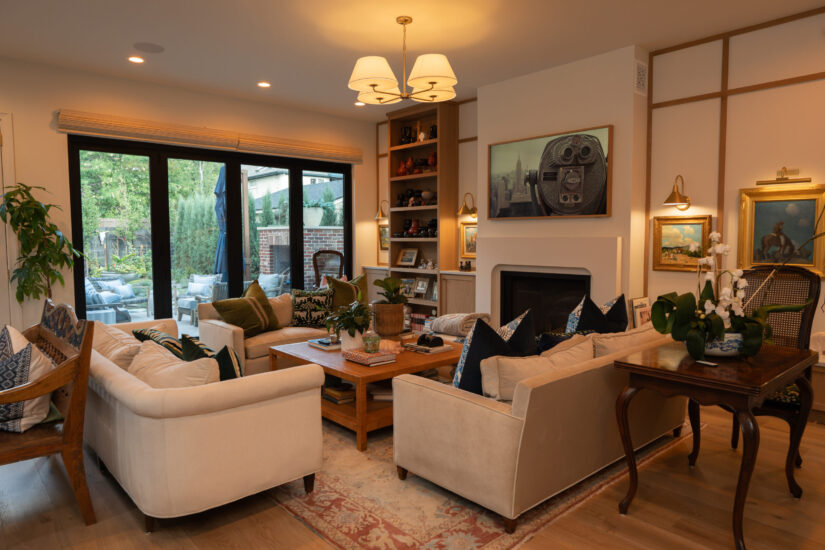
The day before CEDIA Expo’s show floor opened in Denver, CE Pro editors and other trade press skipped the convention center and climbed into an Uber instead, riding out to a real, lived-in home that integration firm Daisy and manufacturer ADI were using as a live demonstration of what thoughtful residential integration looks like in practice. The house — a roughly 5,700-square-foot custom build at 178 Humboldt Street — was built on spec by Denver builder DevX and designed by Studio Shelter, the firm that handles finishes and trim for most of DevX’s projects. Daisy’s Denver office pre-wired the house before it ever went to market, then layered in a full Control4 and Snap One ecosystem after the first-time homeowners bought in at the trim phase — giving the integrator rare latitude to shape the technology from the studs out.
“Most homeowners buy the home because of the finish and feel in it,” said Erin Thomas, General Manager of Daisy Denver, who led the walkthrough. That finish — warm, light wood tones throughout — dictated a lot of the technology choices, she said, noting that Daisy typically specs golden-toned woven wood shades in DevX homes because they complement the builder’s signature palette.
The Frame TVs, hidden subwoofers and magnetic keypad trims are the vocabulary here, not the story. The real lesson is how Daisy assembled those pieces into a repeatable, client-centered philosophy that any integration firm can study and adapt.
Invisible Technology as the Default, Not the Upsell
The clearest through-line across every room was a commitment to making technology disappear. Samsung Frame TVs appear throughout the house, several set in custom Leon frames with Leon soundbars powered by hidden Sonos amps so the audio hardware visually matches the screen — right down to a custom wood-frame TV in one bedroom, chosen to echo the home’s natural finishes.
That obsession with clean walls goes deeper than screens. Daisy specified screwless, magnetized Lux by Control4 keypads and outlet plates in light almond rather than snow white, blending them into the interior palette. Visible screws, Thomas said, are simply “an eyesore” in a home at this level. When a data and TV drop landed in an awkward spot because the buyer’s furniture layout wasn’t finalized, Daisy’s installers turned the problem into a feature, mounting a Séura lighted mirror over the outlet to conceal the wiring entirely.
Concealment isn’t reserved for clients who ask for it; these days, it’s the baseline. But invisible isn’t the only mode. The same magnetic Lux trim kits let a homeowner snap on a new look in seconds as a room evolves, and Thomas said the decision to hide or show technology really comes down to the client. “It’s really going to be a one-off conversation with the homeowner to decide how they want to be featured in the home,” she said, noting that some clients want technology to disappear into millwork, while others “want a big freaking floor-standing speaker” as a focal point rather than something to conceal — Daisy points to KEF floor-standing towers on other projects as exactly that kind of deliberate statement piece. Invisible by default, visible by choice.
Whole-Home Thinking Beats a Pile of Subsystems
What makes the house a useful case study is that it’s real — not just a showroom. Control4 sits at the center of a single ecosystem orchestrating Sonos audio, Hunter Douglas shading, Clare Controls security, Luma surveillance, Origin Acoustics and Episode speakers, Samsung displays and Episode Radiance landscape audio. A centralized rack downstairs houses eight Sonos amplifiers, Control4 processors, an Integra receiver, a WattBox and Apple TVs; a dedicated panel powers every automated Hunter Douglas shade in the house.
That unified backbone is what makes the experience feel effortless. Guests are greeted with an automated welcome scene; homeowners trigger presets that shift lighting, audio and shades together with a single command; control lives across Lux keypads, dedicated touchscreens, Halo remotes and the Sonos app, so the interface fits whatever moment calls for it. Clients don’t buy shading, audio and security as separate line items — they buy a home that responds as one, and integrators designing at the ecosystem level are the ones earning the referrals that follow.
Lifestyle-First Design Drives the Spec
Every system decision traced back to how this particular family lives. One bedroom doubles as an art studio for a homeowner who paints, so Daisy specified tunable, art-calibrated lighting that shifts color temperature to make her paintings — and the home’s growing art collection throughout the main living space — pop, a demo the team ran repeatedly for the tour group. Downstairs, a separate lighting scene can throw team colors across the room for the household’s sports fan. The backyard is built as a genuine outdoor living space, with landscape audio, combined light-and-speaker fixtures and a subwoofer buried in the yard. Even the home gym gets its own Sonos-powered ceiling audio and automated Hunter Douglas shades.
None of it started with a product sheet. It started with a conversation about routines, hobbies and comfort.
The Pre-Wire Strategy That Protects the Project
Much of Daisy’s advantage here traces back to timing. Thomas traced Daisy’s relationship with DevX back several years to a lunch meeting with a realtor who was separately building his own home — a project done with another AV company that went well enough that the realtor recommended Daisy to his builder. Roughly three months later, DevX began sending Daisy completed projects and introducing the integrator to new homeowners. The 178 Humboldt Street house is roughly the tenth DevX home Daisy has worked on, and the firm now sometimes locks in pre-wire infrastructure a year or more before a buyer ever signs.
The arrangement has scaled considerably since. Daisy pre-wires every speaker location in DevX homes with covers only so that homeowners can decide later whether to activate full audio coverage. “[We have] a very good relationship with this builder,” Thomas said. On a current custom project with the same builder, a roughly 8,000-square-foot home, Daisy’s scope has grown to include around $300,000 in Lutron lighting alone, on top of a $30,000 pre-wire. A separate 10,000-square-foot project underway in Breckenridge will include full blackout shading throughout.
Owning the wire early means owning the infrastructure knowledge later. By the time it’s time to design, Daisy already understands the house better than anyone else at the table and can present options without opening a single wall.
Making the Sale Simple With Good, Better, Best
Once the wire is in, Daisy simplifies the buying decision with tiered proposals. A prime example is a “good, better, best” speaker lineup built around Origin Acoustics Director models (the D63, D83 and D109) that lets clients mix performance levels room by room. Because infrastructure is already in place, Daisy can hand a client a clean preliminary proposal matched to budget and performance expectations before any construction begins.
“It’s fun because once my team installs a product and we see the client’s reaction to it, it’s so easy to sell again,” Thomas said. “I can sell this Lux lighting to any house I walk into now because it looks so good, and I really stand by it.”
Introduce a buyer to even a single smart switch inside a Control4 ecosystem, and that small taste of automation and design often becomes the catalyst for a whole-home upgrade — experience sells better than any spec sheet.
Collaboration and Care as Differentiators
The house also illustrates how these projects get built and stay built. Daisy Denver’s Director of Engineering Dustin Hutton and his team worked onsite for roughly three weeks alongside manufacturer partners’ own engineers to handle programming and commissioning — building scenes that trigger automatically as visitors move through the house, alongside everyday automations like a “goodnight” scene that shuts everything down at once. The firm worked closely with DevX and Studio Shelter to weave technology into finishes and wallpaper from the start, and it built a close enough relationship with the homeowners that Thomas ended up with a house key.
That relationship doesn’t end at handoff. Daisy Care, the firm’s service arm, returns quarterly to clean, service and adjust shading and curtains so that the system keeps performing as installed. That’s often the part that clients remember most.
The Home as a Teaching Tool
Complementing a buzzing show floor, ADI put editors and guests in an Uber and sent them to an actual residence during CEDIA Expo to get a real-world picture of the technologies on display. Visitors got to pull off and snap on Lux trim kits themselves and watch a room’s look change in real time.
Unsurprisingly, the house would see more traffic in the days that followed. Indeed, Daisy and ADI said roughly 15 to 20 people would tour the home informally once the show floor opened, with sales and engineering reps stationed on each level to field questions. The property was also slated as a stop on a larger, curated circuit for architects, builders and interior designers tied to the show. Daisy expected 34 builders, designers and architects, along with roughly 25 of its own staff split across four vans, to move through several Denver-area locations before the group reconvened for dinner.
For ADI, which runs an ongoing customer-install content program through its marketing team — documenting completed integrator projects from a Scottsdale residence to a Miami nightclub build-out — the Denver home fit a familiar mold.
“We’re really trying to bridge design and technology in all of the work that we do,” said ADI Global PR Manager Colette Gelman. “When we see homes like this, we’re like, ‘We have to showcase this.'”
Pre-wire aggressively. Design for the whole ecosystem. Lead with lifestyle. Sell through experience. Collaborate deeply with builder, designer and manufacturer partners. Service for life. That’s the roadmap Daisy’s Denver showcase home lays out — and it demonstrated it in the rooms where a family actually lives.