I was born and raised about 45 minutes outside Boston, and I still live in the same area, so making local industry connections has always come naturally to me. One of those connections is Adam Zell of Boston Automations.
If you know him, you probably already know the story: an industry outsider who walked into custom integration with a corporate IT background, a fresh perspective, and little patience for doing things the way they’ve always been done. AI is just the latest example. According to Zell, it’s fast becoming an essential business platform, one that can help interior designers, architects and technology professionals operate more efficiently, serve clients better and uncover revenue opportunities they haven’t even considered yet.
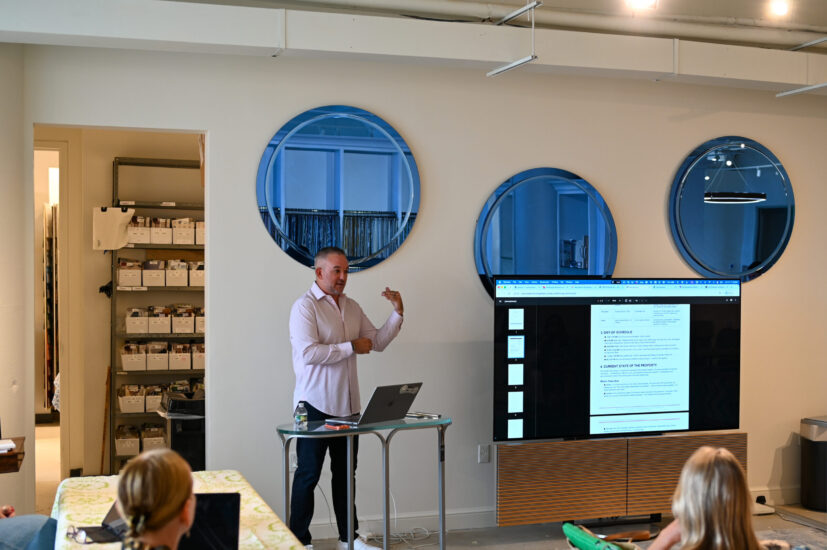
For the past year, Zell has been educating fellow custom integrators and members of industry buying groups on practical AI applications, not flashy demos, but workflows people can actually use on a Monday morning. Recently, he took that education effort outside the integration channel entirely, hosting a workshop at the Boston Design Center aimed at helping interior designers and architects understand how AI can strengthen their businesses and their collaboration with technology professionals.
The venue mattered. The Boston Design Center houses more than 60 individually owned luxury interior design showrooms and functions as a hub of design expertise across New England, exactly the kind of room where a technology integrator earns credibility not by pitching gear, but by solving problems the designers in that building deal with every day.
Meeting Design Firms Where They Actually Struggle
Zell didn’t use his time at the podium to talk about AI-generated renderings or design tools, the obvious play for a room full of designers. Instead, he walked attendees through how AI can streamline the unglamorous parts of running a firm: meeting documentation, project management, website development, marketing and business coaching. The session was deliberately built around eliminating administrative drag rather than reimagining the creative process.
That choice reflects something Zell understands about his audience and his own position in it. The event served a dual purpose: continuing an industry-wide conversation about AI, and positioning both himself and the broader integration community as informed, capable business partners to the designers and architects who often control the room.
“Projects are almost always driven by interior designers,” Zell said. “Once we get into these luxury homes, the decision makers will be the homeowner or the designer, and then we’re part of that.”
It’s a candid admission of where integrators sit in the pecking order on most luxury projects, and it’s precisely why Zell sees AI fluency as a way to move from vendor to trusted advisor.
AI Adoption Is Accelerating, and the Gap Is Widening
Zell founded Boston Automations after a career in corporate IT, and his own deep dive into AI started less than a year ago. What began as sharing workflows with fellow members of his industry buying group quickly turned into demand for live training sessions. His message to the Boston Design Center crowd: the companies that lean in now are already pulling ahead.
“It is astounding how quickly companies that are adopting AI are blowing past all the rigid companies who are flat out refusing to use it,” Zell said. “Last year was more of a chat year of AI. This is the year of things happening, people doing stuff and really becoming transformational.”
That shift, from AI as a novelty you chat with, to AI as infrastructure that quietly runs alongside your business, is the throughline of Zell’s entire pitch. He’s not asking designers and integrators to become technologists. He’s asking them to stop treating AI like a toy.
Importantly, Zell was careful to frame AI as additive rather than a threat to the people in the room. Luxury design and installation work is still fundamentally creative and physical; AI isn’t laying cable or specifying finishes. What it can do is claw back the hours currently lost to administrative overhead, freeing designers and integrators to spend more time on the work only they can do.
“It’s only going to enhance your job,” Zell said. “It’s not going to steal your job.”
Better Meetings, Better Projects
Of all the workflows Zell demonstrated, meeting documentation drew some of the strongest reaction. His recommendation: adopt AI-powered recording and transcription tools that automatically capture client conversations, summarize discussions, and turn them into usable project documentation, rather than relying on memory or scattered notes.
He showed attendees how months of client meeting transcripts can be consolidated into detailed project overviews, room-by-room walkthroughs, and client briefing documents before an installation ever begins. On one project in particular, Zell credited that level of documentation and preparedness with directly winning him the job.
“The only way I would have been this prepared was having these tools and leveraging them,” Zell said.
He was equally direct about tool selection, pushing back on the idea that there’s one “right” platform to standardize on.
“The important thing isn’t a tool; it’s using a tool that you like and sticking with it,” Zell said.
Beyond ChatGPT
Much of the workshop was spent introducing attendees to the wider AI landscape beyond conversational chatbots: research tools, meeting transcription software, website builders and automation platforms that quietly handle work a firm would otherwise pay a person to do.
Zell’s larger point was that the specific model matters far less than most people assume. What actually separates firms getting value from AI and firms that aren’t is how well they’ve learned to communicate with the tool.
“If you’re not good at creating prompts, eventually you will get good at that,” Zell said. “You’ll remember the four things and you’ll start putting that into every request.”
For anyone intimidated by the learning curve, his advice was to lower the stakes and just start.
“Pick a platform, start using it, start learning, and you’ll eventually know if you like it or not,” Zell said. “If it’s not giving you what you need, then you can switch.”
AI as a Business Coach
One of the more provocative threads Zell pulled on was the idea of AI as an ongoing business advisor, something that reviews communications, flags inefficiencies, and surfaces patterns a busy owner might otherwise miss entirely. He described how firms are using their AI tools to evaluate emails, sales conversations and internal workflows for blind spots.
“The more you start using these tools, they understand your persona and they know more about you than your family,” Zell said. “I’ve heard many people say that their chat tool is their business coach, or their sales coach, or their marketing.”
Creating New Revenue Opportunities
Zell’s favorite proof point is one close to home: a dedicated website he built to promote golf simulator installations, despite having essentially no web development or design background.
“I’m not a website designer, not a graphics guy. I don’t create videos. I don’t do any of these things,” Zell said. “I said I’m going to push myself.”
The site generated its first customer inquiry within days, with no paid advertising behind it, which Zell holds up as evidence that AI meaningfully lowers the barrier to entering a new niche market.
“This is all it takes is a day of sitting down and thinking about it and brainstorming it because there’s a system out there that will create these things for you,” he said.
Start Small, Then Build
Zell was careful not to overwhelm the room with a laundry list of platforms to adopt all at once. His guidance was sequential: automate one simple task, build confidence, then move to the next workflow. For anyone worried they’re behind, he offered some perspective.
“If you’re a one, that means you’re above 80% of the population who have never touched it and are scared,” Zell said. “Just go on there and start doing anything. The more you start doing it, the better.”
Ultimately, Zell’s goal isn’t AI adoption for its own sake; it’s building a business that punches above its headcount.
“I want to function like I have 25 employees, but there’s only eight of us,” he said. “How do I become more efficient? I have agents in these things running in the background doing tasks for me that I would have to hire someone to do.”
For an industry built on relationships, craftsmanship and trust, that’s the pitch Zell is betting will resonate: not AI as a gimmick, but AI as the quiet infrastructure that lets small teams operate like much larger ones.