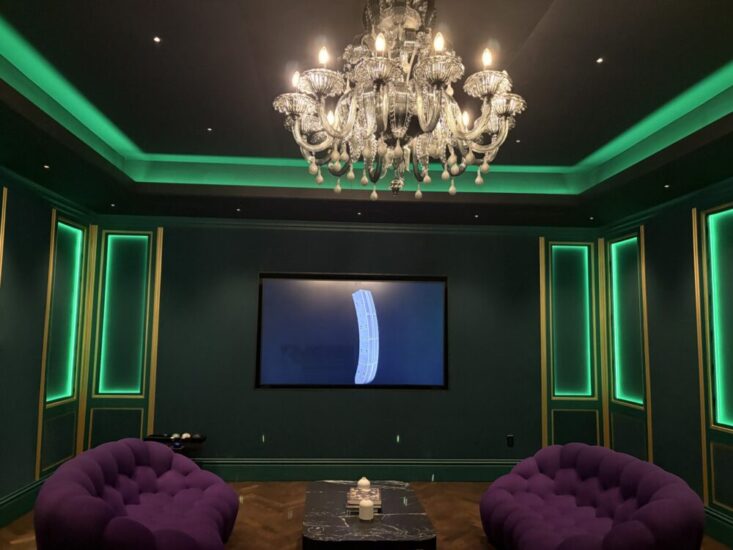
There’s a music venue in Boston, Roadrunner, that has some of the best audio of any venue I’ve been to. I listen to very aggressive punk and metal, and that sound can get muddied fast at any venue with a lackluster audio system.
Not Roadrunner. It sounds pristine there, almost as good as the recording, and they don’t need to blow out your eardrums to impress you.
A few years ago, I was chatting with Mary Beth Henson from L-Acoustics about audio at music venues. I mentioned Roadrunner, and of course she said that’s an L-Acoustics system.
Since then, I’ve learned just how precise L-Acoustics systems can be, and HYRISS is an incredible example of that fine-tuning and customizability. I’d seen pared-down versions of HYRISS at CEDIA Expo, but this Nashville installation is the real deal. It’s even better than the London install, because it was built from the ground up in a new build, not retrofitted.
A room that lies to you, on purpose
Nick Fichte had barely started talking when I noticed the room sounded wrong. I heard footsteps overhead, people shuffling nearby, a bright echo off hard surfaces. For a space pitched as acoustically perfect, it sounded oddly alive.
“That’s all fake,” said Fichte, the company’s global business development director for hospitality, home and yacht, as he led our press group through the new digs.
What I was hearing was a day-long recording of L-Acoustics’ Highgate showroom in London, captured before any acoustic treatment went in and played back to fool us. It worked. It’s a parlor trick, but it makes the core argument of HYRISS before you even sit down: in a properly treated room, the sound of the space itself becomes something you choose.
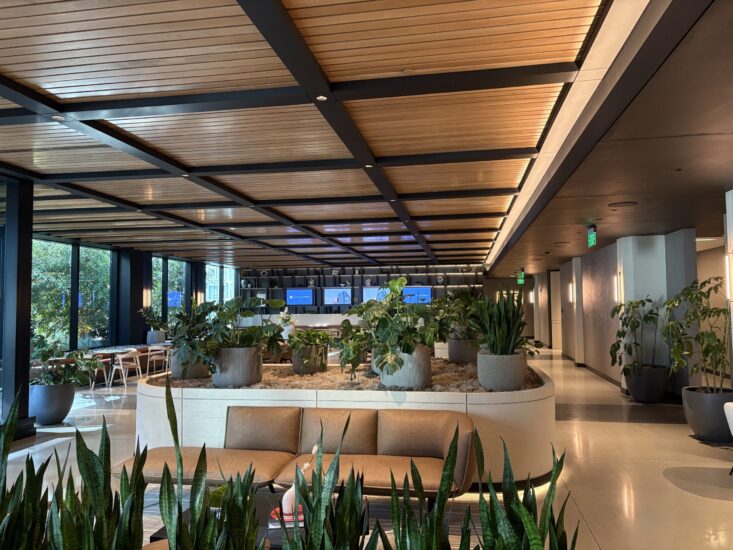
L-Acoustics’ sprawling new Nashville location features an area for private events, which it often holds for musicians.
The Nashville showroom opened in February 2026 inside the CAA Creative Office Building at Nashville Yards. It’s only the second full HYRISS in the world, after London’s in 2024, and it’s part of L-Acoustics’ new 11,100-square-foot Americas headquarters. The people it’s built for are the ones who decide what luxury rooms look like: integrators, architects, interior designers, developers, and some very successful recording artists with discerning ears.
Fichte told me the idea started with a problem President and Founder Christian Heil wanted to solve in his own home: reorienting a spatial audio system for different uses.
From stadiums to living rooms
HYRISS, short for Hyperreal Immersive Sound Space, is built on the live-sound work that made L-Acoustics famous. Before we saw the showroom, Oscar Sturup, the company’s global applications lead for spatial systems, walked us through the Creative Studio next door. It’s a 16.1-channel L-Acoustics Creative Studio where front-of-house engineers pre-produce immersive shows.
His argument is one I’ve thought about at plenty of concerts: live sound technology has advanced in every way except format. Consoles, amplifiers and line arrays have leapt ahead, yet most shows are still mixed in stereo, which for much of the audience really means dual mono. L-ISA treats each input as an object placed in space, so a vocal stays anchored to the singer wherever you’re standing. He played Raye’s Royal Albert Hall performance, remixed from the multitracks, and while it measured around 85 dB, it felt far louder to me.
The same research produced L-Acoustics DJ, a machine-learning tool that splits any stereo track into drums, bass, vocals and everything else in real time. Each stem can then be moved around the room independently. HYRISS brings that concept, those tools, and the loudspeakers behind them home.
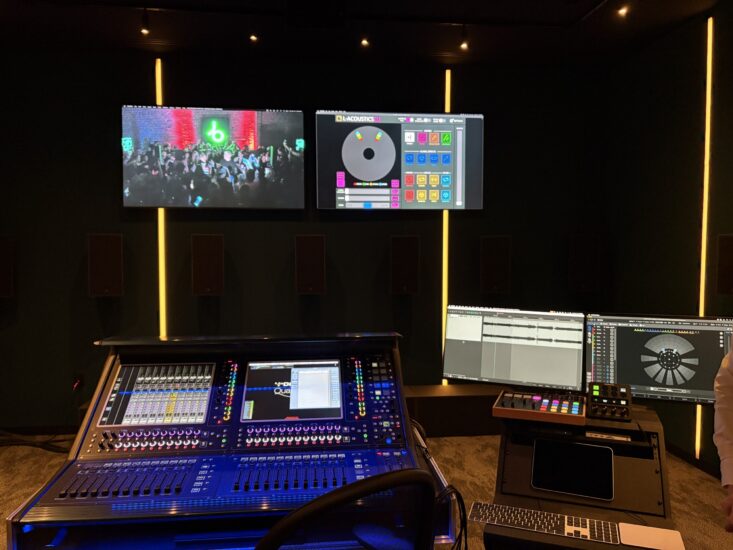
The L-Acoustics DJ system provides some of the technology behind HYRISS.
One space, endless experiences
That’s the HYRISS tagline, and the automated demo is built to prove it. Fichte calls it the theme-park version: one button gives every visitor, anywhere in the world, the same ride.
Mine opened with rainforest sounds, a plain stereo file that the system’s Anima engine pulled apart and spread around the room live. An Atmos underwater soundscape followed, pitched at wellness and relaxation. Then music played from a single pair of ceiling speakers. “The world has been obliterated with ceiling speakers,” Fichte joked, right before the same track bloomed into a full hi-fi presentation.
Next came Ambiance, L-Acoustics’ hybrid acoustic enhancement system. Microphones feed processing that changes the room’s reverb, so a voice or guitar sounds like it’s in a concert hall while still coming from where the person is standing. Then a clip from A Star Is Born in straight Atmos, an immersive classical recording where I faced an imaginary orchestra, and a finale that turned the room into a dance floor.
The live demo afterward told me more. From a tablet, Fichte rotated a stereo track to face whichever couch he pretended to sit on. He narrowed it to one speaker for the news, then spread it diffusely so nobody at a party gets stuck beside a blaring box. He did the same with a full Atmos soundtrack, swinging the center channel toward a faux window. An MLS match streamed in stereo came back with the commentary pinned forward and the crowd wrapped around me.
What’s behind the walls
The room hides 15 slim Soka columns around its perimeter, 12 X6i speakers overhead and a single X8i coaxial center. The X8i is the one exception, chosen because a 98-inch TV sits where a column would otherwise go. Fichte asked us to guess the subwoofer count. I guessed low. The answer was 32. Every main speaker is paired with two subs, managed by unreleased bass technology so there are no dead spots as you walk the room. Ideal spacing between speakers, he said, is roughly 1.5 to 2.5 meters; any wider and sounds start jumping from box to box.
Conventional sources, including an Apple TV, a Kaleidescape and a Bluesound node, feed a StormAudio processor. It handles HDMI and Dolby decoding, which L-Acoustics doesn’t license. From there, LC16D converters put the signals onto a Milan-AVB network, where two L-ISA Processors do the heavy lifting: one for Anima and spatial rendering, one for Ambiance. LA7.16i amplifiers, rated at 1,300 watts per channel, drive the speakers. Control runs through an L-Acoustics-designed interface template for Q-SYS or Crestron.
Rules, price and the people who hold the keys
L-Acoustics is strict about all of it. A HYRISS system has to be L-Acoustics from speakers to amplifiers. Fichte told me he has turned away orders that paired the company’s speakers with third-party amps, “We want to ensure that we can guarantee the experience, it is our brand reputation on the line.” he said. Dealers who want a branded showroom get a Visual Identity guide which dictates everything down to the flooring, so the experience is as consistent as walking into a Louis Vuitton or Rolex store.
The Nashville room would retail for roughly $350,000, which Fichte placed on the smaller side of medium. Simpler templated packages in small, medium and large sizes are also available starting at around $150,000, and developers can get per-square-foot pricing.
Early projects show the appeal. One London client’s rarely used DJ room now hosts dinner parties, yoga and kids’ Halloween parties. Another chose HYRISS over a dedicated theater system at a similar price so that their space could become multi-functional.
The bigger hurdle, the team told me, is perception. HYRISS asks designers to treat sound like lighting: planned early and set by scene. That’s why L-Acoustics wants architects in this room. I get it. Once you hear footsteps that aren’t there, the conversation changes.