Today, Nov. 3, is Smart Home Day, a chance to celebrate how far connected living has come. I’ve spent much of my career covering that progress, from sophisticated lighting control and whole-home audio to intelligent security and the latest advances in AI. I’ve toured incredible homes and talked with the integrators and manufacturers who make it all work.
This Smart Home Day, though, I’m seeing the industry from the other side: as a homeowner renovating a house that’s about as dumb as they come.
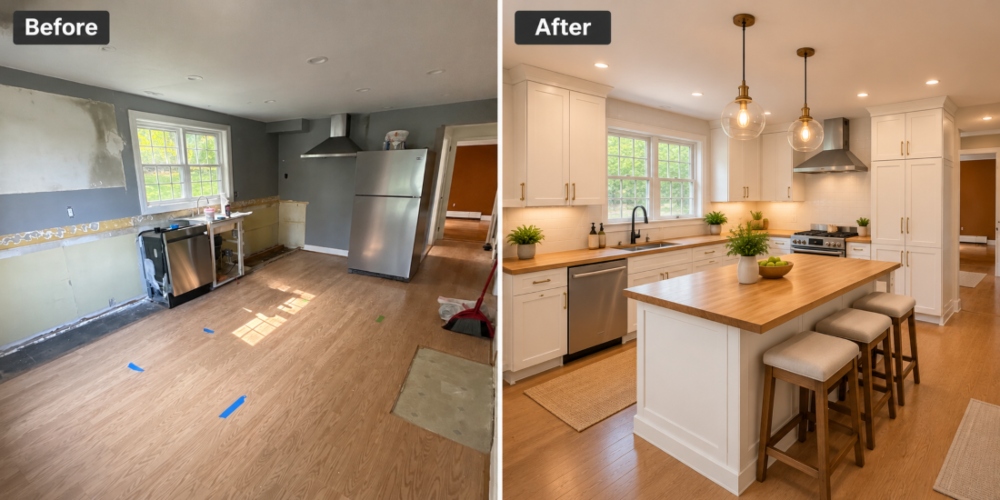
My wife and I recently bought a home built in 1947 that’s much larger than our first. We’ve spent the last several weeks tearing apart the kitchen, installing cabinets, replacing flooring and working through a to-do list that somehow keeps getting longer. There are no lighting scenes, motorized shades or centralized control. Right now, I’m just trying to get the kitchen lights installed.
From test lab to teardown
It’s a big change from our first home. That one was a starter home in every sense, but it had been nicely renovated before we moved in. In six years, the most maintenance it needed was HVAC filters and a new water heater. It’s also where I started covering this market, so naturally the house became a bit of a test lab: smart switches and dimmers, a security system, a video doorbell and a smart thermostat. With modern wiring, most of it was plug-and-play. I didn’t appreciate how much that mattered until we moved.
The contrast with my day job has been hard to miss. We closed on the new home just days after CEDIA Expo filled the Colorado Convention Center in Denver, and the show floor told a consistent story. AI is becoming real installation infrastructure instead of a marketing slide. Lighting and shading have become core businesses rather than add-ons. Networking is treated as the foundation everything else depends on.
One trend stuck with me more than the others, for obvious reasons: retrofit is no longer a secondary product line, and it’s now shaping manufacturers’ roadmaps. Somewhere, an engineer is designing products for houses like mine.
What CEDIA Expo and Home of the Year taught me
At the same show, we announced the 2026 CE Pro Home of the Year Award winners: 81 entries across 23 categories, representing some of the best work in the channel. Nerve’s Pinnacle 2 residence in Park City, Utah, runs more than 770 connected devices, including 163 motorized shades, on a single Crestron platform. USA Integration’s El Maro took home four medals by itself.
Now, I have a kitchen with no lights. (They’re being installed this week, it’s fine.)
But the gap is narrower than it looks. Our judges didn’t score those projects on how much gear they had. They scored them on how well each team solved problems and worked within real-world constraints. Two of the most competitive categories were Lighting & Shading and Design + Tech. Nerve founder Todd Astill summed up what his clients want as “more tech with less awareness of the technology.” On a much smaller budget, that’s what I want too.
Our Design & Tech Deep Dive survey, which you will read about in the next issue of CE Pro, found the same thing. Integrators named lighting control (86%) and motorized shading (77%) as their fastest-growing categories, far ahead of audio and video. Their biggest frustration was getting brought into projects early enough. Reading those results with my own kitchen walls open, that last one felt personal.
Where I’ll lean on the pros
Now I’m learning how many decisions, obstacles and expenses sit between a traditional house and a smart one, and it’s given me a new appreciation for the work integrators do every day. It’s one thing to write about the benefits of intelligent lighting. It’s another to figure out how to retrofit it into a nearly 80-year-old home without opening every wall. The same goes for networking, security, entertainment and almost every other category we cover at CE Pro.
We’ll get there eventually. For now, there’s plenty of work for me: drywall, painting, electrical, plumbing, flooring and trim, plus managing a growing collection of tools and daily trips to the hardware store.
My eventual goal isn’t to turn every room into a technology showcase. It’s a home where technology makes everyday life a little easier: better lighting, more efficient heating, reliable Wi-Fi and simple automation that solves a real problem. As this year’s Home of the Year winners showed, the smartest home isn’t the one with the most technology. It’s the one where the technology makes sense for the people living in it.
When it’s time for lighting control, automation and security, I’ll lean on this industry for help, because I can’t wait to put my tools away and stop crawling around in drywall dust.