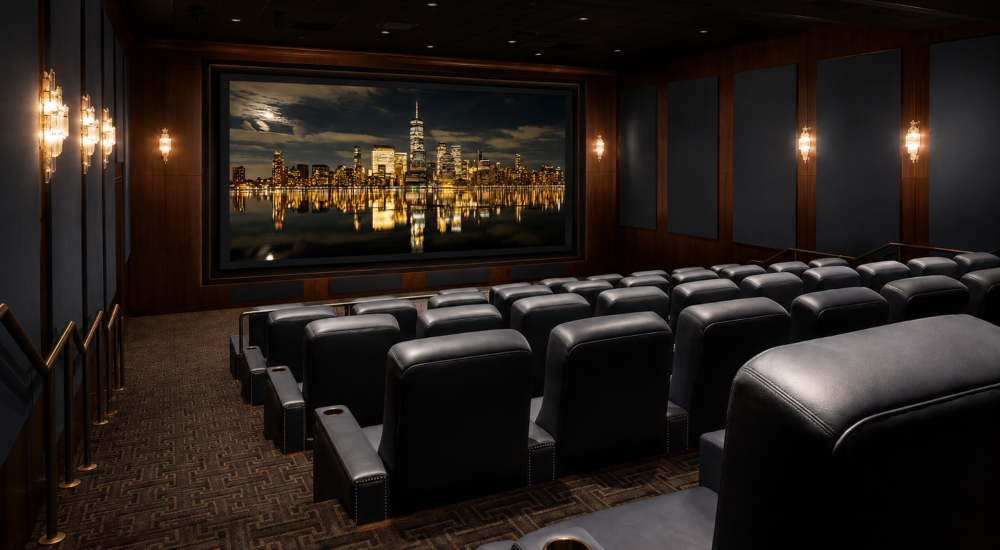
CEDIA Expo 2026 is right around the corner, and with Stewart Filmscreen making its return to the show floor, CE Pro sat down with Adrian Silva, Vice President, Stewart Filmscreen, to learn more about its recently released Director’s Choice Gen 2 projection screen, how those changes factor into the current landscape for custom integration, and what Stewart sees as being the next big thing for high-performance cinema in the next few years.
CE Pro: You recently came out with the Director’s Choice Gen 2. What prompted the redesign?
Adrian Silva: Much of the direction came directly from our theater consultants and integration partners. They were asking for the same high-performance, four-way masking experience, but in a system that was slimmer, easier to install, and more adaptable to different room designs.
At the same time, home cinema screens are getting larger, while the space available around them is often becoming more limited. We saw an opportunity to rethink the product from the ground up and create a system that could deliver a larger image without requiring a larger architectural footprint.
Director’s Choice Gen 2 is the result of that feedback. It gives integrators more freedom in how and where they install the screen while preserving the performance and craftsmanship people expect from Stewart.
CE Pro: What were some of the parts you updated?
Silva: Nearly every part of the system was reconsidered.
The biggest mechanical change is the enclosure. Director’s Choice EVO was 16.5 inches deep, while Gen 2 is only 7.25 inches deep, with a reduction of more than 56%. It can also support image widths up to 20 feet while maintaining 7-inch borders. Previously, achieving that image width required approximately 16-inch borders and depth.
We also introduced the QuickSnap front-loading screen attachment system. It allows the screen material to be installed from the front and plays an important role in making the overall structure more compact. A removable front fascia provides direct access for service and maintenance.
The control platform was updated to the Somfy Digital Network (SDN) for enhanced integration with today’s leading control systems. This provides greater programming flexibility and supports integration with leading third-party control platforms, including Crestron, Control4, AMX, Clipsal, and others.
CE Pro: What are some of the benefits you would say this newer version has over the older one for installers? For homeowners?
Silva: For installers, it is about having more options and fewer obstacles. The compact design works in rooms where a deeper masking system might not be practical, and the wall-mount option expands the range of possible applications. QuickSnap also makes it easier to install or replace the screen material, while the removable fascia simplifies access if service is needed.
For homeowners, the benefit is more screen and less visible structure around it. They get a clean, architecturally integrated installation and a larger, more immersive image within the available space.
They also get the benefit of precise masking. The system adjusts on all four sides to frame content in different aspect ratios, so the visible screen area matches the format of the movie rather than leaving unused screen material around the image.
CE Pro: Based on what you’ve done with the Gen 2, where would you say high-performance home cinema is heading in the next few years?
Silva: We believe projection will continue to offer the most cinematic experience in the home, especially as clients ask for increasingly large images.
The challenge is making that experience work naturally within the architecture of the room. Products will need to become less visually intrusive, easier to integrate, and more flexible in how they are installed and controlled.
Sound will continue to be an important part of that evolution as well. Acoustically transparent screen materials allow the speakers to be placed behind the image, just as they are in a commercial cinema. That creates a much stronger connection between what viewers see and what they hear.
The future is not simply about making screens larger. It is about delivering image, sound, masking, automation, and room design as one cohesive experience.
CE Pro: You’ve been expanding your QuickShip program, recently as well. How does that play into the value offer Stewart is looking to provide for integrators?
Silva: QuickShip is about helping integrators keep projects moving.
Timelines can shift, specifications can change, and sometimes a screen is needed much sooner than originally expected. By offering next-business-day shipping on a selection of our most popular products, we give dealers a way to respond quickly without having to move away from the quality or performance they originally planned for the project.
It is one more way we can support our partners beyond the product itself.
CE Pro: What are some of the products that integrators can receive through QuickShip now?
Silva: The program currently includes Balón Edge, WallScreen Deluxe, Cascade G2, and Luxus G2. These models are available with popular materials including StudioTek 130 G4, FireHawk G5, and Harmony G3.
We have also added the outdoor-rated RS1, screen sizes up to 150 inches, and select perforated material options. That gives dealers a broader range of choices for dedicated theaters, media rooms, acoustically transparent installations, and outdoor entertainment spaces.
CE Pro: In your opinion, what would you say is the primary value the additions are providing to integrators?
Silva: The biggest value is access.
Screen sizes in the 140- to 150-inch range are becoming much more common, and more projects are being designed around speakers placed behind the screen. By adding larger sizes and perforated options to QuickShip, we are making it easier for integrators to get the configurations they are already specifying.
That can help them manage schedule changes, complete projects sooner, and give clients the performance they expect without waiting through a standard custom-production timeline.