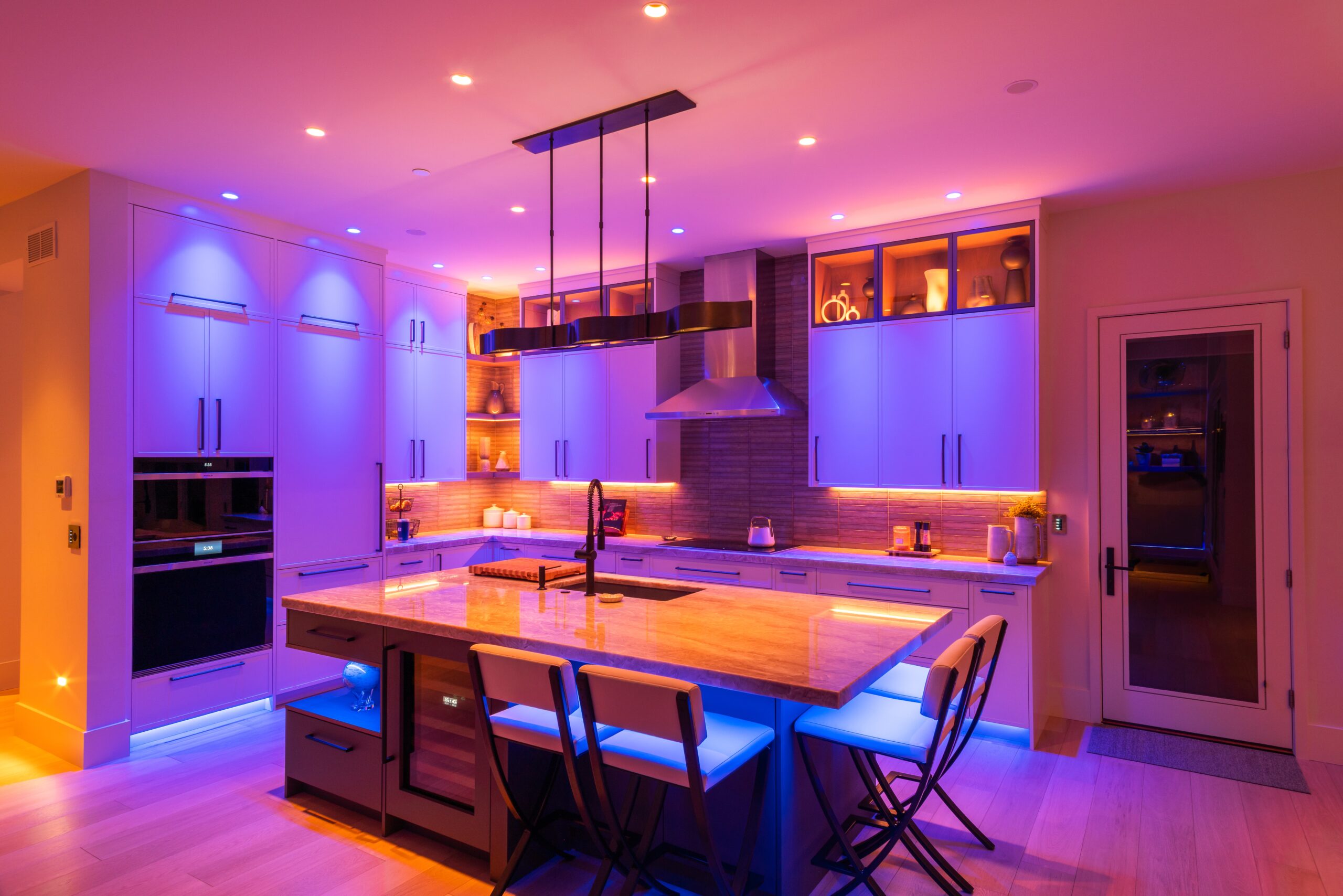
While color compatibility is a recurring issue on many projects featuring decorative and color-tunable lighting side-by-side, that 4000K chandelier in the great room doesn’t need to throw your dreams of circadian lighting, warm evening scenes and colorful parties out the window.
The challenge with including decorative lighting in custom integration projects
Imagine this: you crafted a fantastic architectural lighting design, the client is excited about tunable white recessed downlights and full dynamic color linear lighting and then you find out that the decorative fixtures they want included are set to a static color that cannot be changed by the control system you have in place.
Now it seems like your showstopper of a house going to hit a sour note every time your client keys in a particular lighting scene.
Smart bulbs can solve a few of the problems, but the decorative fixture that can successfully hide an ugly light bulb is increasingly rare. It seems that most of the design trends these days focus on built-in LEDs in countless configurations from twisted knots to glowing surfaces, without a screw-in base in sight.
So, what are you to do as an integrator?
How to better balance decorative fixtures within a home’s lighting control system
First of all, make sure the fixture is dimmed one way or the other. It can take effort to track down driver specifics for decorative fixtures, but getting the right dimming tech is key to most of the following solutions.
Keep an eye out for 0-10v control, which requires a separate pair of wires to the fixture and likely specific modules added to the controls. 0-10v is ubiquitous in the commercial and hospitality market, so they will be around for a long time. You can even make the decorative fixtures part of a digital solution by installing in-ceiling DMX dimmers, so long as you took the time to run control signals.
Whatever you do, just make sure the fixtures can dim reasonably low. Don’t expect terrific dimming, however, and map out when the fixture starts to flicker or drop out so you keep away from those parts of the dimming curve.
Layer architectural lighting in ways that allow it to ‘replace’ the decorative fixture
Next, make sure you have plenty of reinforcement utilizing architectural fixtures. A beautiful pendant over a dining room table is a great start, but start with the idea that the table should be well-lit even when the pendant is turned off.
That often means adding layers of light to replace the decorative fixtures, which can seem excessive to a customer. “Why do I need downlights over the table? I have a chandelier!” Study the chandelier and you are likely to discover that it does not put much light down on the table and let the client know.
There is a reason we call them decorative fixtures – they are more decoration than functional light sources. A pair of recessed downlights – with your preferred color technology built in – will almost always deliver more light to the table than a chandelier.
Build scenes with controllable lights first, then add in decoratives
The final key is to build strong scenes first with the lights you can control, then add in the decorative fixtures towards the end.
The scenes need to be easy to access (engraved keypads, for example) and reflect the way the client will live in the space. Stay away from load-based keypads (buttons for chandelier, sconce, downlight, etc.), which will almost inevitably ensure the lighting looks not-so-great every night.
Focus on the most critical areas in a room, perhaps the dining table, kitchen counters, or fireplace, and get the light just right using your high-tech fixtures that feature color tuning, dynamic color, or warm-dimming LEDs. I like to start with lower intensities and then build as necessary–our eyes adjust to ambient brightness and if we start bright everything else will look dark.
Next, light up the secondary features like art and cabinet faces (which might be just about as important and therefore just about as bright), again relying solely on the lights you can control best.
Once you have the light in the room near perfect, only then is it time to start easing in the decorative fixtures. Start very low in intensity, then gradually ease them up until they look good without glare.
Decorative lighting fixtures can still work in the connected home
We used 3000K decorative fixtures in the Prosource showroom in Golden, Colorado, despite utilizing dynamic color, warm-dim, and tunable white fixtures everywhere else. The result is less discordant than you might think; when decorative fixtures are dimmed low, their light is overpowered by the other lights but still give off a pleasing glow.
We have successfully implemented full dynamic day and night scenes–and party scenes–in multiple spaces using this approach. Often the decorative fixtures are in the bottom 25% of their brightness, which is only possible when all the other lighting in the room fills in.
Yes, I would be thrilled if manufacturers started offering their decorative fixtures with smarter lighting built in. A chandelier that features tunable white from 1800K to 4000K? I would be in heaven. But I am not waiting around for that to happen.
In the meantime, we get great results – despite “dumb” decorative fixtures – by balancing decorative intent with architectural performance.
David Warfel is Chief Evangelist of Light at design firm Light Can Help You (lightcanhelpyou.com).