There’s a different kind of pressure when your client has been your friend for more than 30 years.
Manny Marroquin and I met when we were young second engineers coming up in the Los Angeles recording-studio scene. Manny was at Enterprise Studios, I was at Encore Studios both in Burbank, CA. , and neither of us could have predicted where our careers would eventually take us.
We were both learning our craft in an era of large commercial studios, SSL consoles and sessions that could run around the clock. You learned quickly that signal flow mattered, reliability mattered, and when a room was full of people and the clock was running, the equipment simply had to work.
Manny stayed behind the console and went on to have the kind of career very few engineers ever achieve. His work has touched nearly 250 million albums worldwide, with more than 40 No. 1 albums, 100 Top 10 albums on the Billboard 200 and 18 Grammy Awards.
My path went in a different direction. I spent about 12 years working professionally with major artists in recording studios before my career began to evolve beyond the control room. During those years and as large format studios were starting to diminish, I saw a need among many of the artists and producers I worked with for car audio systems that could deliver something closer to the listening experience they were accustomed to in the studio.
That led me into designing and building studio-grade automotive audio systems for music-industry clients. In many ways, it was my first step into systems integration: taking what I understood about critical listening, signal flow and professional audio and applying it in an entirely different environment.
From there, my work eventually expanded into residential technology and the broader world of systems integration. Over time, CW Technologies grew into the company it is today, designing and integrating AV, automation, networking, lighting, security and control systems.
More than three decades after Manny and I first met, those two paths came back together at Larrabee Studios which he now owned.
And I’ve learned that working for a friend—especially a friend with extremely high standards—brings its own set of challenges.
Friendship Doesn’t Replace the Job
There are obvious advantages to working with someone you’ve known for decades. There’s trust. There’s history. Communication can be much more direct because neither person has to spend months figuring out how the other thinks.
But friendship doesn’t eliminate the responsibilities that come with a commercial project. If anything, I think it raises them.
You still have budgets. You still have deadlines. You still have architects, designers, manufacturers, subcontractors and other trades. Decisions have consequences, and somebody ultimately has to be responsible for making the technology work. When you’re the integrator, that’s our job.
Working with a friend also means knowing when to separate the friendship from the project. There are times when you have to say, “I don’t think we should do it that way,” or explain why something that sounds simple has much larger implications once you consider networking, control, signal flow, serviceability or reliability.
The benefit of a long relationship is that those conversations can happen honestly. Manny knows that I’m going to tell him what I think. And I know that when it comes to sound, I’m working with someone who has spent his entire adult life listening critically at an extraordinarily high level.
That makes for an interesting client-integrator relationship.
We Still Speak the Same Language
One of the things that makes these projects unusual is that Manny and I still share the language of sound and the recording studio.
I don’t have to explain why signal flow matters. I don’t have to convince him that the last few percent of performance can matter. And neither of us believes that a piece of equipment is automatically right for a project because it has impressive specifications or a great reputation.
Eventually, you have to listen to it. That philosophy has stayed with me throughout my integration career.
At CW Technologies, we don’t select every loudspeaker from the same manufacturer simply because it’s a brand we like. We look at the application, the room and what we’re trying to accomplish. Then we listen. The current Larrabee expansion is a good example.
The project adds three independent long-term artist recording suites, bringing Larrabee to nine studios. The same building also incorporates a new Private Dining Room serving Verse LA, while Mensano, Manny’s new European-inspired restaurant and wine bar, is located between Larrabee Studios and Verse.
These spaces are physically and creatively connected, but they don’t all need the same technology. That’s where the integration work gets interesting.
Designing for the Person in the Room
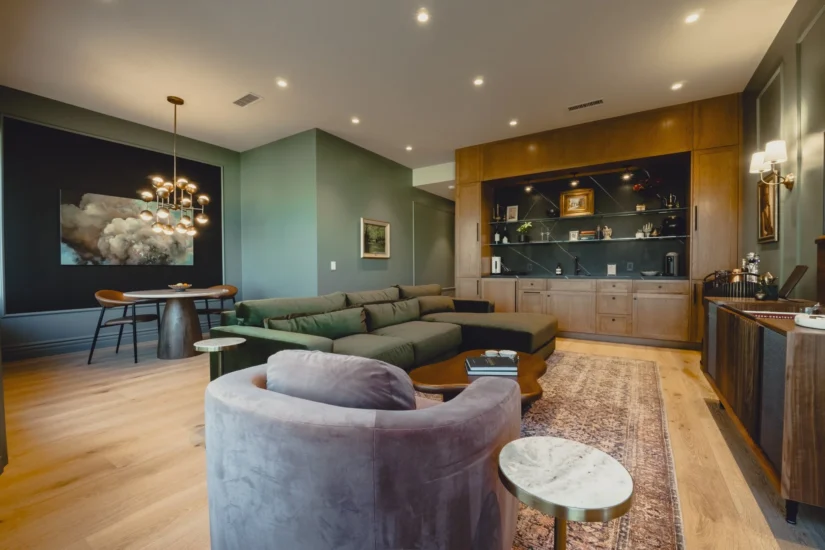
The three new Larrabee artist suites are intended for long-term occupancy. An artist or production team might live with these rooms for an extended period of time. That influenced one of our biggest control decisions.
We deliberately chose Crestron Home for the artist suites. Could we have built a fully custom Crestron system? Absolutely. But that wasn’t necessarily the right answer for the people who would actually be using these spaces.
I wanted an artist to be able to walk into a suite, understand the interface immediately and make normal adjustments to audio and lighting scenes without calling an engineer or asking someone from the studio how the room works.
That’s something my recording background probably influences more than I realized earlier in my integration career.
Technology people naturally get excited about what a system can do. Users usually care about how easily they can make it do what they want. Those are two very different things.
Crestron TSW-1070 touchscreens provide the user interface in the suites, but there’s considerably more happening behind them.
Crestron DM NAX provides the backbone of the distributed audio system, with DM-NAX-8SZA streaming amplifiers and DM-NAX-4ZSP processors providing networked audio distribution. DM-NAX-XLR-IO interfaces give us professional balanced connections where the Crestron system needs to interact with professional audio equipment.
Sonance 70v architectural pendants provide distributed audio throughout the common areas.
The infrastructure is sophisticated. The experience isn’t supposed to be. To me, that’s good integration.
One Project Doesn’t Mean One Audio Solution
The Verse LA Private Dining Room is located in the same new building, but its requirements are different from the artist suites.
For the PDR, we integrated Focal Utopia loudspeakers with Crestron AV and lighting control. That means we’re using Sonance in the Larrabee common areas, Focal in the Verse PDR and Meyer Sound at Mensano.
I like that because it demonstrates something we believe pretty strongly at CW Technologies: there isn’t one speaker that’s right for every room. Selecting the loudspeaker is also only part of the job.
We routinely incorporate DSP and system tuning into our audio projects. A loudspeaker doesn’t operate on a specification sheet. It operates in a room, and the room gets a vote.
My recording career permanently shaped the way I think about that. Engineering matters. Specifications matter. Product design matters. But after everything is installed, processed and tuned, I still want to stand in the room, close my eyes and listen.
When Your Client Really Knows Audio
There is another side to working with Manny that probably isn’t typical of most commercial integration projects.
You aren’t going to bluff your way through an audio conversation with an 18-time Grammy-winning mix engineer. And for me, luckily I’ve never based any of my companies on being a salesman, but on actual real life performance. That’s actually something I enjoy about these projects.
We can have conversations about sound without getting caught up in marketing language. If something sounds good, it sounds good. If something isn’t right, we keep working on it and figure out the solution.
Manny also has a longstanding relationship with Meyer Sound, and that relationship has played an important role in his hospitality projects.
Verse LA is home to a rare restaurant installation of Meyer Sound’s Constellation acoustic system. Forbes highlighted Verse in its Best of 2023 coverage as an “L.A. Can’t-Miss Spot,” and sound is clearly part of the restaurant’s identity.
With Mensano, Manny again collaborated directly with Meyer Sound, which helped develop the Meyer loudspeaker solution for the venue.
That established a natural division of expertise on the project. Manny and Meyer brought their relationship and shared approach to the loudspeaker system, while CW Technologies focused on integrating that solution into the larger AV, control, DSP and network infrastructure.
Our responsibility was to make all of those technologies work together as one cohesive system. To me, that’s what integration really means.
Making Different Ecosystems Work Together
Mensano is a commercial restaurant, so we approached its control system differently from the Larrabee artist suites. Instead of Crestron Home, we designed Mensano around a Crestron CP4 processor with custom SIMPL programming.
Crestron DM NAX provides networked audio functionality, with a DM-NAX-4ZSP and DM-NAX-XLR-IO providing professional connectivity, including multiple dedicated DJ inputs.
The audio system combines Meyer Sound UP-4slim loudspeakers, MM-10XP subwoofers, MPS-488 power supplies and GALAXY 8/16 DSP processing with a Q-SYS Core 8 Flex for signal management.
That gave us Crestron, Q-SYS and Meyer Sound technologies that all needed to operate as one system.
Rather than trying to force everything into one manufacturer’s ecosystem, we used networked audio—including Dante, AES67 and AVB where appropriate—to bridge those environments.
That’s the part of integration the customer shouldn’t have to think about. Restaurant staff shouldn’t need to know which protocol is carrying audio across the network or which processor is handling a particular function. They should press the button they need on a keypad or touchpanel and have the right thing happen.
Again, sophisticated infrastructure and simple operation.
Lighting Is Part of the Experience, Too
Audio gets a lot of attention on a project involving Manny, and understandably so, but lighting has been equally important to these spaces.
We integrated DMF Artafex architectural lighting throughout the three new Larrabee studios and the Verse Private Dining Room, controlled through Crestron CLX-2DIMU8 universal dimming modules and Horizon 2 keypads.
At Mensano, we also integrated DMF architectural lighting with Crestron control, allowing scenes to change the character of the restaurant as it transitions from daytime into dinner and evening service.
I tend to think about lighting similarly to audio. When it’s done well, most people aren’t thinking about the technology. They’re responding to how the room feels.
For an artist spending long days or weeks in a studio, that matters. For someone having dinner at Mensano or attending a private dinner at Verse, it matters there too.
The Part Nobody Sees
Some of the most important work we’ve done across these projects will never be noticed by an artist or restaurant guest. And that’s probably a good thing.
CW Technologies designed and deployed the wired and wireless network infrastructure supporting both the Larrabee Suites building and Mensano. Today that network isn’t just providing Wi-Fi. It’s carrying or supporting AV, networked audio, control, security and other operational systems. DM NAX and AES67 depend on it, as do many of the connected devices throughout the properties.
We also deployed IP surveillance across the properties and a cloud-managed ProdataKey access-control system at Larrabee.
Security at a facility like Larrabee has requirements that go beyond a typical commercial space. High-profile artists will be working there, and unreleased recordings and other intellectual property will exist inside those rooms long before the public ever knows about them.
So networking, AV, control and security can’t really be treated as isolated scopes anymore. They’re layers of the same system. That’s one of the biggest changes I’ve seen since my recording days.
What Working With a Friend Has Taught Me
I’ve worked with Manny on more than one project now, and I think the biggest lesson is that friendship can make a project better—but only if you still treat the work professionally. The history helps. The trust helps. Being able to communicate directly definitely helps, but your friend is still your client.
He has a business to operate, a budget to manage and expectations for what you’re delivering. You still have to document the system, coordinate with other trades, solve problems and stand behind the finished product.
Sometimes you have to disagree, but I actually think that’s where the trust becomes most valuable.
A good client relationship isn’t one where you say yes to everything. It’s one where both sides understand that everyone is trying to get to the best result.
Manny and I started our careers on the same side of an SSL console. He stayed there and reached a level in the recording industry that very few people ever will.
I eventually moved to a different side of technology, but I carried a lot of what I learned in those studios with me. Signal flow still matters. Reliability still matters. The experience of the person in the room still matters, but at the end of the day, you still have to listen.
More than three decades after we were young second engineers trying to build careers in Los Angeles recording studios, Manny and I are working together again—but in very different roles.
Today, one of those young engineers owns Larrabee Studios. The other is helping engineer the technology behind its next chapter.
Carlos Warlick is president and founder of CW Technologies, Inc., a Los Angeles-area technology integration firm specializing in high-performance residential and commercial AV, automation, networking, lighting and security systems.