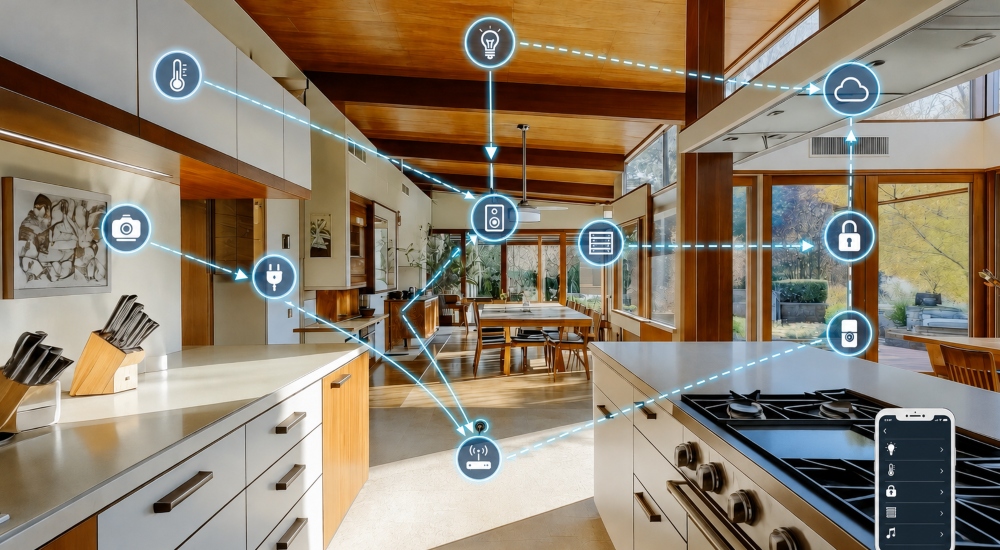
Rising energy costs, the widespread increase in work from home (WFH) and the rise in subscription-based entertainment, among much more, are changing how much time Americans are spending in and around the home. As such, many are saying that the profession of “home integrator” has become as important as a plumber, electrician or HVAC technician.
What is a ‘home integration professional’?
The role of a home integration professional has evolved considerably in recent years from audio-visual systems integration to now also include security systems and access control integration, IT/WIFI optimization, shading systems, lighting, backup energy and more.
The areas within home featuring technology addressable by these professionals have extended beyond a home theater in luxury homes to now include outdoor entertainment areas, multi-use zones, home offices, bedrooms, home gyms and garages, with the homes serviced having broadened to new demographic groups and new neighborhoods.
Why home integration professionals are needed today
So much of the home today relies on technology that is constantly being developed at a breakneck pace. This is especially prevalent in the luxury, custom, and high-mid-range sectors of the American residential property market, where affluent owners seek holistic systems and seamless experiences.
“[Everyone] relies on network integration for the effective use of their doors and locks, fitness equipment, screens and sound systems, security cameras, computers, displays, and printers,” says Jason McGraw, Group Vice President and Show Director, CEDIA Expo/Commercial Integrator Expo.
A trade show for integration professionals in home and commercial sectors, CEDIA Expo/CIX takes place in Denver, drawing in 15,000 integration professionals including business owners, their technicians and a broad array of manufacturers in between. The show is generally held in September, with registration for this year’s show (taking place Tuesday, September 1, to Friday, September 4, 2026) now open.
“You want that network and the connected devices operating as efficiently, securely, and reliably as possible. That is why the most successful homes in the most admired neighborhoods typically feature work by an integration professional.”
The trends told in data
Adoption of home security systems have gone up 52% since 2024, with 61% of U.S. households now having at least one security camera, while 28% have a professionally monitored security system (~30.2 million homes) as of 2026.
Alongside that, energy bank adoption has also grown, with the U.S. installing 57.6 GWh of new energy storage in 2025 — the largest single year on record, according to the Solar Energy Industries Association (SEIA). This comes as the national average residential electricity rate reached 17.01 cents/kWh in 2025, a 2.6% increase from 2024, which the U.S. Energy Information Administration said costs the average U.S. household approximately $140–$145/month.
The issue is that as homes become more complex due to their integration of these technologies, savings are missed, redundancies are normalized, vulnerabilities are exposed and experiences are disrupted.
Digging deeper
The bigger issue is that more people are noticing when these systems break down as lifestyle shifts redirect people to being around the home more often.
As of 2025, 22% of the U.S. workforce, approximately 32.6 million Americans, work remotely (13% fully remote, 26% in hybrid arrangements) according to the Eye on Housing report from the Bureau of Labor Statistics (BLS).
Home schooling has also grown significantly, with 6.5% of U.S. school-age children—approximately 3.4 million students—being homeschooled in 2024–2025, growing at nearly 3x the pre-pandemic rate, according to Nation Home Education Research Institute (NHERI).
Why not DIY?
DIY solutions exist to this day, but for McGraw the true value for a home integration professional now lies in the total cost of ownership for a system.
“Successful Americans spend much of their income and time on their home and in their home, and yet so much value and opportunity falls through the DIY gap. With so much technological, demographic, societal change reshaping how we select our homes, use our homes, invest in homes and enjoy our homes, it’s only a matter of time before the home integration professional is called to design and optimize systems for everyday homeowners.”
Looking at the bigger picture
For many Americans, McGraw says system integration is now a must-have. He also concludes that home integration systems are more attainable to Americans than is generally perceived.
“If a technology is attached to the home — a television to a wall mount, a smart lock on door, smart shading on windows, backup energy installed in the garage — then the technology can be included on a mortgage and whereas the cost may be spread over time, the payoff on some technologies — like energy savings or productivity gains — can be immediate,” McGraw notes. “This is another strong argument for hiring systems integration professionals!”