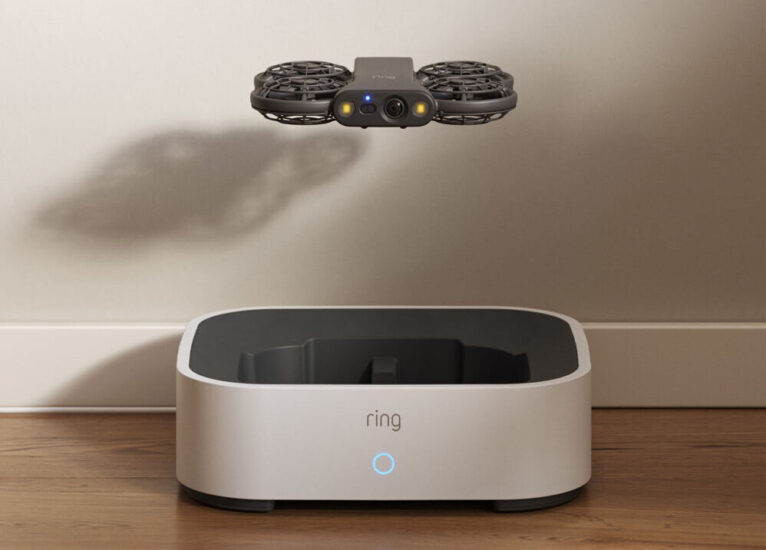
Amazon’s Ring is launching Ring Robotics and two new robotic security devices—an indoor drone camera and rover camera—designed to monitor, patrol and respond to custom routes or disturbances.
Rover Cam will ship in the U.S. on Dec. 16, 2026, for $999.99. Drone Cam will ship in the U.S. on Jan. 27, 2027, for $249.99. Both devices work with existing Ring cameras, doorbells, sensors and alarms and are managed in the Ring app.
Ring founder and chief inventor Jamie Siminoff said customers had asked for “eyes in the places a fixed camera couldn’t reach.” He described the line as the start of autonomous protection for homes and businesses.
The announcement did not address professional installation, dealer programs or integration with third-party platforms.
Ring Drone Cam
Drone Cam stays in a dock with its camera off. It launches on a schedule, on demand, or automatically when a connected Ring camera, sensor or alarm is triggered, and flies to patrol points set by the user.
The drone records 2K video with a 148° field of view and can rotate 360° in flight. Two LEDs turn on automatically in low light. It can also be controlled from the new Alexa Home Map.
Ring said the propellers are audible by design, so people nearby know when the drone is operating.
According to Amazon’s listing of this product, it has up to eight minutes of flight time tested with a new, fully-charged battery under controlled conditions, but actual flight time may vary based on environment, usage, and battery condition.
The company also caveats that Ring Drone Cam performs best in environments with varied visual detail. Surfaces that are highly reflective like polished marble or wet tile, plain and featureless like blank matte walls, or transparent like frameless glass and mirrors may disrupt performance.
Ring Rover Cam
Rover Cam is an autonomous wheeled robot for businesses. It can run scheduled patrols, travel to a room or saved patrol point on command, and respond automatically when a connected Ring device is triggered.
Its camera sits on an adjustable periscope mast that can be raised to see over counters and shelving, with the height saved for each stop. Rover performs a 360° scan at each stop and records up to 4K video continuously while moving. Person detection remains active while it is docked. The robot also has a siren, a light tower and two-way audio.
Ring said the product was inspired by feedback from Amazon Astro owners, who identified roving security as their favorite feature.
Ring did not disclose battery life, runtime per charge or maximum coverage area. However, the robot cannot climb stairs and is restricted to a single-floor environment. It also isn’t compatible with curved edges, sunked areas, flooring transitions greater than 1.375″ and black, glossy floors.
AI Pilot
Both devices use AI Pilot, a Ring navigation system that combines onboard cameras, vision models, sensors and cloud processing.
During setup, the user carries Drone Cam through the space, while Rover Cam explores on its own. The system creates a floor plan, identifies rooms and suggests patrol points such as doors, windows and registers, which users can edit. On patrol, it plans routes and steers around obstacles in real time.
Privacy features
Drone Cam’s camera is off while docked and records only during flight. Rover Cam’s Sleep Mode retracts the mast and turns off the microphone. Both devices have LED recording indicators, and Rover also shows recording status on its screen. Video from both is protected by Throw Away the Key (TAKE), which Ring describes as its strongest default encryption.