Editor’s note: Listen to the entire session from CEDIA Expo 2026 in this podcast episode here!
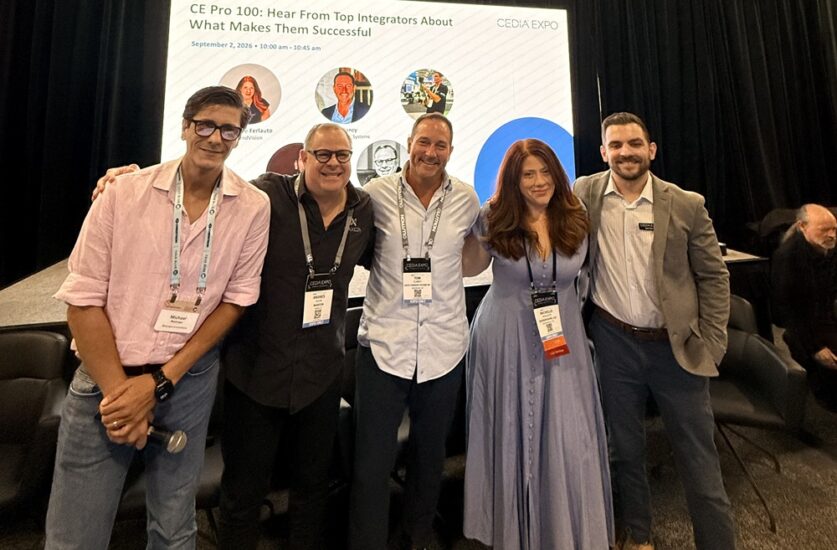
The Smart Stage at CEDIA Expo 2026 opened with something new: a panel of CE Pro 100 honorees talking about what got them on the list and what keeps them there.
CE Pro Executive Editor Zachary Comeau hosted Michelle Ferlauto, COO of SoundVision in Mooresville, N.C.; Thomas Clancy, executive vice president and COO of Audio Command Systems (ACS), which is celebrating its 50th year and ranks No. 6 on this year’s list; Andrés Klein, co-founder and CMO of Maxicon, which has grown from two people to 64 in 21 years and added an office in Madrid; and Mike Restrepo, founder of the 16-year-old Restrepo Innovations.
Check out this year’s CE Pro 100!
What Got Them Here
Asked what built their companies, the panelists pointed to people and principles more than products. Clancy has watched the CI business change dramatically during ACS’s long run on the CE Pro 100. He said a firm has to change with the market, but it also has to hold itself and its employees to the values it claims.
“If I had to say the two things, it would be adaptability and accountability,” Clancy said.
Restrepo told a more personal story. He said he started his company broke and nearly homeless, and what kept him going was the chance to do work he loved. He has built the company’s culture around that idea, telling employees that every day on the job is a chance to live their dream. In his view, accountability follows from that.
“If you live your dream, you make yourself accountable,” Restrepo said. “Fostering that culture into everyone is what allowed our company to scale.”
The First Key Hire
Two panelists named the same first key hire: their wives. In Maxicon’s early days, Klein and co-founder Sammy, now the company’s CTO, handled sales, pre-wiring and installation themselves. They needed someone to manage ordering, invoicing and finances but couldn’t afford to hire anyone, so Klein’s wife took the job.
Restrepo’s wife filled a similar role, and he believes that kind of hire matters more than most integrators realize. Many owners assume their first hire should be another tech so they can step out of the field. Restrepo said a strong back office is what actually lets a small company grow.
“My ego said I could do anything, so my wife put reality in the back end,” Restrepo said. “I could be lost in the dark, and she was the light.”
Ferlauto chose a different hire: an in-house engineer who builds and programs racks before they leave the shop. The decision was partly strategic and partly forced by COVID, and she said it changed how SoundVision works. Systems arrive turnkey, so installers spend less time troubleshooting on site and clients get a smoother experience.
“We are constantly trying to get upstream of our installs,” Ferlauto said.
For ACS, the turning point was a change in philosophy. The company stopped thinking of itself as a speaker-and-TV shop and built out dedicated engineering, CAD and programming departments. Clancy said that restructuring is what allowed ACS to scale.
“Audio Command decided we’re no longer going to be an AV company. We are going to be a professional systems integration company,” Clancy said.
Defining Success in 2026
Clancy said his definition of success has changed over the past decade. It used to mean growing revenue. Now it means being able to see what’s coming, including labor needs, margins and procurement requirements up to a year out.
“If you had asked me this question 10 years ago, I would have said revenue,” Clancy said. “Today, it’s predictability.”
At SoundVision, Ferlauto said the focus is on rewriting standard operating procedures, making sure employees actually follow them and finding practical uses for AI. Klein said most of Maxicon’s sales and marketing effort goes into relationships with designers, architects and builders. He estimated a strong relationship can be worth about half a million dollars over three to four years. What he values most is being treated as a real partner on the project team.
“We are respected not as the guy who’s installing speakers and TVs, but the guy who’s actually putting together all the technology along with the vision of the design community,” Klein said.
Practices and Pivots
Asked to name one business practice behind their success, Ferlauto said consistency is what earns referrals. That requires the whole team to agree on a process and someone to hold everyone to it.
“Discipline, process, discipline,” Ferlauto said. “Sounds easy, but somebody has to enforce the process.”
Clancy chose authenticity. He said every company talks about its culture and values, but integrators carry extra responsibility because of how closely their work touches clients’ daily lives.
“We are the most intimate thing in our customers’ home. We’re the first thing they touch in the morning, we are the last thing they touch in the evening,” Clancy said.
Clancy also described a major shift in how ACS wins projects. For years, TVs and speakers got the company in the door, and networks came later. ACS reversed that order after asking clients whether they would rather have working Wi-Fi or running water. Clancy said 80% chose Wi-Fi, and the company now leads with the network.
Ferlauto said SoundVision’s biggest shift was redefining itself as a service company. It created a department that handles only service calls, with a same- or next-day response commitment. Clancy said ACS has long held the same view.
“We are a customer service business that happens to deal in technology,” Clancy said.
Restrepo said his guiding rule is to never get comfortable. When business slowed sharply early this year, he rebuilt the company’s marketing from scratch. He redesigned the website around AI and began publishing far more content than usual. He said the results brought in government and commercial work well outside his usual residential business.
“My phone has not stopped ringing,” Restrepo said.
Advice for Younger Integrators
Klein said Maxicon’s breakthrough past $4 million in revenue came after the founders brought in a third partner, CEO Ilan Weinstein, who understood finance. He said peers in the ProSource buying group also helped, because they had already solved many of the problems Maxicon was facing.
Ferlauto has worked for three integrators and warned against running a business on constant chaos.
“Chaos is contagious, and it is going to burn out your team, and it is going to probably affect your personal life,” Ferlauto said.
Clancy cautioned that a large job outside a firm’s specialty can pull people and money away from profitable work.
“Not all revenue is good revenue,” Clancy said. “Learning the difference between revenue and profit is probably the single biggest recommendation I can make.”
Clancy also encouraged younger integrators to lean on the industry’s camaraderie. ACS and Restrepo Innovations compete for the same projects in Manhattan and Long Island, yet the two firms stay in regular contact. Restrepo said he has referred clients to both ACS and Maxicon, and Ferlauto said peer groups such as HTSA have been invaluable.
“Even though we’re competitors, he’s a phone call away, and I’m a phone call away from him,” Clancy said. “We are a true family. Embrace that.”
What Not to Miss in 2026
In the closing round, most of the panelists came back to AI. Restrepo urged integrators to use it but not depend on it so much that their teams lose expertise. He sees it as a chance for small firms to compete with much larger ones.
“AI is this amazing set of crutches. If you use them too much, you become weak,” Restrepo said.
Clancy rejected the idea that AI will replace employees. He said the best place to start is with the repetitive tasks employees dislike most.
“If you can use it to make your employees’ jobs 10%, 20% easier, better, that’s when you’ll begin to see the real benefits,” Clancy said.
Ferlauto ended on relationships rather than technology. She said the most valuable thing attendees can take home from any show is a stronger connection with their vendors. Every integrator eventually faces a product failure or stock shortage, and the vendor’s response often depends on whether they know who you are.
“If you’re just another faceless name in the crowd to a vendor, they’re just not going to help you,” Ferlauto said.