TapouT Theater is a Mixed Martial Arts Knockout
He’s also known as Dan Caldwell, co-founder and CEO of TapouT, a company embedded in the MMA industry.
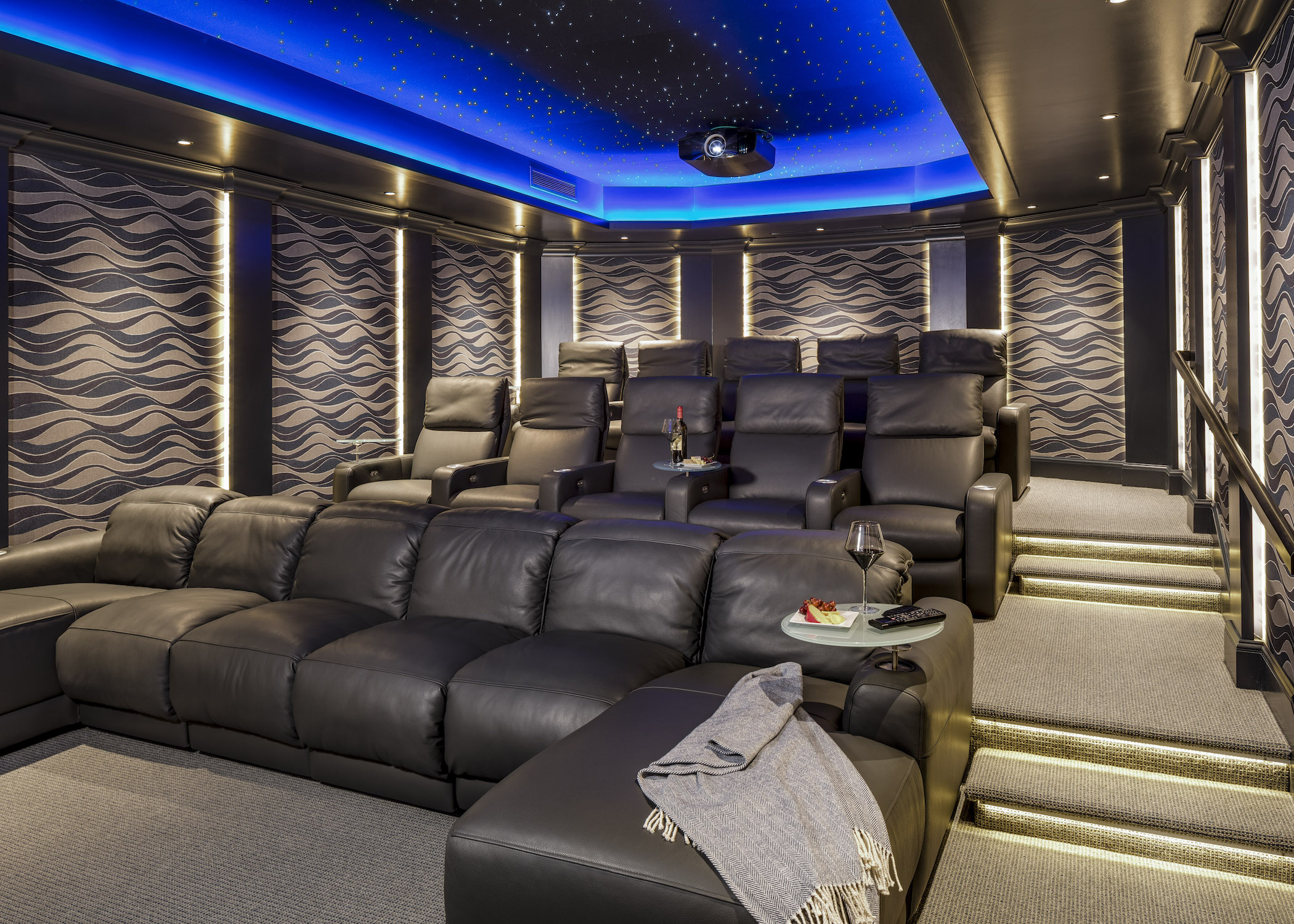
The fighter/executive set out to have an elaborate theater built at TapouT’s Grand Terrace, Calif., headquarters and enlisted San Bernardino, Calif.-based Audio Video Evolution (AVE) to install the electronics.
Why does a corporation need an elaborate theater? Well, TapouT — which says it manufactures a “countercultural” clothing line and produces a “raucous” reality show — isn’t a typical corporation.
A Little Background
Caldwell and a fighter called SkySkrape are both TapouT-sponsored MMA fighters.
A third TapouT-sponsored-fighter, Mask, a.k.a. TapouT co-founder Charles Lewis Jr., died after a car accident in March 2009.
“Movies have always played a big influence in Charles’ and my lives,” Caldwell says. “Movies can be escapism and have helped influence creativity. When everyone else was out partying and hanging out, me, Charles and Skrape would be watching the newest flicks at the theaters.”
When Marc Kreiner came on board as TapouT’s president, Caldwell says he and Lewis marveled at his home theater. “After seeing that, we said we were going to build a movie theater in our office one day.
“TapouT has always been on the forefront of Mixed Martial Arts and with that comes the responsibility of educating the consumer. Visual media is a big part of what TapouT does.
“We produce commercials, short documentaries and films — all used to help promote the sport. So building a movie theater seemed like a good fit.”
The project began just before Lewis passed away on March 11, 2009. “I know he would have loved to have seen how it came out,” Caldwell says. “When I sit in the theater it definitely makes me think about him and how he inspired people. We want to use the movie theater to continue to inspire everyone.”
As such, it’s called the Charles Lewis Jr. “Mask” Theater.
Subscribe to the CE Pro Newsletter
Article Topics
News · Slideshow · Home Theater · Commercial · Screens · Installation · Speaker ·About the Author

36 Comments (displayed in order by date/time)
“B&K Reference 70 receiver”
They could have done alot better then that, ever the top of the line B&K audio products are far behind a basic receiver from denon, onkyo, pioneer.
I don’t know where these comments come from, particularly the B&K pre/pro. The Ref 70 is full featured with all the latest audio and video processing options, including Dolby TrueHD, DTS-MA, Silicon Optix’s Reon chipset, vertical stretch for anamorphic content, IR routing, XLR and RCA inputs and outputs.
Tom didn’t mention what amp is mated to this pre/pro, but this unit doesn’t take a backseat to any piece of electronics in its price category.
I’m pretty certain that most of us would be pretty happy with this system.
Love it. #1. because of the dark fabric. #2. because you can fit everyone you know in it
.
I know they were going for gladiators with the decor but it looks like an alley in the middle of a city where some brawling may go down
. Totally fits IMO.
http://i716.photobucket.com/albums/ww161/DougWinsor/P1010021.jpg
http://i716.photobucket.com/albums/ww161/DougWinsor/P1010020.jpg
Sorry but the B&K products are empty boxes.
Frakin LMAO…..
When are these writers gonna actually use any of the products they promote? How much money did they pay you?
Dumass!
Steve, what exactly should a pre/pro contain internally?
It’s not an amp, there’s no need for a big torodial transformer, heatsinks and other amp design features.
The pre/pro probably has that space to allow the unit’s processors to properly ventilate.
The chassis may also be used for other products and the use of it may be for the economy of using the same chassis throughout its current product line.
The important thing is the circuit design, reliability of the unit and its performance.
Your earlier comparisons to A/V receivers isn’t even relevant and neither are these links to the photos.
I suggest you and the Duke visit a B&K dealer and demo one for yourself.
“The pre/pro probably has that space to allow the unit’s processors to properly ventilate.”
The heat generated by an audio/video processor is a fraction of a modern day CPU/GPU so that is irrelevant.
“The important thing is the circuit design, reliability of the unit and its performance.
Your earlier comparisons to A/V receivers isn’t even relevant and neither are these links to the photos.
I suggest you and the Duke visit a B&K dealer and demo one for yourself.”
So what makes a B&K “better” then other audio products? Why is the B&K so much when we see it as an empty box? The much cheaper options from onkyo/integra offer the same video processing with many more features.
Is it the same circuit design?
Have you ever visited an A/V store or a custom installer to see what type of heat is generated by a rack full of gear?
Are they using the same DACs, are they using XLRs, are they software/firmware upgradeable?
Do you take your product to the business you purchased it from so they can stand behind the product?
Have you ever listened to a B&K product?
Your the B&K fan boy so why don’t you know what B&K uses parts wise? Explain how a digital processor is affected by heat? The chip is either operational and can process the 0’s and 1’s or it can’t and by your lack of understanding of heat it is obvious you have no clue about simple heat sinks. Do a little research in PC’s using top of the line AMD/intel CPU’s and ATI/Nvidia GPU’s.
With you comment about listening to a product I assume you listen by name and price. Why would the B&K sound any better then another processor or receiver?
http://focus.ti.com/docs/prod/folders/print/dsd1608.html
Looks like this “high end” processor uses a lowly DSD1608 DAC with a pathetic 108dB SNR.
Well Steve, I you may be wrong first of all with the DACs the unit uses. According to AVS Forum the unit uses The PCM 1796, which is a 24-bit/192kHz DAC with a dynamic range of 123dB.
It appears that you have never auditioned any piece of audio equipment never mind the B&K piece.
We are also not talking about computers, this is A/V equipment and how a small American company chooses to build a component.
You’ve also probably never seen a rack mounted A/V system so you have no idea of the heat involved in locating an A/V system in an equipment closet.
Since you’ve never seen this gear in person you have no idea of the heat a pre/pro and Class A or Class A/B amp combination can generate.
Since you shop for gear on the Internet based on price and spec sheets its appears that you overlook part of the enjoyment of buying A/V gear.
I am not going to get into name calling, but you should audition equipment before buying it. Price really isn’t a factor. No one is saying to compare an a/v receiver to a high-end system. The important thing is there are differences in equipment that won’t show up in a spec sheet or a Web price.
I’ve sold B&K components for years… I think the stuff sounds better than the rice burners, (I’m also a huge Denon dealer), and I think it more than fairly priced. Not to mention, I’ve never had a defective piece and their in-field customer support is great.
Thanks for the dealer perspective Dave.
I am not favoring one brand over another, it bothers me however when consumers rip products on this site or EH.com and they do so without even seeing the product.
The Web is a great tool for researching a product and I do it for things like appliances, cars, electronics and guitars, but you can’t get the total picture of a product without auditioning it.
No one buys suits or cars without visiting those respective dealers, consumers need to do the same thing with electronics. They also need to do so with the honest intention of possibly buying the product from an authorized dealer.
No dealer can afford to waste his time with a tire-kicking, Web driven consumer looking for a deal.
Bob
No problem Bob… As you already know, I’m the first guy to rip a product apart when it’s overpriced or media hyped. B&K is simply an affordable alternative for those that want to go beyond a mass produced overseas made product.
The thing that really cracked me up was the discussion of which DAC’s were being used. Back in the day, people, (who knew just enough to get themselves into trouble), used to compare the DAC’s that were used in $200.00 Denon & Sony CD players. Maybe it’s me, but unless your mother is Lassie, who would be able to hear the difference?
In this case, whereas we’re speaking of a high end component, you can use the finest DAC’s money can buy, but that does not guarantee the actual performance in the end. Only if you ignore the many other integral internal components that process the signal, can you go on specs alone.
“Well Steve, I you may be wrong first of all with the DACs the unit uses. According to AVS Forum the unit uses The PCM 1796, which is a 24-bit/192kHz DAC with a dynamic range of 123dB.”
From what I have read it might only use that for 2CH operation since the PCM1796/DSD1796 and the DSD1608 is a 8CH DAC. Either way the B&K uses the most common DAC in most other receivers from onkyo, denon, pioneer.
“It appears that you have never auditioned any piece of audio equipment never mind the B&K piece.
We are also not talking about computers, this is A/V equipment and how a small American company chooses to build a component.
You’ve also probably never seen a rack mounted A/V system so you have no idea of the heat involved in locating an A/V system in an equipment closet.
Since you’ve never seen this gear in person you have no idea of the heat a pre/pro and Class A or Class A/B amp combination can generate.”
Really, it is very simply to look up the video/audio processors used in your empty box ref 70 and then look at the companies specification for heat production. You do realize like everything else heat is easily measured.
“I am not going to get into name calling, but you should audition equipment before buying it. Price really isn’t a factor. No one is saying to compare an a/v receiver to a high-end system. The important thing is there are differences in equipment that won’t show up in a spec sheet or a Web price.”
So what makes the B&K ref 70 better then anything else? It does not run a better video processor, it lacks decent room correction, and it uses plain old DAC’s that everyone else uses.


Lame…..