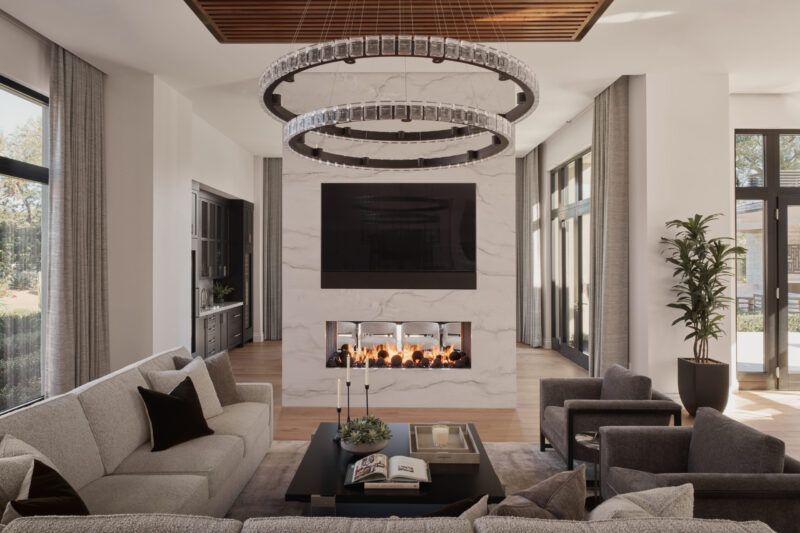
CE Pro’s Home of the Year Award entries usually get judged on the finished room: the screen that disappears into a wall, the lighting scene that sets a mood at the tap of a keypad. The bill of materials rarely gets a second look. But line up enough of them and a clear picture emerges of which brands the industry’s top integrators actually trust when the stakes are highest.
We analyzed complete equipment lists from 30 Home of the Year Award-winning projects, covering roughly 250 brands across video, audio, control, lighting, security, networking, power and infrastructure, and more. The mix spans 16 whole-home systems, dedicated theaters, media rooms and listening rooms, golf-simulator and bowling recreation spaces, partial lighting-and-shade scopes, landscape lighting jobs and a handful of non-residential builds. A brand counts once per project, no matter how many units were specified.
If you’re familiar with the CE Pro 100 Brand Analysis, which is essentially a similar ranking of the brands most used by the CE Pro 100, then you’ll see some similar trends.
The Backbone Nobody Sees: ADI
The single most consistent finding has nothing to do with the gear clients show off. ADI and legacy Snap One products appear in 24 of the 30 projects. WattBox power conditioners and IP-controlled outlets showed up in 21, Strong racks and mounts in 20, Araknis routers and switches in 17, Wirepath cable and structured wiring in 17, and Binary HDMI and signal cabling in 13.
That consistency holds whether the home runs Control4 (also an ADI brand) Crestron, ELAN or Savant. Integrators may argue about control platforms, but when it comes to the rack, the network and the power behind it, the award winners largely buy from the same catalog. WattBox’s remote reboot and OvrC monitoring appear to have become a baseline expectation for any system an integrator plans to support long term.
Control: Control4 Leads, Crestron Goes Big
Control4 was the most common platform, used in 13 projects, followed by Crestron in 7, Josh.ai in 6, Nice/ELAN in 3 and Savant in 1. The counts only tell half the story. Crestron Home tended to run the largest, most keypad-dense estates: one project specified 92 Horizon 2 keypads, another 68, and a third paired 77 Crestron CLX/CLT dimmer modules with its lighting design.
Voice is becoming a layer that sits on top of either platform. Josh.ai appeared in six projects, across both Control4 and Crestron homes. One whole-home system specified a Josh Core with nine Nanos set into Lutron Palladiom faceplates, four Josh remotes and six Josh touchscreens, effectively making voice and Josh’s own interface the primary way the family interacts with the house.
Lighting and Shades: Lutron’s Category
No category was more concentrated. Lutron appeared in 16 projects, and in the high-end jobs it was usually the full HomeWorks stack, specified in 12 projects, with Palladiom keypads in 8. Every Lutron project included motorized shades or drapery, mostly Sivoia QS and Triathlon. Newer Lutron lines are showing up too: Sunnata keypads were common, and individual projects added Ketra lightbars and lamps, Lumaris tunable-white tape light and Alisse keypads.
Crestron lighting appeared in five projects, and only where Crestron was also the control system. Control4 keypads and dimmers appeared in seven.
On the fixture side, two brands dominate the specifications. American Lighting’s Proluxe line of linear LED tape, extrusions, DMX decoders and drivers appeared in 8 projects, including one that ran roughly 430 feet of linear LED. DMF recessed downlights also appeared in 8. One project specified 216 DMF 2-inch modules and 245 square trims; others used 136 and 159 housings. Landscape lighting was the one lighting segment where Lutron and DMF did not dominate. There, WAC Lighting, ClaroLux, LumienPRO and Coastal Source did the heavy lifting.
Video: A Three-Way Tie, and the Direct-View LED Moment
Samsung and the Apple TV 4K (third generation, 128GB) each appeared in 14 projects, and Sony in 13. Apple TV remains the default streaming source. Sony won the living rooms and theaters with Bravia 8 and 9 sets, A95L OLEDs, 98-inch professional displays and laser projectors. Samsung won outside and on the wall: The Terrace outdoor TV appeared in seven projects, and The Frame was even more common, with one home specifying five Frames.
The bigger story is at the top end. Flagship rooms are moving from projection to direct-view LED. The lists included a Samsung The Wall 146-inch display, a 115-inch Samsung Micro RGB set, a custom 130-inch CinemaScope dvLED wall and 1.2mm-pitch LED walls from Quantum Media Systems. Projection still owns the reference theater, with Barco, Christie, Digital Projection, JVC and Sony projectors paired with Lumagen (3 projects) and madVR (2) video processors. However, it doesn’t take a genius to understand that video walls are making a major play for the home entertainment market when it comes to video. This year’s CEDIA Expo saw quite a few video walls, including a handful of new players.
Unsurprisingly, Kaleidescape appeared in 8 projects, as it’s becoming hard to find any home theater without a Kaleidescape player providing the source. AVPro Edge was the most common distribution brand at 17 projects, spanning MXnet AV-over-IP, 4×2 matrix switchers, HDBaseT kits and Bullet Train active-optical HDMI. Crestron DM NVX appeared in 6, mostly in Crestron homes.
Audio: The Most Open Field
Speakers remain the most competitive category, which suggests that sound is still where integrators express the most personal preference. This isn’t very surprising, as the field is flooded with impressive audio brands. Sonance was the most widely used brand at 14 projects, helped by the Invisible Series, VX in-ceilings and landscape systems. Sonos followed at 11 and Origin Acoustics at 9, then JL Audio (subwoofers) and James Loudspeaker at 6. Marantz and Sony ES receivers (5 projects each) were the most common theater electronics, from Marantz AV10/AMP10 separates to Sony’s STR-AZ series. Coastal Source bollards anchored the most ambitious outdoor audio systems.
Invisible and small-aperture speakers are clearly in demand. One project specified 87 pairs of Crestron Ultimate small-aperture speakers; two others used a combined 49 James SA63-7 3-inch small-aperture models. At the reference end, the lists read like a high-end show floor: Wisdom Audio planar-magnetic line sources, ASCENDO infrasonic subwoofers, Wilson Audio, Trinnov and StormAudio processing, and Bang & Olufsen’s BeoLab 18 and 19.
Networking: Ruckus Rules, Wi-Fi 7 Arrives
Wireless access points from Ruckus, sold either through Access Networks or directly, appeared in 13 projects. Paired with Araknis switching, that makes a Ruckus-based enterprise network the de facto standard for award-level homes. Ubiquiti UniFi is the challenger at 3 projects, and it delivered the only full Wi-Fi 7 build in the set: a home with 17 U7 access points and UniFi Protect AI cameras on a single platform. Fortinet firewalls and Starlink as a backup internet connection each appeared in two projects, and one home used a Sophos firewall.
Security: Luma Leads, Cloud Cameras Emerge
Luma was the most common surveillance brand at 8 projects, with up to 19 cameras on a single NVR, followed by IC Realtime. DSC PowerG sensors (7), Yale smart locks (6), Qolsys panels (5) and System Sensor detectors (4) round out the core security stack, while DoorBird and 2N covered IP intercoms. The outliers point toward enterprise and AI video: one estate specified 53 Verkada cloud cameras, and others used UniFi Protect AI cameras and a Camect analytics hub.
The Growth Potential Category: Energy
One whole-home project did integrate a standby generator into its control system. Otherwise, energy showed up only as power quality and uptime: WattBox and SurgeX conditioning, online and lithium-ion UPS units, and isolation transformers from Torus and 360 Power Quality. Climate integration was also light, limited to a few thermostats, HVAC bridges, garage and fan integrations, and one air-quality monitoring system.
That is either a blind spot or an opening. Integrators are already running the network, the rack and the control system, so they are well placed to add energy management. For now, the award-winning homes are leaving that work to someone else.
The Products That Keep Showing Up
Brand counts show who integrators trust, but model counts show what they actually reach for. A handful of specific products appeared again and again, across different integrators, regions and control platforms.
The Apple TV 4K (third generation, 128GB) is the single most repeated product in the set, specified in 14 of 30 projects. Next come the building blocks of a premium lighting system: the Lutron HomeWorks QSX processor (HQP7-2) in 10 projects and Lutron’s LQSE-4A5 LED+ dimming module in 8. Samsung’s lifestyle TVs are close behind, with The Frame in 8 projects and The Terrace outdoor TV in 7.
On the infrastructure side, the WattBox WB-800-IPVM-12 power conditioner and the Araknis AN-520-RT dual-WAN router are near-default choices, appearing in 8 and 7 projects respectively. Sonos also earns its place behind the wall: the Sonos Port appeared in 8 projects and the Sonos Amp in 6, often feeding architectural speakers instead of Sonos’ own. In control, the Control4 Halo remote (8 projects) and Crestron’s CP4 processor (7) and HR-310 remote (6) show up wherever their platforms do.
Most-Repeated Products
These products showed up the most across this year’s award winners.
* Apple TV 4K (3rd gen, 128GB), Video source (14)
* Lutron HomeWorks QSX processor (HQP7-2), Lighting control (10)
* Samsung The Frame, Display (8)
* Control4 Halo remote, Control (8)
* Sonos Port, Audio streaming (8)
* WattBox WB-800-IPVM-12 power conditioner, Power (8)
* Lutron LQSE-4A5 LED+ dimming module, Lighting control (8)
* Samsung The Terrace outdoor TV, Display (7)
* Araknis AN-520-RT router, Networking (7)
* Crestron CP4 / CP4-R processor, Control (7)
* Crestron HR-310 remote, Control (6)
* Sonos Amp, Audio (6)
Top 15 Brands
These are the brands that integrators leaned on to create these award-winning projects.
* WattBox (21)
* Strong (racks and mounts) (20)
* AVPro Edge (17)
* Araknis (17)
* Wirepath (17)
* Lutron (16)
* Samsung (14)
* Apple TV (14)
* Sonance (14)
* Sony (13)
* Control4 (13)
* Binary (13)
* Ruckus / Access Networks (13)
* Sonos (11)
* Middle Atlantic (11)
Category Leaders
* Control: Control4 (13), runner-up Crestron (7)
* Lighting & shades: Lutron (16), runner-up DMF and Proluxe (8 each)
* Video: Samsung and Apple TV (14 each), runner-up Sony (13)
* Audio: Sonance (14), runner-up Sonos (11)
* Networking: Araknis (17), runner-up Ruckus / Access Networks (13)
* Security: Luma (8), runner-up DSC (7)
* Power: WattBox (21), runner-up SurgeX (7)
* Racks & infrastructure: Strong (20), runner-up Wirepath (17)
* Movie servers: Kaleidescape (8)
* Video processors: Lumagen (3), runner-up madVR (2)
* Projectors: JVC (2), runner-up Barco, Christie, Digital Projection, Sony (1 each)
* Projection screens: Stewart Filmscreen (3), runner-up Seymour (2)
* Surround processors: Trinnov and StormAudio (2 each), runner-up JBL Synthesis, Anthem (1 each)
* Subwoofers: JL Audio (6), runner-up SVS (3)
Brand counts show how many projects specified a brand at least once. Product counts come from a manual pass through the lists and should be treated as approximate.
What It Means for Integrators
Honestly, we think this list is really indicative of the market and what we heard last month at CEDIA Expo 2026. The lists point to a few clear shifts in high-end integration. Lighting has become the centerpiece of the premium home rather than an add-on, built on panelized lighting control, architectural keypads, motorized shades and long runs of linear LED. Behind the walls, integrators are standardizing on a common infrastructure stack, and remote monitoring and management are now close to standard. Voice control is being added on top of every major control platform, and audio is disappearing into the architecture through invisible and small-aperture speakers. On the network, fiber backbones and the first Wi-Fi 7 build signal rising bandwidth demands, while security is moving toward cloud-managed and AI-driven video. Homes are also gaining dedicated recreation spaces instead of dedicated home tehaters, from golf simulators to bowling lanes. In the flagship rooms, direct-view LED displays are starting to replace projection.
For integrators who aspire to create award-winning projects, here’s where to start:
- Standardize the stack. The winners differ on control and speakers but converge on power, network and rack. Standardizing on one infrastructure platform keeps installs predictable and support remote.
- Lighting is the premium differentiator. Panelized HomeWorks QSX, linear LED and shades showed up in nearly every top whole-home project, and they account for many of the largest line-item quantities.
- Plan for direct-view LED. The flagship rooms are moving to dvLED and Micro RGB. That changes power, cooling, structural and calibration requirements, and those need to be planned at prewire.
- Make audio disappear. Invisible and small-aperture speakers are now standard in high-end work. Designers want great sound without visible grilles.
Methodology
This analysis draws on equipment lists, bills of materials, proposals and installer reports from 30 Home of the Year projects. Multiple documents covering the same home were merged into a single project. A brand counts once per project regardless of quantity. Distributor abbreviations were mapped to manufacturer names where they could be confirmed; unconfirmed codes were excluded.