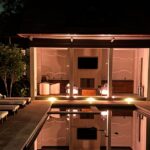
HTSA Green Home Theater Runs on Solar Power
Four solar panels provide 700 watts of power for 19 hours of off-the-grid home theater entertainment each week.
The Home Theater Specialist of America (HTSA) buying group is helping its members sell a high-end home theater to clients who are concerned about energy usage.
Its Guiltless Green Home Theater [watch video on next page] was unveiled this week at the group’s annual spring meeting in Chandler, Ariz. It is the first home theater powered by solar panels, which provide 19 hours of off-the-grid entertainment every week. That’s the equivalent of watching about 10 major motion pictures a week without consuming any energy generated by conventional power sources, such as coal or nuclear.
The system retails for $29,575 installed with a solid dealer margin built into the package. That price includes the solar panels, the complete home theater, and even risers.
But the sellability of the package gets even better when you include the federal and state tax write-offs for solar panel installations. Currently, homeowners can receive a 30 percent tax write-off for the cost of solar panels. In some states, like Pennsylvania and North Carolina, there is an additional state tax incentive of 35 percent.
So with the tax deductions, the solar portion of the installation has a short payback time of less than two years, according to Richard Glikes, executive director of HTSA.
HTSA’s Guiltless Green Home Theater is the buying group's first green home theater project, and is a case study in the use of renewable energy for the consumer electronics industry. The showcase project demonstrates to consumers, custom installers, and consumer electronics vendors that the costs and environmental impact of energy consumed by home theater systems can now be offset using readily available solar technology.
The Guiltless Green Home Theater was installed in a spec home at the Whitehorse residential development in Newtown Square, Pa. Four solar panels were mounted on a southern facing roof of the home. They provide 700 watts per hour during the four and a half usable hours of sunlight each day, for a total of about 22,000 watts over the course of a week.
The home theater room, when used at full capacity, requires about 1,150 watts per hour. That provides about 19 hours of off-the-grid home theater entertainment each week.
Its Guiltless Green Home Theater [watch video on next page] was unveiled this week at the group’s annual spring meeting in Chandler, Ariz. It is the first home theater powered by solar panels, which provide 19 hours of off-the-grid entertainment every week. That’s the equivalent of watching about 10 major motion pictures a week without consuming any energy generated by conventional power sources, such as coal or nuclear.
The system retails for $29,575 installed with a solid dealer margin built into the package. That price includes the solar panels, the complete home theater, and even risers.
But the sellability of the package gets even better when you include the federal and state tax write-offs for solar panel installations. Currently, homeowners can receive a 30 percent tax write-off for the cost of solar panels. In some states, like Pennsylvania and North Carolina, there is an additional state tax incentive of 35 percent.
So with the tax deductions, the solar portion of the installation has a short payback time of less than two years, according to Richard Glikes, executive director of HTSA.
HTSA’s Guiltless Green Home Theater is the buying group's first green home theater project, and is a case study in the use of renewable energy for the consumer electronics industry. The showcase project demonstrates to consumers, custom installers, and consumer electronics vendors that the costs and environmental impact of energy consumed by home theater systems can now be offset using readily available solar technology.
“We all love high-end gadgets and gizmos, but no matter what, they still use a lot of energy,” says Glikes. “Today we’ve taken the guilt out of high-end home entertainment with our debut of the Guiltless Green Home Theater. It’s time we address the energy use of the systems we install, because their environmental impact and expense are not trivial. When people see this project, they’ll learn that a solar home theater isn’t something out of science fiction. It’s a practical solution we can install today, and one that ultimately pays for itself.”
The Guiltless Green Home Theater was installed in a spec home at the Whitehorse residential development in Newtown Square, Pa. Four solar panels were mounted on a southern facing roof of the home. They provide 700 watts per hour during the four and a half usable hours of sunlight each day, for a total of about 22,000 watts over the course of a week.
The home theater room, when used at full capacity, requires about 1,150 watts per hour. That provides about 19 hours of off-the-grid home theater entertainment each week.
Subscribe to the CE Pro Newsletter
About the Author

Jason Knott, Editor, CE Pro
Jason has covered low-voltage electronics as an editor since 1990. He joined EH Publishing in 2000, and before that served as publisher and editor of Security Sales, a leading magazine for the security industry. He served as chairman of the Security Industry Association’s Education Committee from 2000-2004 and sat on the board of that association from 1998-2002. He is also a former board member of the Alarm Industry Research and Educational Foundation. He is currently a member of the CEDIA Education Action Team for Electronic Systems Business. Jason graduated from the University of Southern California.
2 Comments (displayed in order by date/time)
Ahh, summer is here, the time of year for barbeques, fireworks, and weekend camping trips. While everyone notices the heat during the summer, what you may not think enough about is the source of all that heat, the sun, or more specifically solar power. That increased heat during the summer is because of higher concentrations of sunlight reaching the earth’s surface during that period. That increased radiation means that solar panels have more energy to draw from during the summer than the winter.
Page 1 of 1 comment pages


Genius, HTSA!