The 2.35 Home Theater: Benefits and Challenges

The challenges and opportunities of 2.35 constant-height anamorphic projection.

image

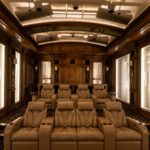
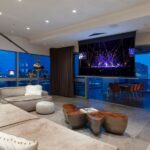
The owner of this theater (systems design and installation by Atlanta-based Design Cinema Privée) wanted a venue that looked like an opera hall, and he got all that and more. The dramatic video comes courtesy of a CinemaScope-widescreen that receives a picture from a Runco 3-chip 1080p DLP projector with an anamorphic lens.

By John Caldwell
August 25, 2008
Cinemascope films have been a vital part of commercial cinema for 55 years.

Larger and more immersive by design, these wide-viewing-angle films have engrossed audiences with projected images that fill nearly the very edges of the peripheral vision.

It has only been in the last two to three years, however, that a growing group of cutting edge specialty home theater dealers have learned how to take full advantage of Cinemascope viewing.

We present a generic primer on constant-height 2.35 anamorphic projection, intended to answer many of the basic architecture and set-up questions that dealers are having with the technology.

5 Benefits of 2.35 Systems


There are many benefits to constant-height 2.35 projection, but here are 5:
  • Increased brightness.
  • Increased perceived contrast ratio.
  • Complete use of the vertical resolution (pixel array) of the digital video chip.
  • Elimination of pesky black bars at the top and bottom of the screen.
  • Larger screen size, wider viewing angle and, with it, the ability to potentially place all three channels behind the screen, like the commercial reference.
Having a wider viewing angle is seen as the last great advantage that commercial movie theaters have over home theaters, but not anymore. Now, home theater dealers can rightfully claim technical superiority when certain practices are maintained.

The constant height paradigm is known by a variety of trade names, including Cinewide or Theaterwide, CineScope or TheaterScope, etc.

Whatever the name, the image is the same height regardless of whether it's 1.33, 1.78, 1.85 or 2.35 material -- only the width of the images changes.

In flat screen monitor viewing, the height and width change with changing aspect ratio material. Similarly, because the screen is inherently larger than a plasma display, clients won't try and stretch a 4:3 image to fill the entire 16:9 display.

12 Challenges of 2.35 Technology


While the benefits are broad-reaching and compelling, there are challenges to the technology as well. These should be of concern to any integrator.

Vertical Stretch
Where does the vertical stretching take place? You can't always assume that it can be done inside of the projector. Many native 16:9 projectors can't do this internally.

When they can't, you must rely on a properly matched outboard video scaler/processor. Remember, the outboard lens is where the horizontal stretching takes place.

Optics
Optics are critical for proper geometry and edge focus. Most lenses do a fair job for the center of the image, and great optics always cost more.

You can find oil- and liquid-filled lens solutions at the low-end and great German-made precision lenses at the top-end of the market.

There are manual and motorized solutions, but leaving something as critical as lens position and focus to the client is a very dangerous thing for an installer to do.

Generally speaking, lens selections made by the projector companies tend to stay in line with the market position of the complementary projector.

Lens Motorization
Manual lens solutions are not often recommended for high-end clients. Motorized is the only way to go in these situations.

Look for quiet and quick- and easy-to-integrate mounting and automation solutions to keep your install, calibration and programming time to a minimum.

Your Focal Distance Will be Shorter
The focal distance (F/D spec) of your projector will change (occasionally for the worse) when an anamorphic lens is used.

If your lens has a focal distance of, say, 1.4:1 to 2.8:1, this means that in order to make a 100-inch wide image, you'll need to have the front of the lens be 140 inches to 280 inches away from the screen.

With an anamorphic lens in place, your focal distance will be shorter. Divide 1.4 and 2.8 by 1.33 and you'll get a new focal distance of approximately 1.05 at the short end and 2.1 at the far end. This means that the new 2.35 image calls for the lens to be 105 inches to 210 inches back.

Gaining some ability to have the lens closer makes for a brighter image and reduces light scatter around the screen. But losing 70 inches from the old 16:9 mounting location could mean that you can't fit the projector in the sofit at the back of the room.

Larger Screens Need Brighter Projectors
After calibration, your projector needs to be at least 12-foot Lamberts, considered to be the minimum screen brightness standard in a completely light-controlled room.

The SMPTE and THX standard, however, calls for 16-foot Lamberts. For reference, cinemas usually produce between 12- and 22-foot Lamberts. A direct view TV produces somewhere close to 35-foot Lamberts.

Lens Insertion Loss
Any anamorphic lens will cause at least a 10 percent loss in available light to the screen. This is important when you are doing acceptable-foot Lambert calculations for screen size or projector brightness.

Consider the same projector with two different architectures: a 1080p projector that claims 1,000 lumens out of the box.

After calibration for high-def color space (CIE re 709) and for the less-than-neutral-colored room, your projector is really putting out only 550 lumens. This is a typical spec today.

On a 100-inch-wide, 16:9, neutral-gain screen, you would be looking at nice bright 18.5-foot Lamberts. Now add a good anamorphic lens and now you're down to 495 lumens.

With a 2.37 neutral-gain screen that is 120 inches wide, you will have only 13.8-foot Lamberts. While not quite THX or SMPTE spec, it's acceptable (but bordering on the absolute minimum). Take into account the bulb's half-life and you are under 12-foot Lamberts fairly soon. So, be careful.

Bigger, wider constant height designs will often necessitate a brighter class of projectors. Fortunately, there is a growing sea of them out there.

Pick Your Screen Carefully
Size matters. In order for constant height, 2.35 projection to realize its full potential, you need to start with a native 2.35, 2.37 or 2.40 fixed or motorized screen.

Try adding motorized lateral masking panels that roll in from the sides of the screen (like the curtains in a commercial movie theater) to adapt to the aspect ratio of the material being presented.

This won't work in motorized drop-down screens as elegantly; the masking panels tend to be fixed in width and drop down like Venetian blinds. However, adjustable masking panels on a CinemaScope screen will yield a perceived higher contrast ratio and, arguably, more of a drama or "wow" effect from your installations.

Acoustically transparent screens, as well as acoustically transparent (AT) masking panels, allow for all three channels -- L, C and R -- to be placed where the film's sound engineer intended them to be.

With the advent of well-woven screens that don't alter video resolution, home theater designers can deliver the same sonic architecture as the commercial movie reference. Most clients will jump at the chance to hide their speakers, get a wider image and achieve commercial reference imaging.

With constant height projection, it's preferable to use good matte white, neutralto slightly negative-gain screens.

The best idea is to use four masking panels: two lateral adjustable masks for picture width and masks at the top and the bottom of the screen. This will accommodate movies that have aspect ratios like 2.4, 2.55 and even 2.70 (without annoying black or grey bars at the top and bottom of the screen).

This four-way masking approach to a native 2.35 screen still allows for maximum video resolution and image brightness.

Are Curved Screens Better?
Curved screens for constant height projection have only one or two technical advantages:
  • helping to correct the pin-cushioning effect of a mis-matched anamorphic lens on a projector mounted too close to the screen
  • possibly helping with edge brightness issues in some higher-gain screens
But, they do add a high degree of "gee wiz" coolness in a theater.

Automating Lens and Masking
Manual 2.35 viewing lens solutions can remove a lot of cost, but giving a high-end client a low-end solution is not recommended. This approach is better suited to the do-it-yourself market.

You're paying for great optics and the ability to move them quickly, quietly and reliably into place for the clients.

Automating the lens positions and masking panels for foolproof operation over a range of sources for the client is highly desirable. You must carefully consider it when properly engineering a constant height projection system.

Look for the projector and lens suppliers as well as the screen suppliers to have their act together on this.

One simple way of automating is to pre-program one's scaler processor to automatically move lens and masking panels into place via a 12-volt trigger when a particular source, like a Blu-ray player, is selected on a separate HDMI input to the scaler.

Look for simple solutions like this when planning your equipment selection.

2.35, 2.37 or 2.40 Choices
Technically, the screen you select may be one of three different aspect ratios. Be careful, especially when tight tolerances or things like cabinetry or millwork are involved.

2.35 is an aspect ratio on the DVD box. But there is a case to be made for 2.37 too. 2.37 is the actual aspect ratio of a screen with a native 16:9 projector and a 1.3333 anamorphic lens in front of it.

If you multiply 1.777 by 1.333, you get 2.37. This is the exact aspect you will be projecting when the anamorphic lens is placed in front of the 16:9 native projector's OEM lens.

As if all that isn't confusing enough, the 2.35:1 ratio isn't entirely accurate. At least, not in the way it's commonly used today. Early CinemaScope movies and pre-1970 Panavision movies were actually shot in 2.35:1, but the ratio has since become shorthand for anything done in super-widescreen.

Today, CinemaScope and Panavision both use 2.39:1. Many of the films that people refer to as being 2.35:1 are actually shot in 1.85:1 or 2.39:1. 2.39:1 is commonly rounded up to 2.40:1 (as seen in ads for Runco and Stewart FilmScreen).

Viewing Angle & Seating Distances
Most of the standards for viewing angle and seating distances for home theater were largely taken from research done in commercial movie theaters in the last century -- certainly well before the advent of 1080p sources and 1080 projection.

Most of these standards were developed for the last row of the commercial movie theater as the so-called (albeit debateable) money seat.

You may see formulas that range from 1.3 to 2 times the screen width for minimum seating distance. These are good examples of viewing formulas that were developed in the last century.

One useful formula is to take seating distance at 0.90 for those who like to sit in the middle third of their commercial movie theater and at 1.0 for those who like to sit in the first third of the commercial movie theater.

This is a great qualifying question to ask your clients early on in the design phase of your consultation. "Where do you like to sit in the commercial movie theater – in the bottom third of seats, the middle third or the top third?"

The answer to this will tell you a lot, especially about the client's preferred viewing angle.

Demo Material
Any blockbuster film shot in CinemaScope is a good candidate for constantheight 2.35 anamorphic projection.

But with Blu-ray (and the late great HD DVD) format, the following movies are great for demonstrating the benefits of anamorphic viewing and the projector's attributes, like deep color saturation, natural skin tones, deep black-level and wide contrast ratio:
  • "Seabiscuit"
  • "Tombstone"
  • "The Fifth Element"
  • "Star Wars: The Phantom Menace"
  • "Transformers"
  • "Bourne Ultimatum"

How 2.35 Cinemascope Works


The black bars displayed by inactive pixels when watching a movie using a 16:9 format screen are eliminated when using the constant height projection scheme.

When black bars are present, they imply a consequent loss of the available resolution.

To fully use a projector's resolution, the active frame is stretched vertically. Doing so makes every pixel active, and the brightness level is greatly enhanced.

An anamorphic lens is then moved in front of the projector beam (manually or automatically) in order to magnify the aspect ratio of the picture back to the original 2.35:1 movie format. The resultant picture is extremely detailed.

It allows the use of exactly what the market is asking for: screens that take up entire walls.

This same process can be used to enjoy broadcast HDTV and other 16:9 sources. High-definition sports in CinemaScope is a blast.

There will be a loss of a small percentage of the top and bottom of the native picture, but the experience will be hard to beat.

The History of Cinemascope


The process of anamorphosizing optics was originally used to provide a wide-angled viewer for military tanks.

Developed by French professor Henri Chrétien during World War I, the optical process, called Hypergonar by Chrétien, was capable of showing a field of view of 180 degrees.

After the war, the technology was first used in a cinematic context in the short film "Construire un feu" in 1929 by French movie director Claude Autant-Lara.

Anamorphic widescreen was not used again for cinematography until 20th Century Fox bought the rights to the technique in 1952 to create its CinemaScope widescreen technique. CinemaScope was one of many widescreen formats developed in the 1950s to compete with the popularity of television and bring audiences back to the cinemas.

"The Robe," which premiered in 1953, was the first feature film released filmed with an anamorphic lens.

Although CinemaScope was capable of producing a 2.66:1 image, the addition of multi-channel sound reduced this to 2.55:1.

Theater owners, however, were dissatisfied with contractually having to install three- or four-track magnetic stereo. Drive-in theaters had trouble presenting stereophonic sound at all because of the technical nature of installations.

Due to these conflicts, Fox revoked its policy of stereo-only presentations. They added an optical sound track while keeping the magnetic for theaters that chose to present their films with stereophonic sound.

The addition of the optical soundtrack reduced the width of the presented aspect ratio further to 2.35:1.

Wider viewing angles and closer seating to the screen are possible due to lack of noticeable pixelization in today's 1080p systems. Larger screen sizes are also seen as a contributing factor to the popularity of constant height projection.

At a 10-foot viewing distance, a screen needs to be at least 70 inches diagonally or larger to see a difference between 720p and 1080p resolution. Since most 2.35 screens are much larger than 70 inches and most home theater seating is at least 10 feet back, 1080p and constant height viewing seem to be a perfect match for one another.

Runco Brings 2.35 to the Home Market


The tools for creating constant-height 2.35 anamorphic projection in the home have been around for many years.

But it took the campaigning of a few industry veterans, most notably John Bishop, principal of New England-based rep firm Bishop Audio Services, to gain the attention of Sam Runco and the team at Runco to make constant-height projection a force in the marketplace.

Bishop convinced Runco and his engineers to dust off the technology and take a second look at it as a means for better positioning their business and creating a distinct performance advantages for dealers.

Of course, the arrival of 1080 sources and 1080 projection were certainly contributing factors as well.

Today, Cinewide is the centerpiece of the Runco product mix. It is estimated to be an attachment sale to 50 percent of the company's overall projector sales.

News spread pretty quickly, and now several other specialty projector and screen suppliers have taken up the challenge of constant-height projection. Each month, the range of quality and price points in this segment grows.

Still, many dealers remain on the outside looking in.

John Caldwell is co-founder and director of sales at StJohn Group Inc. He can be reached by e-mail at .(JavaScript must be enabled to view this email address).


Return to full story:
http://www.cepro.com/article/the_235_home_theater_benefits_and_challenges/