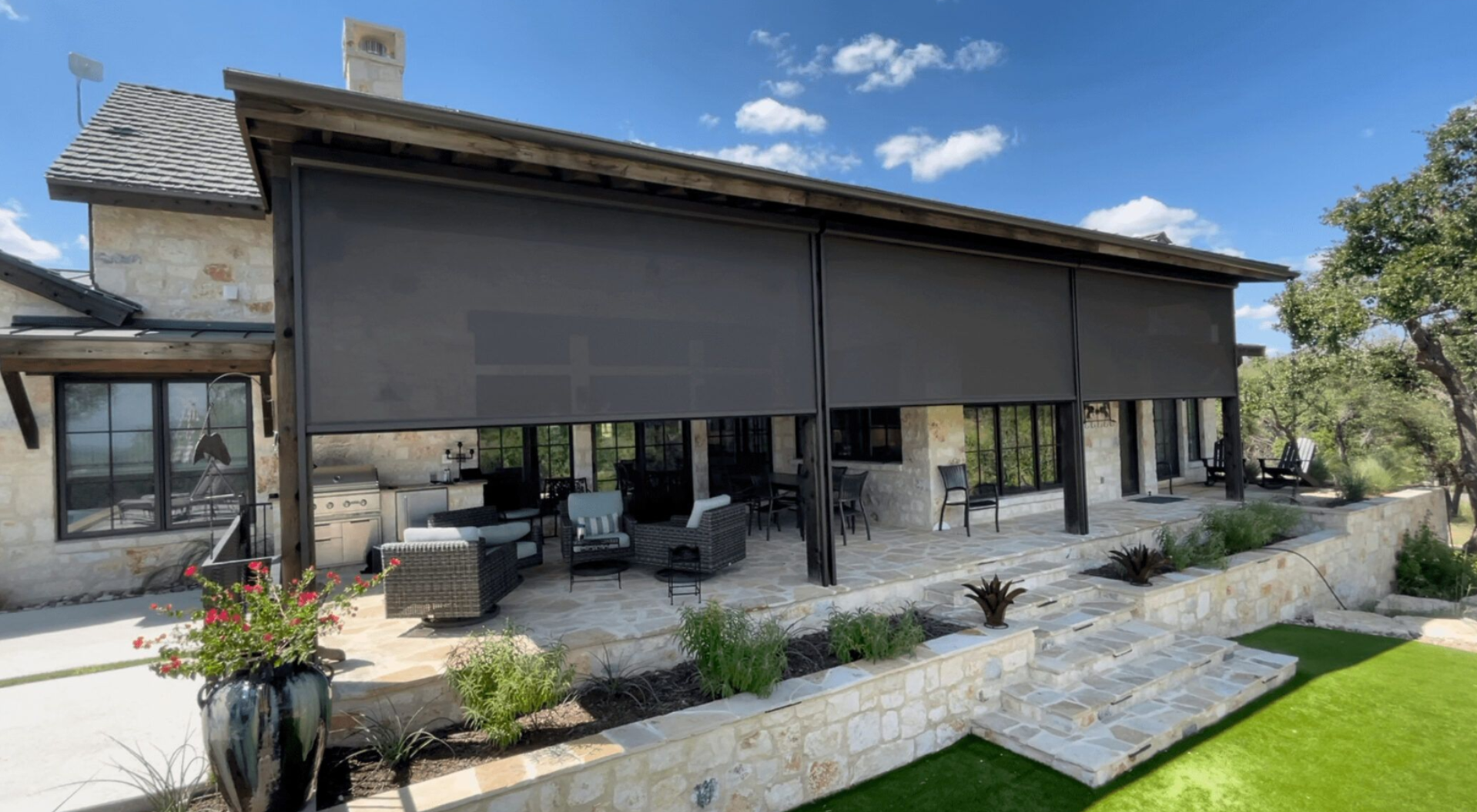
A stormier southern winter outlook and forecasts of record global warmth in 2027 make outdoor shading a year-round planning consideration. For custom electronics integrators, that means coordinating solar control with mounting requirements, motorized operation and product-specific wind precautions. Patio shade specifications must account for seasonal exposure while keeping homeowner expectations grounded in each system’s capabilities and limitations.
What Does the 2026-2027 Weather Outlook Mean for Shading Plans?
National seasonal outlooks and global temperature projections describe broad patterns, rather than a particular patio’s summer conditions or local demand for shades. The El Niño pattern is also expected to fade by spring, so the winter outlook should not be treated as a prediction of hotter local summer conditions or higher shade demand.
The value of those forecasts for integrators lies in establishing a planning context. Site exposure and product specifications should guide individual projects, with precipitation forecasts kept separate from site-specific wind-exposure assessments. Forecasts should prompt product-specific questions rather than replace installation documentation.
The National Oceanic and Atmospheric Administration favors wetter-than-average winter conditions across the southern United States, from California to Florida. National Weather Service Director Ken Graham explains that El Niño shifts the jet stream, which “tilts the odds toward stormier weather across the South.” That outlook supports discussing seasonal exposure without predicting wind conditions at an individual residence.
Separately, Met Office climate scientist Nick Dunstone says large El Niño events release significantly more heat from the ocean to the atmosphere, especially in the calendar year after the winter peak. He adds that “2027 is very likely to replace 2024 as the warmest year on record.” This global projection provides context for solar-control planning, rather than a location-specific summer forecast.
Wind management also differs by product type. Folding-arm awnings project outward, while vertical patio shades use a different mechanical arrangement. For vertical screens, the guide system matters alongside the fabric. Matt Pierce, whom Shading Texas‘ site describes as having worked in the solar shade industry for more than 15 years, in settings from Alaska to Texas, explains that retractable screens resist wind differently depending on the fabric and how it is attached to its guides. In that guidance, zipper-style guide rails, in which the fabric is welded to a zipper-like mechanism along its length, offer the best resistance to strong winds. Systems that anchor the fabric only at the top and bottom leave the sides with minimal support and suit lower winds, and string-guided designs resist only low-speed wind. Integrators comparing proposals can use that distinction to ask which guide system is specified and what wind conditions it is intended for.
For an awning-specific example, Shading Texas, which installs motorized awnings and screens in Austin and San Antonio, says it “includes a wind motion sensor with all of its patio awnings.” The sensors can trigger retraction when wind movement activates them, offering a practical example of weather-responsive automation. The company describes the sensors as detecting high wind speeds — when one is triggered, the awning retracts toward the house, and the homeowner can redeploy it once the wind dies down. For screens, its motorization page lists timers and wind sensors for automatic retraction during severe weather among its additional automation services, so integrators should confirm whether a given proposal includes them rather than assume it. Integrators should treat that feature as a risk-reduction measure, with operating limits and storm procedures established for the selected assembly.
What Is the Installation Process for Motorized Shades?
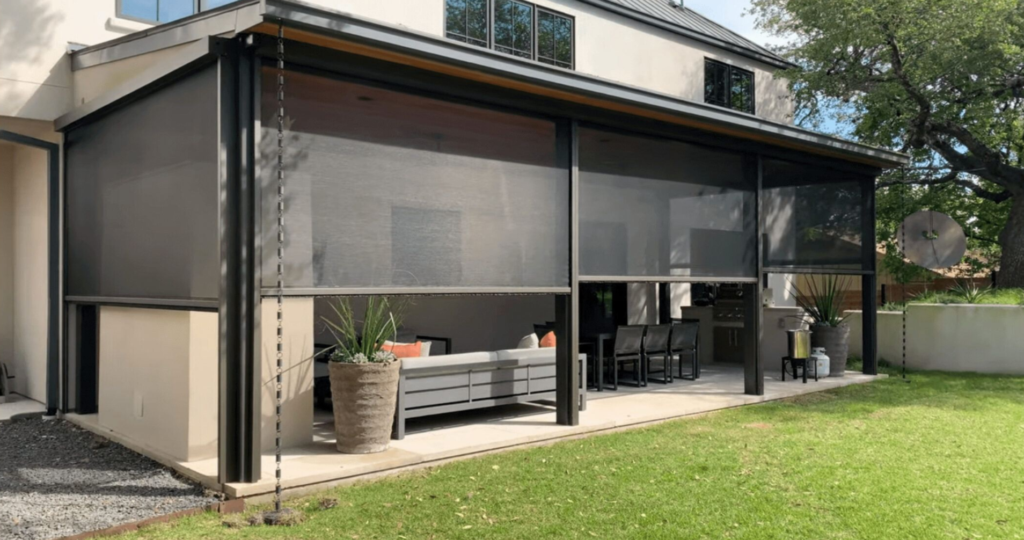
Motorized patio shades compatible with Amazon Alexa and Google Assistant. Project by Shading Texas.
Motorized exterior shade installation typically combines housing and guide mounting, roller-and-motor assembly, power coordination and programming. The exact sequence depends on the selected product, mounting conditions and control platform, so integrators should treat the process as a planning framework rather than a universal assembly procedure.
The workflow generally follows five coordinated stages:
- Assess the opening and mount the housing: The installer evaluates the mounting surface, structural backing and housing position before fastening the cassette. Product-specific requirements should govern fastener selection and alignment. If the substrate is uncertain, the installer should refer it to the appropriate construction professional.
- Secure the retention tracks: The installer positions and fastens the side guides according to the system’s instructions. Track installation is a functional requirement for exterior shade systems that use retention tracks, particularly where wind exposure is a concern.
- Install the roller and motor: The installer assembles or positions the fabric tube, drive motor and supports as the product requires. Factory-preassembled components may change the order or extent of work performed on-site.
- Coordinate the power connection: The electrical scope must match the specified motor and approved wiring arrangement. Integrators should confirm supply requirements for the selected shade platform rather than assume interchangeability across motorized systems.
- Program and commission the system: The installation team sets travel limits, pairs controls and establishes the supported automation connection. Commissioning should verify movement and control behavior before handover, including any limitations in position feedback documented for the chosen integration.
Can Homeowners Install Motorized Solar Shades Themselves?
Large exterior shades warrant professional assessment because successful installation extends beyond attaching a motorized roller. The scope includes mounting conditions, retention hardware, measurements and electrical coordination, making a product-specific review more useful than a blanket comparison with simpler interior shades.
When homeowners ask whether they can install motorized solar shades themselves, integrators should explain the work involved before discussing control features. Construction experience and installation training are relevant considerations, and so are whether mounting involves brick, stucco or rock and whether tracks will be recessed. Those variables affect the expertise needed for the project.
Measurement accuracy presents another practical concern. Field dimensions should be formally checked before ordering custom products, and integrators should establish who verifies dimensions and approves the order before fabrication begins.
Cross-trade planning should happen before finishes constrain access. Integrators should define responsibility for dimensions, recesses, wiring locations and commissioning early, then identify which tasks require shade-specialist, electrical or construction support.
What Is the Difference Between Solar Shades and Solar Screens?
The useful distinction is between fixed-frame panels and retractable roller systems, rather than two mutually exclusive fabric categories. Solar-screen materials are used in fixed and retractable applications, so terminology alone may leave the actual operating mode unclear.
In its operational comparison, Phifer, a manufacturer of insect screening, solar control fabrics and outdoor fabrics, states that conventional screens are “fixed within a frame and remain” in the opening, while roller shades retract when needed. Before comparing controls or installation scope, the proposal should clarify whether it concerns permanent screening, manually operated roller shades or motorized shades.
That operating difference shapes the homeowner experience. A fixed panel continues filtering the opening while installed. A retractable system allows the fabric to move out of the opening, providing flexibility when unobstructed views or additional daylight take priority. The cassette, tracks and other permanent hardware still require consideration during architectural planning.
Seasonal operation adds another specification question. Integrators can discuss when clients prefer an open patio and when deployed fabric is desirable for sunlight management. Phifer notes that greater blocking reduces outward visibility, making fabric selection a balance between light control and the desired view.
Maintenance and weather procedures also deserve separate review. Retraction offers an operating option, but it should not be presented as proof of longer service life or guaranteed storm protection. The selected system’s care instructions and exposure limits should determine the operating plan.
Where Can Homeowners Find Motorized Solar Shades for a Patio?
According to Shading Texas, homeowners can buy motorized solar shades for patios from online suppliers, home improvement retailers and local shade contractors, so the best source is the one whose proposal covers on-site measurement, installation and automation support. These factors consequently matter more than the sales channel.
Sourcing Routes to Evaluate
A procurement review should identify which responsibilities each proposal includes. Three channel-specific checkpoints can structure that discussion:
- Direct online retailers: Before comparing hardware prices, confirm who is responsible for field measurements, mounting assessments, electrical coordination and installation.
- Home improvement centers: Integrators should establish who performs installation, what that scope includes and whether the specified motors support the required home automation connection.
- Local specialty shade contractors: The proposal should specify whether it covers on-site measurements, retention hardware, programming, commissioning and continuing service.
On cost, Shading Texas says each motorized patio screen project is priced individually, based on the size and number of openings, mounting requirements, screen fabric, controls and installation details, with exact pricing following an on-site measurement and proposal. Its own guidance acknowledges that motorized screens cost more than nonmotorized ones and bring maintenance and power considerations, so a quote that skips those topics is worth questioning.
Homeowner-controlled responsiveness should be kept separate from automatic wind sensing, which requires separate product confirmation.
What to Ask an Installer
Installer selection should establish scope and accountability before equipment is ordered. Relevant questions include:
- Survey and schedule: What does the site assessment cover, and who confirms installation and commissioning dates?
- Sensors and controls: Which weather functions and automation interfaces does the specified assembly support?
- Materials and guides: Which mesh, openness percentage and guide system are specified for this opening, and what wind conditions are they intended for?
- Crew: Will employees or subcontractors perform the installation?
- Equipment coverage: What separate warranties cover frames, motors, electronics and fabric?
- Installation coverage: Which issues does the contractor cover, and for how long?
As a workflow example, Shading Texas says its process includes measurement, custom design and proposal, with an “onsite check to ensure a flush fit and a transparent proposal on a clear timeline.” The company also says the majority of motorized patio shade installations are “completed in a single day, but larger or particularly complex projects could take longer”.
Planning for a Stormier, Hotter Future
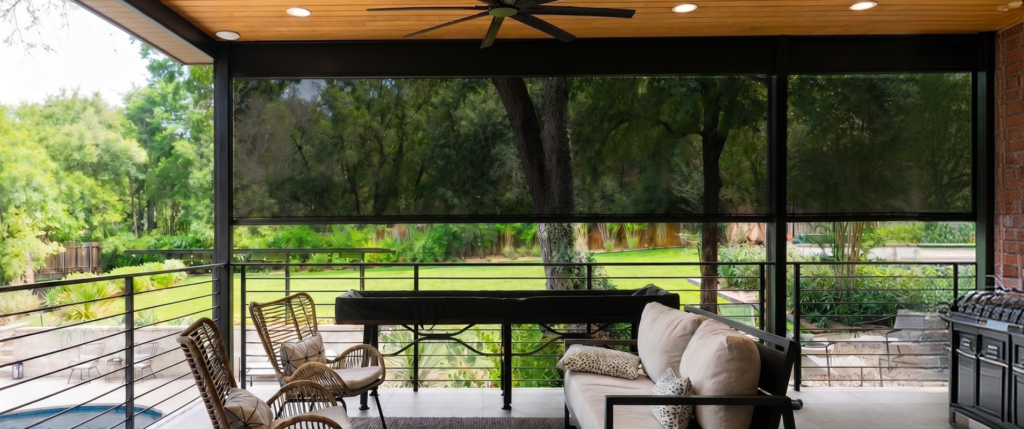
Motorized patio shades in Central Texas. Project by Shading Texas.
Outdoor shading belongs within the environmental-control discussion alongside its architectural role. For integrators, broad weather outlooks provide a reason to review exposure, solar-control priorities and operating expectations before equipment selection.
The practical response is system-specific. Awning wind sensing, vertical-shade retention, fabric selection and automation compatibility each require their own assessment. A global temperature projection should inform that conversation without becoming a promise about local temperatures or future patio use.
Early coordination among shade specialists, builders and electrical trades can help establish a workable installation scope. Clear documentation of mounting responsibilities, control behavior, maintenance procedures and warranty coverage gives residential clients a more grounded basis for choosing outdoor shading across changing seasons.