Recent News

Whole-House Surge Protection Offers Computer-Grade Power
Traditional surge protection isn't enough for home systems; it takes sophisticated filtering to protect the life and performance of today's electronics.
image

06.13.2008 — Why do good systems go bad? How can processors misread information, and why don't these systems last their designed life?

Power quality and surge protection expert William Goldbach -- a Life Senior Member of the Institute of Electrical and Electronic Engineers (IEEE), has spent many years as an electrical engineer identifying the relationship between clean power and control systems performance.

"There is no rocket-science to this puzzle. Dirty power degrades and destroys electronics," he says.

The Surging Damage


Goldbach explains that microprocessors read information through current pulses as binary code (0s and 1s).

As equipment is turned on and off, voltage and current pulses, known as transients, are generated. These pulses of energy are distributed throughout every piece of equipment in the system.

"Depending upon the size and frequency of these pulses, the results will vary. As microprocessors try to function, these transient pulses of energy can cause lock-ups or data can become lost or corrupted," he says.

"Larger pulses will cause catastrophic failure while smaller pulses degrade the life of these systems and controls."

Indeed, over 80 percent of all damaging transients are generated internally by loads cycling. Less than 20 percent are generated externally by lightning or utility grid switching.

Traditional surge protection just isn't enough. It takes sophisticated filtering to protect the life and performance of today's electronics.

A quality surge protector mounted at the main electrical service entrance will lower the energy of a large, externally generated surge. But without enhanced transient filtering, it will do very little to address the hundreds of surges generated internally daily.

These events happen in every home every day.

To properly guard electrical and electronic equipment, a staged approach must be implemented. Whole-house surge protection with enhanced transient filtering mounted at each breaker panel provides the highest level of protection, offering "computer-grade power" to every circuit in the home.

Plug-in suppressors just don't have the energy-handling characteristics necessary to address the "big hits."
Rack-mounted power filters are excellent protection devices to protect A/V and control equipment, but it is impossible to install these types of protection devices on every piece of equipment in the home.

Security systems, lighting controls, flat-panel TVs, washers, dryers and refrigerators are all microprocessor-controlled. This equipment can be most cost-effectively protected at the breaker panel.

Installing panel-mounted protection with enhanced transient filtering will insure that the power fed to rack-mounted protection will never exceed the rack-mount unit's ability to operate at peak performance.

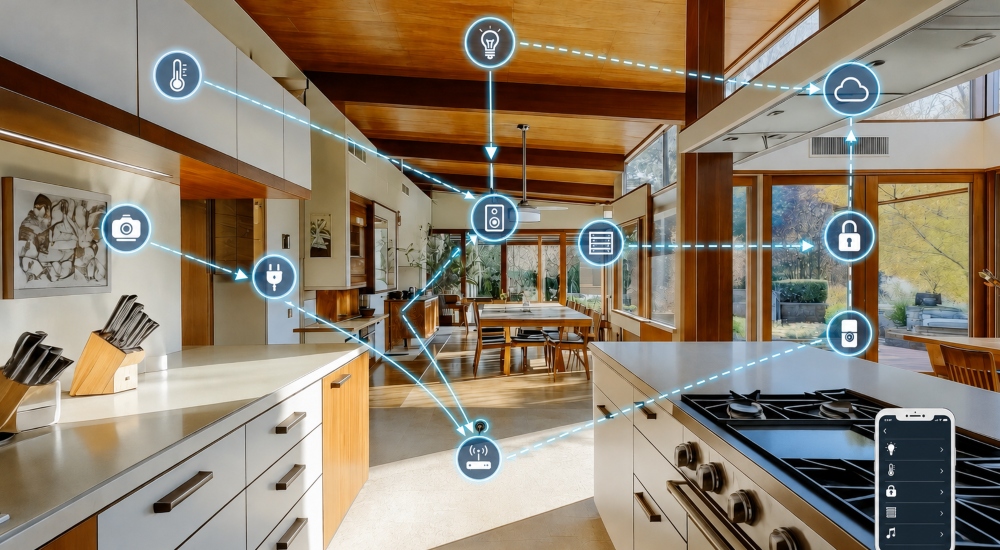
Protecting the Connected Home


Ten years ago, we dreamed of building an intelligent home.

"What if we could control humidity, temperature, lighting and security all from a wireless handheld controller the size of a small writing tablet?" we asked. Today's technology enables us to do this and much more.

Systems can now store and play thousands of movies and songs, adjust lighting levels (inside and out) with the touch of one button, control temperature and humidity based on occupancy, time of day or schedule and view security cameras from thousands of miles away.

This is the electronic age, and every day we can accomplish a greater number of things faster and with greater ease. The custom homeowner wants convenience and is willing to pay for it.

Custom integrators pride themselves on offering and installing the latest and greatest, giving homeowners myriad products for living the ultimate home electronics lifestyle.

Why is it, then, that what was designed to be convenient can become a complex nightmare?

Constantly reprogramming systems and replacing processors, boards and components becomes a never-ending battle. Occasional glitches in the system are as simple as lights turning on and off without user input.

Other times, though, the entire control system may shut down. And this tends not to sit well with the client.

One Central Florida homeowner, Mr. Sechler, recounts his experience: "We brought technology into our home to set a standard of convenience and control, and I had no idea it would require a live-in technician to keep it all running."

Supply power is the most significant part of the power quality equation, but not the complete answer. Telephone, data lines, CCTV and any other copper line entering the home can be susceptible to damaging transients.

A properly engineered protection scheme identifies all exposure points with protection.

Bob Levit is principal of Total Protection Solutions, a manufacturer of power protection products.

Subscribe to the CE Pro Newsletter

Get the latest news, products and more delivered straight to your inbox.
This entry has been viewed 3393 times.

tags
Subscribe to the CE Pro Newsletter
Subscribe to Email Alerts
Subscribe to the newsletter today! 

tagsThis Article Tagged

tagsNews Feeds

tagsSocial Bookmark
Submit to: , Digg, Delicious, Slashdot, Reddit, MyYahoo!, Google, Technorati, Learn about social bookmarking

Comments

Posted by Tuck  on  06/13  at  08:43 AM

I would like to see a third party white paper or a university thesis that details the real truth out all of this. It would likely filter out the marketing hype and scare tactic and leave us with what is actually the best solution. Never concede to a marketing department as 100% truth. smile

Page 1 of 1 comment pages
Post a comment

Name:

Email:

Choose smileys | View comment guidelines

Remember my personal information

Notify me of follow-up comments?

Please answer the question below:

Type the 2nd letter of the word "television":


Rate this article
You must be logged in to rate articles. Login or register.
  • Currently 0/5 Stars.
  • 1
  • 2
  • 3
  • 4
  • 5
Average score: 0 / Total votes: 0