Getting in Front of Architects, Interior Designers and Builders

Why some integrators take a booth at trade shows, what they display and why.

image
By Tom LeBlanc
April 06, 2007
The decision to take a booth at a show -- a home show, a design show or such -- is a tough one. For custom-electronics integrators, it usually means shipping expensive components, setting them up in a public environment and taking valuable employees off jobs to man the booth.

So it better be worth it.

Five Boston area integrators decided that it was worth it to exhibit at the Residential Design and Construction (RDC) 2007 in Boston this week. The show is attended by architects, interior designers and builders. There is also a short window when consumers can walk the floor.

All five integration companies stressed that the audience was key in deciding to exhibit. We talked to them about why that is and what they decided to show these architects, designers and builders.

Educating Architects on Control


Demographically speaking, architects and interior designers are working with the clients smartHome wants, says president Mark Komanecky.

smartHome is a somewhat unique integration company, he says, because it started out primarily offering home control and evolved into including audio and video, as opposed the reverse route. As a result, he says, "We do a lot of high-end jobs."

It doesn't have to be all about high-end jobs, though, and that's a major reason why Komanecky wants to be in front of this audience. "We see ourselves as a company that can provide a lot of information and education about where our industry is going."

He wants architects, interior designers and builders to know that the industry is moving toward a more affordable control model. He says prices are falling -- also with A/V products -- making almost all architects' and interior designers' clients logical integration candidates.

"Also, we are still a small company," says Komanecky of smartHome, which originated in Westborough, Mass., added a "satellite" location in Stowe, Vt. and recently opened a location in the Philadelphia area.

"We can provide a high level of interaction on [interior designers' and architects'] projects. And we fit in well with the design community," he says.

Touting the Benefits of Getting in Early


You can say that Audio Video Design (AVD) uses a less technical approach to luring architects, designers and builders to its booth ... cake. The Newton, Mass.-based company with branch offices in Nantucket, Mass. and Osterville, Mass., is celebrating 35 years in business.

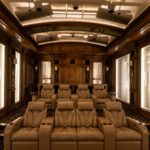
Keeping with the non-tech theme, AVD chose to use static displays instead of actual components in its booth. Large photos in the booth depict technology in lifestyle settings -- home theaters, great rooms, kitchen control, plus a slick wiring job.

The idea, says system designer Ralph Catino, is to show architects, designers and builders the value of getting a integrator on the job early. The wiring shot shows the ambitious work that needs to be down before the walls go up, and the other shots show the fruits of that ambitious work.

There was one actual component in the booth, a Crestron tablet. During conversations with attendees, Catino says the tablet serves as a means of letting the potential partners interact with a control system so they can understand the benefit for their clients.

Early Integration Means Upgrade Opportunity


Getting architects' ears is important for AViX, according to Rusty MacDonald, who does business development for the Osterville, Mass.-based integration company. In fact, it's a big part of his job.

Partnering with architects benefits all parties involved, he explains. It allows integrators to get in early and provide the infrastructure for any level of home technology. The architects or builders benefit because they're able to sell technology upgrade options. The homebuyers benefit because they get to choose from those options and ultimately get a home that meets their needs and is upgradeable.

In addition to getting architects' ears, AViX looked to grab their eyes. The company put together a display that stresses whole-home automation, multiroom audio and home theaters. The booth has several components from Savant Systems' Rosie line of home control products and its plasma display. Savant president Jim Carroll, by the way, used to work for AViX.

The Savant plasma sits above a faux fireplace, and that setup generates interest from builders. Builders can be heard talking about how it's something they are frequently asked to provide, and AViX attendants can be heard saying that the flat panel over the fireplace "solves a problem" for architects, but it can be a complicated installation. It gives them the opportunity to talk about venting issues and segue into the need for expert consultation.

Making Friends with Lots of Benefits


A show like RDC makes sense for Elite Media Solutions because it's all about collaboration, says co-founder Brian Gibson. Partnering up with interior designers, builders and architects and teaming up with other trades is a foundation of Elite's business.

"There are a lot of integrators who like to say they do everything 'in-house,'" says Gibson. He adds that Elite knows it does certain things really well and feels comfortable contracting out other tasks.

Even Elite's booth was about collaboration, as lighting partner Michael Hughson of Billerica, Mass.-based Signature Lighting was on hand. When Elite renovated its Wellesley, Mass., show house in 2005, it called on Signature Lighting to provide the lighting. Now, when Hughson wants to demonstrate lighting to a client, Elite lets him bring them into its showroom since Signature doesn't have one.

It's a give-and-take, mutually beneficial relationship and Elite looks to forge others at the show. "That's why we're here," says Gibson. "We need to make contacts and get into jobs early."

For Elite, it's also about showing the technology that's made easier by pre-wiring. Like AViX, Elite opts to show a flat panel over a faux fireplace. The company, which recently exhibited at Boston's Flower Show, also displayed some of its outdoor technology capabilities.

Bright Opportunities for Lighting Control


Lighting control is on the Custom Electronic Design and Installation Association's top 10 must have technologies list, which was widely discussed at the recent International Builders Show and Electronic House Expo. Maybe the guys at Hingham, Mass.-based Advanced Communication Technologies (ACT) saw that list.

They chose to put lighting control in front of builders, interior designers and architects at RDC in the form of a doll house. Actually, it's a little model home provided by Lutron that demonstrates different lighting settings of Lutron's Radio Ra system. Next to the doll house is an AMX control panel that attendees can pick up and learn how to switch lighting scenes.

Lighting and lighting control makes sense for architects and designers, says project manager Bill Gerber, because it's a way to highlight the great work they do. "If you're a designer who has chosen a great piece of artwork for a home, lighting can enhance that," he says.

There is more to the ACT booth than lighting control as multiroom audio is also heavily emphasized. The company chose to use Niles components and to show that iPods can be incorporated into a Niles multiroom audio system.

Just in case any of the attending builders, architects and designers missed anything, ACT runs a slide show of its design-friendly installation photos on a Fujitsu flat-panel TV.


Return to full story:
http://www.cepro.com/article/getting_in_front_of_architects_interior_designers_and_builders/