All learnin' ain't done with books, but understanding the laws of physics isn't likely to hurt a guy either.
Dennis Erskine is one who, whether by design or by chance, knows that fact intimately.
Armed with a strong educational background that has earned him membership in the Society of Motion Picture and Television Engineers (SMPTE) and the Institute of Electrical and Electronics Engineers (IEEE), Erskine, it's safe to say, takes sound seriously.
His acquired knowledge of the subject hasn't hurt him, or his company, Atlanta-based Design Cinema Privee (DCP), in the least.
The Educational Edge
Harnessing life's little ironies, Erskine struck an unlikely balance in the early days, venturing out into the world as a musician with a physics degree from the University of Utah.
"My interest was in the physics of acoustics and sound isolation," he explains.
Quick Stats
- Company: Design Cinema Privee
- Location: Based in Atlanta, with offices in Austin, Dallas and Minneapolis
- Principal: Dennis Erskine
- Years in Business: 11
- Affiliations: THX, HAA (Home Acoustics Alliance), The Home Shoppe, Imaging Science Foundation (ISF), Custom Electronic Design & Installation Association (CEDIA)
- Memberships: Society of Motion Picture and Television Engineers (SMPTE), Audio Engineering Society (AES), Institute of Electrical and Electronics Engineers (IEEE).
- FYI: "Imagine what you could do if you could do all you imagine."
Merging his love of music with his mastery of science, Erskine designed recording venues and practice rooms for other musicians. It made a lot of sense, but not a lot of dollars.
He ended up ditching that career for one in corporate IT, but continued doing room design for recording studios as a hobby. He eventually ditched IT, too.
Musing over those early days, Erskine says, only half-jokingly, "I was an angry young man. I got fed up with the massive, multi-national corporate environment and started my business designing cinema 15 years ago."
The educational edge Erskine brings to his business has brought clients in return. Although the company originated doing the architectural and acoustic design for rooms, it's become very focused on home theater over time.
The demand was definitely there.
"People come to us not necessarily because they want a home theater. They want one that sounds right. When you separate the wheat from the chaff, at the end of the day, the most important part is the room itself. It will determine if you have a pleasant environment or an unpleasant one.
"It was the most ignored part of the chain (in the industry) for many years. There's no way an $80,000 speaker can overcome the laws of physics. If you put it in a bad room, you're going to have bad sound."
The Divine Design
Although DCP has evolved to offer full design services, installation services, trim and finishes, acoustic treatments and fabric installation, components, project management and automation, acoustic analysis remains the most important ventricle at the heart of the company.
Whether customers opt for DCP's "Custom" design plan, "Select" design plan or the Dennis Erskine "Signature" plan, which is the most in-demand, Erskine performs acoustic analysis for assessment of reverberation times and room modes for all of them.
All three plans also include sound isolation construction techniques and methods to ensure proper screen size, speaker and subwoofer placements, sound treatments and seating locations.
All three plans are contingent, though, on DCP being engaged to do the design up front. "Until we do the design," Erskine explains, "we don't know what we're building or what equipment is appropriate and we can't discuss a budget."
He adds, "Once the design is done, the homeowner can take it to whomever they want, but they usually stay with us. We talk about what our future involvement will be. It could be that their architect and contractor will build and we'll come in once a week and supervise and inspect. Sometimes they say they don't want anyone else touching it and then we do assign a project manager who is on it all the time."
Regardless of who the project manager ends up being, most everything comes back to Erskine, who spends most of his time designing the acoustic spaces and handling client contact.
Sound Scope, Isolated Process
Although DCP has a large installation warehousing and installation facility in Atlanta and the majority of its 30 employees are based there, clients span the globe.
They're usually super high-end and wish to remain anonymous. DCP doesn't deploy work vans with its logo in order to protect that anonymity.
Bio Snapshot: The Sky's the Limit
Teaching is inherent to Dennis Erskine, who, in addition to be a principal of Atlanta-based Design Cinema Privee, is an FAA-certified flight instructor.
Erskine is often spotted soaring over Atlanta when not designing theaters. "We all have various passions and, for me, flying is a tremendous method of forgetting about the day," he says.
"You have to be so focused on what you're doing when you fly. It's so beautiful up there and it's the ultimate sense of freedom you get as a human being." Design Cinema has its own six-passenger plane it uses to fly to its various job sites.
"I enjoy teaching," he says. "Whether it's flight instruction or CEDIA and Home Acoustics Alliance classes, I enjoy passing on what I've been given."
Erskine has crews that travel across the U.S. to do room construction or supervise the contractors doing it. For jobs in remote places like Bosnia, Spain, England, Denmark and Greece, DCP provides the detailed construction drawings, materials list and communicates by phone or e-mail with the contractor on site.
"When the room is calibrated, that audio calibration is a three-day process," Erskine explains. "That means flying there and doing it. Most jobs are in the U.S., but the ones outside the country are larger in budget. In raw numbers of jobs, 10 percent are out of the country. But in terms of dollars, 25 percent are out of the country."
Although builders do bring DCP in on jobs, the company, by and large, deals directly with the homeowner.
"In new homes or retrofits, where they've engaged an architect and a contractor," Erskine says, "the contractor installs the drywall, does the rough electrical and HVAC and we do what we need to do with the sound isolation components and finish it out from there."
Sound isolating a room is serious business to Erskine, but he does approach it with some levity. "From my perspective, I really don't care if I wake the baby, but I don't want to hear the baby when it wakes up," he quips.
"The first things to consider are the physical constraints and dimensions of a space. They drive an awful lot of what the ultimate bill of materials will be in the room and drive the budget. A room with 24 chairs will obviously cost more than one with eight chairs."
He adds, "The first thing we look at in the construction diagram is how we can sound isolate the room. A movie's sound is 22 dB, and residential noise is 30, so you'd have to turn up the sound a lot to hear the quiet whispers. Then when the loud scenes come up, you'd have to turn down the volume control and lose audio, so sound isolation becomes critical in putting the room together."
The DCP Design Plan Menu
For Atlanta-based Design Cinema Privee (DCP), of fering a good, better, best approach to design plan options is a good way to gauge the level of service being purchased by its customers.
The DCP "Custom" design plan is geared toward "do-it-yourselfers" and includes architectural drawings for the floor plan, elevation, framing, electrical, lighting, low voltage, stage/proscenium and soffits.
There's unlimited e-mail support during the process and DCP will provide the customer with a complete list of acoustic materials, lighting fixtures, seating, and fabrics and can also offer full configuration and equipment recommendations.
The DCP "Select" design plan is for the more experienced do-it-yourselfer or contractor. It includes everything in the Custom plans plus more elaborate lighting and prosceniums, complete wall treatments and phone support for the customer and their builder or contractor(s) during the project.
The "Dennis Erskine Signature" plan is DCP's most requested plan, whereby DCP basically does it all. Customers visit personally with Erskine to discuss the design and build out.
He specifically details and provides samples of all millwork, carpet, paint, trim, fabrics, finishes and all other elements forming the interior design of the theater and lobby area.
The designs include, as appropriate, details of lifts, motorized controllers and custom screens. DCP does frequent onsite visits and its crews install all fabric and acoustic treatments and also conduct full audio/video calibration.
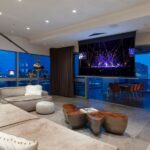
THX-certified home theaters are the pinnacle of home theater acoustic design, according to Erskine. To achieve its standards, DCP works directly with THX throughout the design and building stages of the project and directly supervises all construction, installation and calibration to assure compliance with THX specifications.
When completed, the THX-certified home theater is assigned a plaque with a THX serial number.
"Once we get the room quiet," Erskine explains, "we're looking at seating position versus what we need to do in terms of re-creating the environment the mix was done in. If we have to put absorption in the room and are absorbing sound, we're taking away amplifier and speaker power.
"So, we may have to increase speaker size. Until we design the room, we don't know if 100 watts per channel is appropriate or if we need 500 watts per channel. Some people go by STC (Sound Transmission Class) rating. They'll have STC product installed and then say 'My wife won't let me use the theater anymore -- it's too loud.' They don't understand that STC doesn't apply to any frequency below 125 hertz."
Learnin' 'Em Good
Erskine does understand the scientific thinking that makes for superior sound. He was fortunate to be able to bring that background to his business and is crusading to raise the bar for the industry as a whole.
"Part of the problem is that the industry has been fixated on magic fixes and there's a lot of hype and misleading information out there," he says.
Erskine adds that following advice without having a solid knowledge base can be a mistake. "Some products can make a room sound different, sure, but not necessarily better," he says.
"A lot of people in the industry have been told what to do, but they don't understand why it works and under what circumstances it might not work. So, they end up doing the right thing for the wrong reasons and the results can be unsatisfactory. They don't have the design skills or understand the physics to make it work."
Erskine adds, "I encourage clients to select someone who cares enough about their profession to get professional training to understand acoustics. The more I can get people to do this, the better off we're all going to be."