Audio Video Interiors: Different by Design

AVI has learned not to get beat with its own designs. It charges its potential clients $150/hour for the designs that, hopefully, will sell the system installations in the end.

image

CEA TechHome division’s 2008 Mark of Excellence Integrator of the Year Michael Pope of Audio Video Interiors says deciding to charge clients for design was the best business decision he’s made.

By Erin Harrington
July 03, 2008
No system shall be sold before its time. That's the mantra at Medina, Ohio-based Audio Video Interiors (AVI).

Akin to the notion in real estate that sales are based on "location, location, location," sales at AVI are contingent upon "design, design, design."

Michael Pope, president, is rigid in this posture, which has proven to be a strong backbone for AVI's success and a valuable differentiator in its market as well.

AVI makes it clear to clients up front that they're paying $150 an hour for design. "We start every initial consultation meeting by telling our prospects that Audio Video Interiors does three things," Pope points out.

"We design custom electronic solutions for our customers, we project-manage the installation of custom electronic solutions for our customers and we install custom electronic solutions for our customers. We explain to our prospects that the most important part of any engineered solution is the design."

Pope's reasoning is sound. A great installation team cannot, he believes, make a poorly designed system meet or exceed customers' expectations. An average installation team, on the other hand, can install a well-designed system.

Quick Stats
  • Company: Audio Video Interiors Inc.
  • Location: Medina, Ohio
  • No. of Locations: 1
  • Web site: www.audiovideointeriors.net
  • Principal: Michael A. Pope, president/owner
  • Revenue (2006): $2.5 million
  • Years in Business: 18
  • Number of Employees: 16
  • Commercial/Residential Split: 20%/80%
  • Specialty: Whole-house control and dedicated home theaters
  • Top Five Brands: Crestron, Integra, JBL Synthesis, LG, Bose
  • FYI: "Every system shall be designed before it is sold. We firmly believe that what separates us from our competition is the talent of our employees and the designs they can offer."
AVI figures the design cost into the quote and puts the question to customers: "Doesn't it make sense to pay for a good design upfront so that you get exactly what you want, that is proven on paper to work and at a price you can afford?"

Prior to adapting this policy, AVI found that one of its biggest overhead expenses came from paying its designer/programmers to engineer systems for proposals that were never sold.

"We were providing great system designs for free that clients would take to our competitors for bids," Pope recalls. "The cost to our competitors to bid a system that was already designed is minimal. We were losing business because our client's did not value our designs since they were 'free,'" he says.

According to Pope, AVI's clients considered the designs to be merely sales proposals.

"Once we placed importance and value on the system design," he says, "we set ourselves apart from our competition. We also eliminated prospective customers who were only interested in the cheapest price before we had invested any of our resources."

From Security to A/V


Pope started the business in 1990, primarily installing security and communications systems. He began adding A/V systems to his product mix in 1993 and, in '99, purchased AVI, which was a small retail A/V store.

The company expanded into the custom installations that it does today, continuing to evolve by redefining "custom systems."

"We pre-engineered systems that were designed to meet the needs of 80 percent of our market," he says. "The systems varied by size, price point and customer profile and were the meat and potatoes of our sales."

Now, he says, all of AVI's custom systems are those that don't fit into "the pre-engineered category." AVI charges for those because the company is creating a new design for them from the ground up.

About 80 percent of AVI's work is on the residential side. While its scope of services spans entertainment solutions, automation, wiring and security/life safety systems, AVI sees the most demand for dedicated home theaters and media rooms, followed by multiroom audio and lighting control.

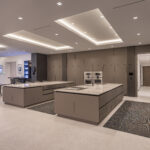
The company's design center, built in 2001, is a definite driver in closing sales. "We built the design center to be very stylish and dramatic, creating the 'wow factor,'" Pope says.

During design center tours, AVI spends more time showing clients its processes than demonstrating hardware. The operations areas are also part of the tours so that prospects can check out AVI's staging area, where all the systems are assembled and tested prior to installation.

MOE Integrator of the Year

Audio Video Interiors won this year's coveted Mark of Excellence Award for "Integrator of the Year."

The Mark of Excellence Awards program, presented by the Consumer Electronics Association (CEA) TechHome Division, recognizes the best in custom home electronics products, services, and installed technology.

Each year, manufacturers, distributors, and systems integrators enter to compete in award categories for this coveted honor judged by independent experts within the industry.

View all the Mark of Excellence winners.
AVI's impressive "Wall of Fame" is also included, and showcases the scads of certifications staff has earned.

The Retrofit Edge


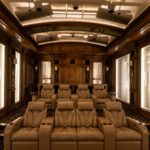
AVI focuses on high-end dedicated theater rooms in the retrofit market.

"We're the only company in our market that can engineer a complete system for a discriminating client," Pope says. "We are equally schooled in acoustics, construction and aesthetic design to create one-of-a-kind custom home theaters."

He adds that these installations often sell at higher margins and finish much more quickly than new-construction projects.

AVI has focused much of its marketing attention on the retrofit market, partly in response to a lagging housing industry and partly because there is less competition in that market segment.

"The most challenging aspect of retrospect installations is dealing with installing extensive systems in a finished home," Pope explains. "It is really critical that a company have a good set of industry partners to work with for architectural and construction assistance."

He says the company has also been more successful with projects wherein AVI can act as the project manager throughout the entire installation, "essentially providing a turn-key solution," he says.

Nevertheless, Popes says dedicated home theaters are where AVI shines. "We're also one of the few companies in our market that integrates complex subsystems in large homes and businesses," he adds.

"We have successfully managed and installed projects exceeding $1,000,000 in both homes and businesses." In those types of installations, he says, good installation processes are a necessity, as are "great designs and well-trained professionals to pull them off."

Although AVI works with remodelers and electricians when required, they install all of their core systems themselves.

Trained & Certified


Training is one of AVI's big priorities. Each year, the company budgets $2,500 for each employee to pursue "elective education."

According to Pope, AVI has very low employee turnover because it helps the staff "grow through education."

Pope says even AVI's non-technical staff benefits from getting more education. "Each employee is encouraged to plan their career path two years out," he says.

"We approve any education that will help our staff members attain a beneficial certification or improve their efficiency or organizational skills."

Pope says that the training funds can be spent on product certification training, seminars, books/tapes, CEDIA or CEA training/certifications, college courses, etc.

"If we require an employee to take a specialized manufacturer training, we do not count that against their elective education funds," he says.

Pope is certain that the training certifications help AVI's sales efforts. "It is true that most people don't understand what individual certifications mean," he concedes.

"But people are certainly smart enough to know that a company with over a hundred training certifications displayed must be a well-trained one."

Keeping Talent


Pope runs what he calls a very "open communication, teamwork-oriented company," where everyone is accountable and gets a chance to be heard.

"We tackle projects to improve ourselves by creating teams from all departments within our companies. I would not be where I am without the efforts of everyone on my team. So, I try to make sure my staff knows that I know how important they are to our success."

Pope says that hiring and retaining good employees involves many different factors.

"My philosophy is that if I provide an environment where my team members have career choices, are treated fairly, actively participate in the business regardless of their job description and their families are taken care of, then, they don't leave."

He adds that when he's hiring a new team member, his employees are his best advocates.

Specific employee retention perks include (in addition to the educational advancement fund) a good health care plan, 401k retirement, a bonus plan and a focus on team participation.

"We let everyone get involved in our operations and process development," he says. "So, everyone on staff is a stake holder."

Again, Pope cites the "Wall of Fame." Having certifications prominently displayed at the starting point of each design center tour promotes company and individual pride as well as a healthy rivalry among staff.

Pope also recognizes employees with such awards as Technician of the Month/Year, Employee of the Month/Year, Sales Person of the Month/Year, and Best Idea of the Month.

Winners are named on plaques in the lobby and receive AVI money that can be used as cash to buy products or used for education.

Budgeting for Success


Coming up with a project budget for the client is big for AVI, Pope says. "Our competition takes a more traditional sales approach, where they make price assumptions and present proposals."

Pope points out, however, that most clients really don't understand what electronic lifestyle systems should cost. They can be surprised, he says.

"Once a proposal is given, any change in price becomes a negotiation process. Some clients are not comfortable telling you that the price is too high and will simply leave to get a cheaper quote somewhere else."

When customers are paying for their system designs, Pope says, they think differently about sharing budget information with sales people. "We are viewed as a consultant, much like an architect. As such, we explain that the budget is part of the system design."

He explains, "Our job as a designer is to achieve all of our client's system goals within the agreed upon budget. Since the systems are well designed, there are fewer change orders and we can stay within that budget."


Return to full story:
http://www.cepro.com/article/audio_video_interiors_different_by_design/