Lighting gobbles up 11.7 percent of a typical home's electrical bill. Another 11 percent of the electrical cost is attributable to the HVAC system.
A flat-screen TV uses 120 watts of power when turned on and 40 watts when off. A DVD player uses up to 25 watts of power. And an audio system can draw up to 400 watts of power.
Those are just some of the power consumptions that many of your clients are becoming more aware of as energy prices skyrocket and the amount they are spending to power their electronics competes with the same household dollars necessary to heat the home and run the refrigerator.
Integrators are also finding themselves doing more installations than ever in homes using alternative energy sources, such as solar panels and wind turbines.
The bottom line is that homeowners now want to know how much energy they are using and, more importantly, how they can curtail that energy usage using technology.
A new system from a company called Agilewaves Inc. promises to make integration with the low-voltage control more seamless than ever with line voltage usage.
Using the power of a whole-house control system, the system can automatically actuate change to alter gas/water/electrical usage to stay within prescribed limits, giving the homeowner complete automated control over his utilities using a low-voltage system.
How? The Menlo Park, Calif.-based company has announced native integration of its Resource Monitor product with a Crestron control system.
The system doesn't just tell the homeowner that his electrical, water or gas bill is going up, it actually affects some sort of change to mitigate it. For example, it can raise the thermostat or lower the shades.
"We are closing the gap between feedback and action," says Collin Breakstone, vice president of Agilewaves Inc.
Why pay to run your refrigerator from 1:00 a.m. to 2:30 a.m. when it won't lose a single degree of temperature if turned off for 90 minutes in the middle of the night? Why pay to keep a motorized shade control system active all day and all night, pulling hundreds of watts of power, when it is typically used only 30 seconds a day?
These are some of the solutions integrators can now bring to their clients.
"End users want to be empowered to do the right thing," says Breakstone.
Feedback Cuts Consumption
According to the US Green Building Council, buildings are responsible for 39 percent of all U.S. energy consumption.
Agilewaves' Resource Monitor delivers real-time information via touchscreen, Web page or phone, about gas, electricity and water use. Studies have shown that feedback alone can yield an average 10 percent to 15 percent reduction in consumption, often far exceeding 20 percent. It's called "The Prius Effect."
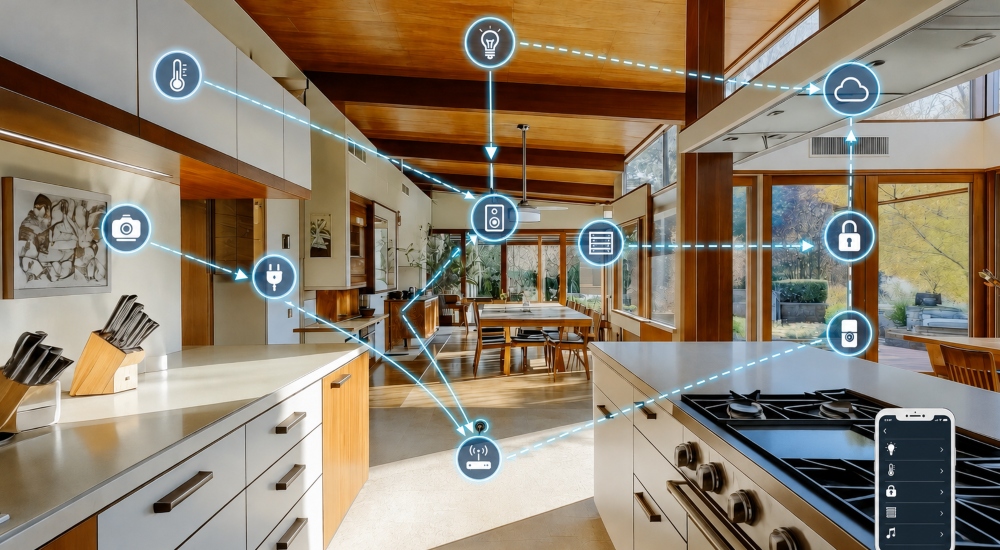
Control systems, such as those made by Crestron, can automate electric, gas and water systems as well as lighting, HVAC, entertainment and security. By "closing the loop" between feedback and control, Agilewaves has connected consumption monitoring with its management from a single interface.
The system also allows integrators (on behalf of homeowners) to set limits for utility consumption, reflected in dollars, carbon, gallons or kilowatts.
Previously, the system would alert the user through an email or text message when the target threshold is approaching. The homeowner would then identify behavioral efficiency steps to reduce energy use.
Now, if a preset limit is reached, the Resource Monitor can pro-actively signal the control systems to take direct action, such as shutting off water, dimming lights, lowering the blinds or adjusting thermostats. This ultimately results in improved energy and water efficiency, reduced costs and a minimal environmental footprint.
Even better: the system does not require the integrator to have an electrical license. You are never touching the line voltage. The system is able to measure electrical usage simply using a two-wire toroidal ring sensor that simply clips on a circuit wire.
"Configuration of the system depends on the level of granularity the homeowner wants the electrical usage information," according to Breakstone.
"It can be per circuit, by appliances, by lighting, or even by floor. You can even divide out the kitchen information to show you the amount used by the lights vs. the appliances in the room."
The installation involves mounting a small enclosure with landing boards/punchdown terminals for the sensor wires. From there, signals are sent via Cat 5 to the proprietary hardware "brains" of the system…about the size of a Mac Mini that can be either rack-mounted or placed in the enclosure. (In case you are curious, it draws 20 watts of power.)
The UI of the system can now be natively integrated into a whole-house control system.
"The dealer doesn't need to try to replicate our UI via programming," says Breakstone.
The first installation of the system has just been complete by the
Miller Design Company in Woodside, Calif. Using Agilewaves' Resource Monitor with a Crestron control system, Miller Design can track its utility use in real time, while simultaneously controlling the climate, entertainment and lighting, rendering it a truly "smart building."
"The seamless integration of Agilewaves' Resource Monitor with our control systems provides homeowners with the most technologically advanced solution to create an energy-efficient home," said Bill Schafer, director of channel development at Crestron.
"Together, we are empowering distributors and integrators to tackle the longstanding problem of energy waste from buildings in an entirely unique way."
"Home and building owners can finally monitor and automate the steps needed to reduce their energy consumption, carbon footprint and operating costs without relying on human intervention," says Peter Sharer, CEO Agilewaves.
"By aligning our companies' initiatives, we are achieving a new standard for reducing building emissions that is far superior to any other product on the market today."
Currently, Agilewaves has 20 active installations and 20 more in the design phase. The product has a strong margin for dealers, according to Breakstone, who most recently worked for a
CE Pro 100 integration company in the Bay Area.
The company is setting up an authorized dealer program, which requires the integrator to conduct a pilot project installation. The base package for the Resource Monitor tracks eight electrical circuits, whole-house water usage and whole-house gas usage.
There is also a recurring revenue aspect to the product. Homeowners can purchase a three-year total tech support contract for the system for a one-time fee of $240 or for $11 per month.
MSRP is $7,200.