Recent News

Loudspeakers Basics: How It All Works
A speaker system is made up of drivers, which are typically a woofer, midrange unit and tweeter, crossovers, an enclosure ... and, of course, a clever marketing story.
image

07.25.2008 — After working for several well-known consumer electronics brands over the years, Paul Scarpelli has spent the past 10 years as Triad Speakers Inc.'s director of sales.

Drawing upon that experience, Scarpelli explained to CE Pro the fundamentals that installers should know about freestanding and architectural speaker products.

How is a loudspeaker used in an audio system?

The purpose of a speaker is to integrate into an audio system (and the room) to reproduce as accurately as possible the audio signals that are sent to it.

An appropriate speaker system for a particular application would be one that fits the budget, interfaces well with the room size, design and acoustical properties.

In addition, it should have sufficient headroom for the demands made upon it with flat frequency response, low distortion and freedom from compression.

How does a loudspeaker work?

Loudspeakers are electro-mechanical devices. A raw dynamic driver consists of a basket, cone, suspension (which incorporates components called a spider and surround), a permanent magnet and a voice coil.

The voice coil interacts electromagnetically with the permanent magnet, which causes the cone to move in and out. This produces a replication of the input signal. A crossover or dividing network channels bands of frequencies to the appropriate woofer, midrange or tweeter.

To work best, crossover and driver components must be of high quality and properly implemented. The enclosure must also be properly designed and it must be acoustically inert as not to add any spurious distortions.

What are the differences between passive and active loudspeakers?

A passive loudspeaker has no dedicated amplifier, and almost any outboard receiver or amplifier can drive it.

An active loudspeaker is mated to an amplifier that is optimized to the speaker -- and that may mean bi- or tri-amplification, protection and/or equalization.

An active speaker is not inherently superior to a passive speaker system (although there can be some advantages, such as using a line-level crossover). The cost of a comparable passive speaker and amplification compared to an active speaker system is usually a wash.

What are the differences between soft dome and metal dome tweeters?

In dynamic loudspeakers (cones and domes), a lot is made about materials -- mostly by marketing departments.

A soft-dome tweeter is no better or worse than a metal-dome tweeter, but it depends how it's made and used. A metal-dome tweeter may have faster transient response, but worse impulse response, with more ringing.

However, despite all the exotic cone materials available, many of the best and most expensive drivers still use a treated or coated paper cone. It is very stiff and light, making almost the perfect material.

What's the difference between a sealed enclosure and an open-back speaker?

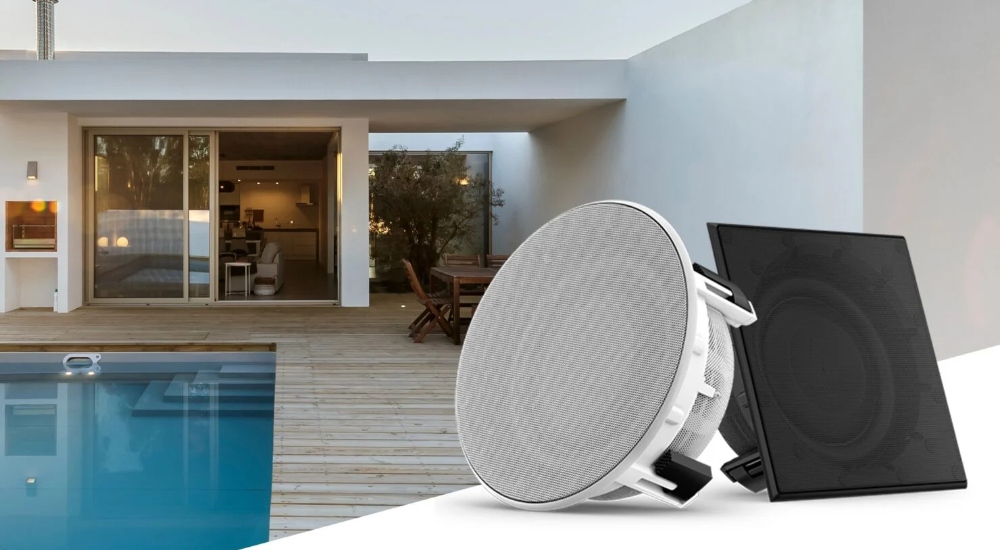
Architectural speakers with open backs are usually less costly, and they can work fine for background music in non-critical listening areas. Because there is no enclosure, sound can bleed into adjacent areas and become an annoyance.

Sealed in-wall and in-ceiling speakers are generally more expensive, and they keep the sound in the intended room. They can also sound better due to the engineered enclosure, which eliminates the arbitrary nature of an open-back speaker.

A sealed in-wall that is comparable to a freestanding speaker can sound as good if not better. The reflection off the wall behind a freestanding speaker does not exist in an in-wall, plus the in-wall can have a few dB more bass extension.

image

Subscribe to the CE Pro Newsletter

Get the latest news, products and more delivered straight to your inbox.
This entry has been viewed 2554 times.

tags
Subscribe to the CE Pro Newsletter
Subscribe to Email Alerts
Subscribe to the newsletter today! 

tagsThis Article Tagged

tagsNews Feeds

tagsSocial Bookmark
Submit to: , Digg, Delicious, Slashdot, Reddit, MyYahoo!, Google, Technorati, Learn about social bookmarking

Comments

Posted by Terry  on  07/29  at  12:34 PM

Nice article, however, it has been bugging me since I read this article this morning…
“...High-Tolerance Crossover...” Shouldn’t it be low or tight - tolerance?  According to Answers.com, Tolerance is defined as, “The permissible deviation from a specified value”.

Page 1 of 1 comment pages
Post a comment

Name:

Email:

Choose smileys | View comment guidelines

Remember my personal information

Notify me of follow-up comments?

Please answer the question below:

Type the 4th letter of the word "theater":


Rate this article
You must be logged in to rate articles. Login or register.
  • Currently 0/5 Stars.
  • 1
  • 2
  • 3
  • 4
  • 5
Average score: 0 / Total votes: 0