Search CE Pro


Print  |  Email  |  Share  |  News  |  Follow on Twitter, Facebook, Google+ or RSS

Linksys Exec Discusses Z-Wave Initiative

Linksys might embed Z-Wave into products as inexpensive and ubiquitous as a router.


Earlier this year, Cisco announced a "strategic investment" in Zensys, creator of the Z-Wave RF protocol for applications such as home automation. However, Cisco, especially the Linksys division responsible for the residential market, has been relatively quiet about the deal.

In the Z-Wave Pavilion at CES, Linksys had a tabletop space. It remained empty, however, except for some generic literature.

CE Pro was able to spend some time with the Linksys executive in charge of the Z-Wave initiative, Malachy Moynihan, vice president of engineering and product marketing for Linksys. He says that Z-Wave "brings more utility to networks. ... Anything we do that brings more utility to home networks is good for us."

Moynihan explains that Linksys "started with a fairly simple definition of networking -- essentially sharing a network connection -- which allowed us to grow tremendously."

Like most of its competitors, the company has added more value to the home network with solutions for IP cameras and voice over IP (VoIP), but "we really need a broader story," says Moynihan.

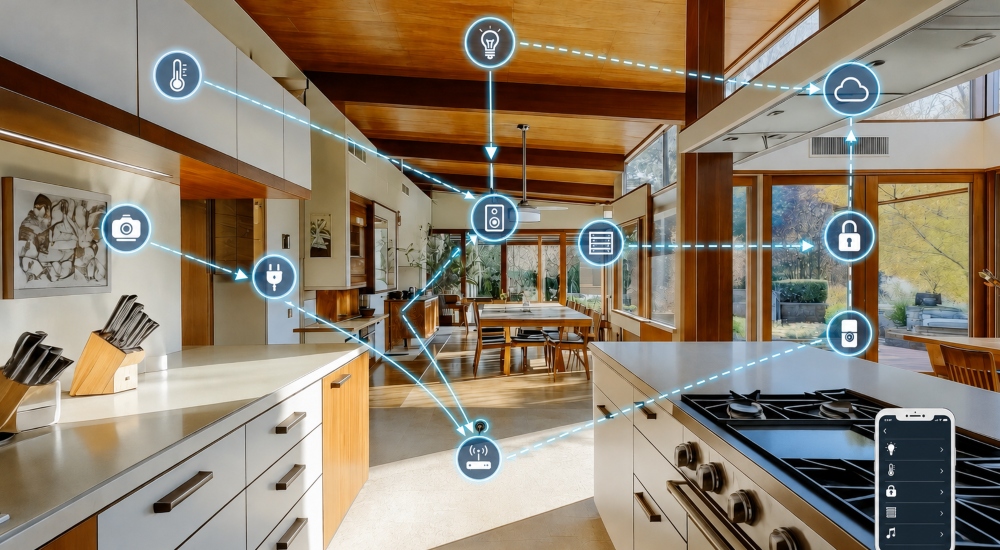
That "story" entails scenarios like the lights turning on automatically when a homeowner wants to view surveillance cameras via the Internet when it's dark. Then there are the far more mundane applications like setting the temperature, activating the sprinklers, or checking the status of the garage door via the Web or any cell phone for that matter.

"When I drive away from home, I'm halfway to my destination and I'm wondering if I closed the garage doors," says Moynihan, adding that a Z-Wave enabled Internet bridge would make it simple for him to check on the garage, and close the door if necessary.

To be sure, plenty of systems today enable these types of applications, but they require dedicated processors or proprietary software running on an always-on PC. Linksys plans to include the Z-Wave radios and necessary software in products as inexpensive and ubiquitous as Internet routers, or at least create low-cost bridges that easily plug into a home network.

The networking company will leave it to others to continue creating Z-Wave peripherals such as light switches and garage door openers. In fact, it is the proliferation of those devices that stimulated Linksys' interest in the protocol in the first place. "The thing I'm most impressed with is how many companies they [Zensys] have actually signed up. ... I grew bored waiting for Zigbee."

Zigbee, also known as IEEE 802.15.4, is a competing control protocol, adopted by a host of industrial controls manufacturers, as well as a growing roster of custom-oriented residential players -- Crestron, AMX, Vantage, Centralite and Xantech, to name a few. Z-Wave has a following among such mass-market brands as Intermatic, Leviton, Wayne Dalton, Monster Cable and Logitech.

Moynihan says that Linksys' first Z-Wave-enabled devices most likely will be sold through retailers that sell home-improvement products like (Z-Wave-enabled) light switches and garage-door openers, rather than mass-market consumer-electronics. Think Home Depot more so than Best Buy, he suggests.

Moynihan also says there is a ready audience among Linksys' current base of service-provider customers. Just as Linksys has a relationship with VoIP provider Vonage, it is not unrealistic to expect Linksys to team up with telcos and cable companies on a Z-Wave-enabled Internet offering.

Linksys is not discounting the professional installation channel either. "We might see an opportunity for product optimized for that segment," says Moynihan.

If the whole thing sounds familiar, Motorola launched a similar line-gateway, cameras, sensors and other wireless peripherals-several years ago. The cable hardware giant had hoped to sell the products through its cable TV and ISP partners, but to no avail. Instead, the products have been sold with mixed results through integrators (via the now defunct Shell Homegenie), and through consumer electronics retailers and etailers. The current iteration of the product line, called Homesight, continues to evolve.

Moynihan is not deterred by the limited success of Homesight. He blames the sluggish performance on the fact the Motorola uses proprietary RF communications protocols. "The problem is, it's theirs," he says. "We're a big believer in the open-source way of looking at things."


Subscribe to the CE Pro Newsletter

Article Topics

News · Networking · Z-Wave · Z-wave · Networking · All topics

About the Author

Julie Jacobson, Co-Founder, EH Publishing / Editor-at-large, CE Pro
Julie Jacobson, recipient of the 2014 CEA TechHome Leadership Award, is co-founder of EH Publishing, producer of CE Pro, Electronic House, Commercial Integrator, Security Sales and other leading technology publications. She currently spends most of her time writing for CE Pro in the areas of home automation, security, networked A/V and the business of home systems integration. Julie majored in Economics at the University of Michigan, spent a year abroad at Cambridge University, earned an MBA from the University of Texas at Austin, and has never taken a journalism class in her life. She's a washed-up Ultimate Frisbee player currently residing in Carlsbad, Calif. Follow her on Twitter @juliejacobson. [More by Julie Jacobson]

Comments

Post a comment
Commenting is not available in this weblog entry.

Sponsored Links

  About Us Customer Service Privacy Policy Contact Us Advertise With Us Dealer Services Subscribe Reprints ©2015 CE Pro
  EH Network: Electronic House CE Ideas Store Commercial Integrator ChannelPro ProSoundWeb Church Production Worship Facilities Electronic House Expo Worship Facilities Expo