How to Sell and Install Outdoor A/V Solutions
Tips for pumping up the backyard beat.
Editor’s note: This is the first in a three-part series about outdoor technology, culminating in the Outdoor Destination at EHX, Nov. 4-7 in Long Beach, Calif. This first installment focuses on outdoor audio/video.
Construction is booming in back yards across America, and integrators are taking notice.
Jonathan Lane of SoCal Smart Home in San Clemente, Calif. says he just followed up with two customers whose interiors he equipped about one year ago. Both homeowners said they had future plans for major outdoor landscaping.
"Both of them were excited to hear from us," says Lane, who adds that he got one gig out of the outreach, and another is pending.
The success has led SoCal to reach out to all of its past customers -- a common practice for the company. This time, however, focus is on the outdoors.
"The weather is great here in Southern California, and customers are anxious to get outside," Lane says. "Most don't seem to realize what the potential is outside (other than music)."
More weatherproof technologies are coming to market, and integrators are taking advantage of the trends in outdoor living. However, putting music, video and control outside is not as simple as just adding another zone.
For integrators to be successful, you need to view the outdoor area as a separate environment with unique characteristics driving placement and product selection.
Failure to do so can lead to blown labor budgets, lost profit and disappointed clients.
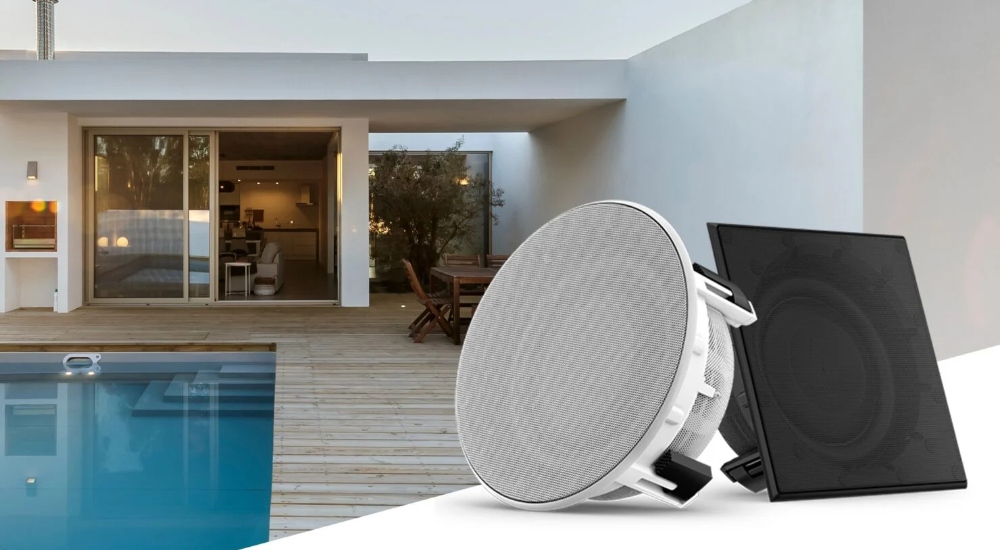
Music can make the mood outside as well as inside, but if the audio requirements grow past a pair or two of speakers on the patio or by the pool, a switch to dual-tweeter speakers or mono may be in order.
Sound dissipates quickly when there are no walls, so attempting to create conventional stereo zones is difficult or impossible, and more speakers are required to get even coverage.
In this regard, outdoor music systems are often more similar in design to a commercial space than a residential one.
Here are a couple of simple approaches to consider:
Medium-Sized Spaces In these areas, where budget is a factor, create "loops" of three to four speakers daisy-chained together and connected seriesparallel to maintain proper impedance.
Speaker selection will depend on the amplifier utilized. Multichannel amplifiers offer the most flexibility with such features as selectable bus inputs, mono or stereo zone outputs, even equalization.
Most outdoor speakers will work with these amps, but look for ones with higher efficiency (90+ db) and proven resistance to rust.
These speakers still require adequate power (at least 25 watts per speaker for average listening levels; three or four times that for large speakers -- or a client who really wants to rock). So, switching to mono is a good idea as it will increase the amplifier output 50 percent to 100 percent.
If mono isn't an option, try using dual-tweeter speakers, but remember to keep the power level up. Don't plan to drive these speakers with a 20-watt digital amplifier or low-wattage Cat 5 keypads (and still expect a satisfied client).
Regardless, try to keep speakers within 10–15 feet of each listening area.
Jonathan Lane of SoCal Smart Home in San Clemente, Calif. says he just followed up with two customers whose interiors he equipped about one year ago. Both homeowners said they had future plans for major outdoor landscaping.
"Both of them were excited to hear from us," says Lane, who adds that he got one gig out of the outreach, and another is pending.
The success has led SoCal to reach out to all of its past customers -- a common practice for the company. This time, however, focus is on the outdoors.
"The weather is great here in Southern California, and customers are anxious to get outside," Lane says. "Most don't seem to realize what the potential is outside (other than music)."
More weatherproof technologies are coming to market, and integrators are taking advantage of the trends in outdoor living. However, putting music, video and control outside is not as simple as just adding another zone.
For integrators to be successful, you need to view the outdoor area as a separate environment with unique characteristics driving placement and product selection.
Failure to do so can lead to blown labor budgets, lost profit and disappointed clients.
Approaches to Outdoor Audio
Music can make the mood outside as well as inside, but if the audio requirements grow past a pair or two of speakers on the patio or by the pool, a switch to dual-tweeter speakers or mono may be in order.
Sound dissipates quickly when there are no walls, so attempting to create conventional stereo zones is difficult or impossible, and more speakers are required to get even coverage.
In this regard, outdoor music systems are often more similar in design to a commercial space than a residential one.
Here are a couple of simple approaches to consider:
Medium-Sized Spaces In these areas, where budget is a factor, create "loops" of three to four speakers daisy-chained together and connected seriesparallel to maintain proper impedance.
Speaker selection will depend on the amplifier utilized. Multichannel amplifiers offer the most flexibility with such features as selectable bus inputs, mono or stereo zone outputs, even equalization.
Most outdoor speakers will work with these amps, but look for ones with higher efficiency (90+ db) and proven resistance to rust.
These speakers still require adequate power (at least 25 watts per speaker for average listening levels; three or four times that for large speakers -- or a client who really wants to rock). So, switching to mono is a good idea as it will increase the amplifier output 50 percent to 100 percent.
If mono isn't an option, try using dual-tweeter speakers, but remember to keep the power level up. Don't plan to drive these speakers with a 20-watt digital amplifier or low-wattage Cat 5 keypads (and still expect a satisfied client).
Regardless, try to keep speakers within 10–15 feet of each listening area.
Subscribe to the CE Pro Newsletter
About the Author

Curt Hayes is president of Deerfield Beach, Fla.-based Audio Design Inc., providers of A/V and automation design/documentation.


Post a comment