Google’s Big Home Automation Play: New Android OS, Wireless Protocol
With new wireless protocol, Android@Home will enable Android controllers to natively operate lights, thermostats, TVs and more. Look out ZigBee, Z-Wave, RF4CE?
It was bound to happen sooner or later: Google unveiled its plans for the automated home during this week’s Google I/O developer's conference.
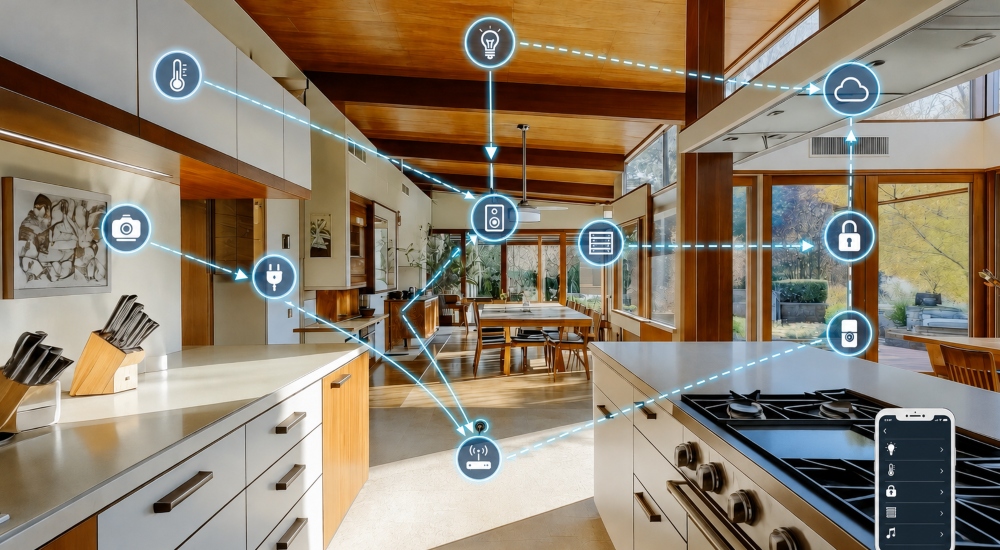
Like many wanna-be Home OS providers before it, Google intends to have its forthcoming Android@Home platform embedded in TVs, lights, thermostats and other electronic devices for instant control via an Android-based controller – phones, tablets, computers, etc.
"We'd like to think of your entire home as an accessory, or better yet as a network of accessories, and think of Android as the operating system for your home," Joe Britt, head of the Android@Home team, told the Los Angeles Times.
An announcement like this would usually be a yawner as similar promises in the past by Motorola (Premise Systems), Microsoft (Simple Control Protocol, UPnP), Cisco (with iControl) and other big names have all fizzled. But Google’s version looks to have some legs. For one, the timing is right, but also because it counts about 100 million activated Android devices, 200,000 free and paid apps available in the Android Market, and 4.5 billion apps installed.
---------------
"I see it more like UPnP or Web Services for Devices (WSD)—try to get mfrs to build it into their lightweight devices, so they are automatically discoverable by the network. ..." Read more comments below.
---------------
Unless you count Motorola, which recently acquired home automation provider 4Home, no other major brand has announced a home automation strategy this ambitious. Even Cisco, partnering with Control4, has stopped short of announcing anything like a whole-house ecosystem.
And, despite its obvious opportunity, Apple has never intimated a plan for whole-house control.
Reports suggest Android@Home will include an entirely new communications protocol that would compete with ZigBee (including RF4CE for A/V control) and Z-Wave, but with enough bandwidth to transmit audio and video.
Google’s first Android@Home partnership is with Lighting Science Group Corp. (OTCBB: LSCG) to launch the first Android-connected LED bulb. In a demo at Google I/O, an Android device controlled LSG lights directly, with no apparent bridge. The bulb, which reports says will be available by the end of 2011 (pictured left), is an omnidirectional, A19, 60-watt equivalent.
PCMag.com reports:

Ordinarily, it doesn’t make sense to combine low-rate automation protocols with higher-rate protocols for streaming media. Devices like thermostats and light bulbs generally cannot support the extra cost and physically larger chipsets required of streaming technology.
Like many wanna-be Home OS providers before it, Google intends to have its forthcoming Android@Home platform embedded in TVs, lights, thermostats and other electronic devices for instant control via an Android-based controller – phones, tablets, computers, etc.
"We'd like to think of your entire home as an accessory, or better yet as a network of accessories, and think of Android as the operating system for your home," Joe Britt, head of the Android@Home team, told the Los Angeles Times.
An announcement like this would usually be a yawner as similar promises in the past by Motorola (Premise Systems), Microsoft (Simple Control Protocol, UPnP), Cisco (with iControl) and other big names have all fizzled. But Google’s version looks to have some legs. For one, the timing is right, but also because it counts about 100 million activated Android devices, 200,000 free and paid apps available in the Android Market, and 4.5 billion apps installed.
"I see it more like UPnP or Web Services for Devices (WSD)—try to get mfrs to build it into their lightweight devices, so they are automatically discoverable by the network. ..." Read more comments below.
---------------
Unless you count Motorola, which recently acquired home automation provider 4Home, no other major brand has announced a home automation strategy this ambitious. Even Cisco, partnering with Control4, has stopped short of announcing anything like a whole-house ecosystem.
And, despite its obvious opportunity, Apple has never intimated a plan for whole-house control.
Reports suggest Android@Home will include an entirely new communications protocol that would compete with ZigBee (including RF4CE for A/V control) and Z-Wave, but with enough bandwidth to transmit audio and video.Google’s first Android@Home partnership is with Lighting Science Group Corp. (OTCBB: LSCG) to launch the first Android-connected LED bulb. In a demo at Google I/O, an Android device controlled LSG lights directly, with no apparent bridge. The bulb, which reports says will be available by the end of 2011 (pictured left), is an omnidirectional, A19, 60-watt equivalent.
PCMag.com reports:
According to Eric Holland, vice president of electrical engineering at Lighting Science, Android@Home will use a new version of a wireless network developed by Google. It will eventually be open sourced, Holland added.
"Google reached out to us, but we were already working on something similar," Holland said. Wireless Science plans five products, including internal lamps and external lighting fixtures that use the technology. They will ship by the end of the year, Holland said.
The network is similar to that used by ZigBee, a low-power wireless network used for short-range home automation. However, the network will be designed to allow for enough bandwidth to transfer video, Holland said. "One of the fixtures we're going to show off next week [at Lightfair, the North American commercial lighting show] will be an external [lighting] fixture with a security camera attached," Holland said.

Ordinarily, it doesn’t make sense to combine low-rate automation protocols with higher-rate protocols for streaming media. Devices like thermostats and light bulbs generally cannot support the extra cost and physically larger chipsets required of streaming technology.
Spotlight: Wireless AV
|
McIntosh MX121, MX151 Control Centers Debut Atlona at ISE 2012: 4X4 HDBaseT, More Wireless Coming DVDO Air WirelessHD Streamer Gets Rid of Wires Peerless PeerAir Combines Mount with Wireless HD Streaming Dynaudio Unleashes Xeo Remote-Controlled, Wireless Speakers Iogear Wireless 3D Media Kit Streams Content 100’ from 5 Sources ZyXEL Enters IP Camera Surveillance Market More filed in Wireless A/V |
Controlling a $15M Bel Air Mansion
85” Plasma Shines in Manhattan Apartment |
15 Keys for Picking a Wireless TechnologyDownload this paper and learn what you need to consider before making a decision. |
|
Presented by IOGEAR
|
||
Subscribe to the CE Pro Newsletter
Read more Energy Management stories
Electric Imp Cloud-based Automation Monitors Almost Every DeviceLED Lighting: 4 Simple Ways to Boost Sales
Eragy Launches Control4 Energy Management Apps
AT&T to Launch Home Automation/Security this Summer
SDG&E and SoCal Edison: Pay to Get Your Dumb Meters Back
More in Energy Management
Article Topics
News · Product News · Home Automation and Control · Control Systems · Lighting · Energy Management · Wireless Av · Android · Google · Android@home ·About the Author

Julie Jacobson, Editor-at-large, CE Pro
Julie Jacobson is co-founder of EH Publishing and currently spends most of her time writing for CE Pro, mostly in the areas of home automation, networked A/V and the business of home systems integration. She majored in Economics at the University of Michigan, earned an MBA from the University of Texas at Austin, and has never taken a journalism class in her life. Julie is a washed-up Ultimate Frisbee player with the scars to prove it. Follow her on Twitter @juliejacobson.


15 Keys for Picking a Wireless Technology
Post a comment