Design Cinema Privee: Taking Sound Seriously
It doesn't take a physicist to install a great audio system, or does it?
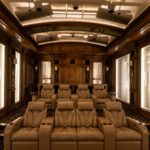
Design Cinema Privee’s THX-certified home theaters are the pinnacle of home theater acoustic design says principle Dennis Erskine.
"The first things to consider are the physical constraints and dimensions of a space. They drive an awful lot of what the ultimate bill of materials will be in the room and drive the budget. A room with 24 chairs will obviously cost more than one with eight chairs."
He adds, "The first thing we look at in the construction diagram is how we can sound isolate the room. A movie's sound is 22 dB, and residential noise is 30, so you'd have to turn up the sound a lot to hear the quiet whispers. Then when the loud scenes come up, you'd have to turn down the volume control and lose audio, so sound isolation becomes critical in putting the room together."
"Once we get the room quiet," Erskine explains, "we're looking at seating position versus what we need to do in terms of re-creating the environment the mix was done in. If we have to put absorption in the room and are absorbing sound, we're taking away amplifier and speaker power.
"So, we may have to increase speaker size. Until we design the room, we don't know if 100 watts per channel is appropriate or if we need 500 watts per channel. Some people go by STC (Sound Transmission Class) rating. They'll have STC product installed and then say 'My wife won't let me use the theater anymore -- it's too loud.' They don't understand that STC doesn't apply to any frequency below 125 hertz."
Erskine does understand the scientific thinking that makes for superior sound. He was fortunate to be able to bring that background to his business and is crusading to raise the bar for the industry as a whole.
"Part of the problem is that the industry has been fixated on magic fixes and there's a lot of hype and misleading information out there," he says.
Erskine adds that following advice without having a solid knowledge base can be a mistake. "Some products can make a room sound different, sure, but not necessarily better," he says.
"A lot of people in the industry have been told what to do, but they don't understand why it works and under what circumstances it might not work. So, they end up doing the right thing for the wrong reasons and the results can be unsatisfactory. They don't have the design skills or understand the physics to make it work."
Erskine adds, "I encourage clients to select someone who cares enough about their profession to get professional training to understand acoustics. The more I can get people to do this, the better off we're all going to be."
He adds, "The first thing we look at in the construction diagram is how we can sound isolate the room. A movie's sound is 22 dB, and residential noise is 30, so you'd have to turn up the sound a lot to hear the quiet whispers. Then when the loud scenes come up, you'd have to turn down the volume control and lose audio, so sound isolation becomes critical in putting the room together."
The DCP Design Plan Menu
For Atlanta-based Design Cinema Privee (DCP), of fering a good, better, best approach to design plan options is a good way to gauge the level of service being purchased by its customers.
The DCP "Custom" design plan is geared toward "do-it-yourselfers" and includes architectural drawings for the floor plan, elevation, framing, electrical, lighting, low voltage, stage/proscenium and soffits.
There's unlimited e-mail support during the process and DCP will provide the customer with a complete list of acoustic materials, lighting fixtures, seating, and fabrics and can also offer full configuration and equipment recommendations.
The DCP "Select" design plan is for the more experienced do-it-yourselfer or contractor. It includes everything in the Custom plans plus more elaborate lighting and prosceniums, complete wall treatments and phone support for the customer and their builder or contractor(s) during the project.
The "Dennis Erskine Signature" plan is DCP's most requested plan, whereby DCP basically does it all. Customers visit personally with Erskine to discuss the design and build out.
He specifically details and provides samples of all millwork, carpet, paint, trim, fabrics, finishes and all other elements forming the interior design of the theater and lobby area.
The designs include, as appropriate, details of lifts, motorized controllers and custom screens. DCP does frequent onsite visits and its crews install all fabric and acoustic treatments and also conduct full audio/video calibration.
THX-certified home theaters are the pinnacle of home theater acoustic design, according to Erskine. To achieve its standards, DCP works directly with THX throughout the design and building stages of the project and directly supervises all construction, installation and calibration to assure compliance with THX specifications.
When completed, the THX-certified home theater is assigned a plaque with a THX serial number.
For Atlanta-based Design Cinema Privee (DCP), of fering a good, better, best approach to design plan options is a good way to gauge the level of service being purchased by its customers.
The DCP "Custom" design plan is geared toward "do-it-yourselfers" and includes architectural drawings for the floor plan, elevation, framing, electrical, lighting, low voltage, stage/proscenium and soffits.
There's unlimited e-mail support during the process and DCP will provide the customer with a complete list of acoustic materials, lighting fixtures, seating, and fabrics and can also offer full configuration and equipment recommendations.
The DCP "Select" design plan is for the more experienced do-it-yourselfer or contractor. It includes everything in the Custom plans plus more elaborate lighting and prosceniums, complete wall treatments and phone support for the customer and their builder or contractor(s) during the project.
The "Dennis Erskine Signature" plan is DCP's most requested plan, whereby DCP basically does it all. Customers visit personally with Erskine to discuss the design and build out.
He specifically details and provides samples of all millwork, carpet, paint, trim, fabrics, finishes and all other elements forming the interior design of the theater and lobby area.
The designs include, as appropriate, details of lifts, motorized controllers and custom screens. DCP does frequent onsite visits and its crews install all fabric and acoustic treatments and also conduct full audio/video calibration.
THX-certified home theaters are the pinnacle of home theater acoustic design, according to Erskine. To achieve its standards, DCP works directly with THX throughout the design and building stages of the project and directly supervises all construction, installation and calibration to assure compliance with THX specifications.
When completed, the THX-certified home theater is assigned a plaque with a THX serial number.
"Once we get the room quiet," Erskine explains, "we're looking at seating position versus what we need to do in terms of re-creating the environment the mix was done in. If we have to put absorption in the room and are absorbing sound, we're taking away amplifier and speaker power.
"So, we may have to increase speaker size. Until we design the room, we don't know if 100 watts per channel is appropriate or if we need 500 watts per channel. Some people go by STC (Sound Transmission Class) rating. They'll have STC product installed and then say 'My wife won't let me use the theater anymore -- it's too loud.' They don't understand that STC doesn't apply to any frequency below 125 hertz."
Learnin' 'Em Good
Erskine does understand the scientific thinking that makes for superior sound. He was fortunate to be able to bring that background to his business and is crusading to raise the bar for the industry as a whole.
"Part of the problem is that the industry has been fixated on magic fixes and there's a lot of hype and misleading information out there," he says.
Erskine adds that following advice without having a solid knowledge base can be a mistake. "Some products can make a room sound different, sure, but not necessarily better," he says.
"A lot of people in the industry have been told what to do, but they don't understand why it works and under what circumstances it might not work. So, they end up doing the right thing for the wrong reasons and the results can be unsatisfactory. They don't have the design skills or understand the physics to make it work."
Erskine adds, "I encourage clients to select someone who cares enough about their profession to get professional training to understand acoustics. The more I can get people to do this, the better off we're all going to be."


Post a comment