Search CE Pro


Print  |  Email  |  Comments (11)  |  Share  |  News  |  Follow on Twitter, Facebook, Google+ or RSS

Why H.A. Manufacturers Fail: Revisited

We've come a long way since January 2006, but all-IP home automation has a long way to go.


image
Web Services for Devices (WSD) as a home-control protocol has enjoyed some popular appeal late, thanks to the resources of home-control vendor Exceptional Innovation, which is creating a library of definitions for different home-control device categories.

For now, like the others, EI has to "WSD-enable" third-party systems by running and hardware bridge and writing the same ol' stifling drivers.

More importantly, like UPnP, the home automation world today shrugs off WSD.

On IP-based A/V Distribution


Boy, back when I wrote the original editorial, I got an earful from Herman Cardenas, CEO of NetStreams which at the time made IP-enabled audio distribution systems. The company has now rolled out IP-enabled video (HD) as well.

I won't get into the merits of the quality of IP-based streaming. This has gone on long enough! There are limitations versus other distribution methods, but NetStreams and others have done a great job of addressing bandwidth limitations, latency, QoS, etc.

But still … not a whole lot of IP-enabled end points like TVs and loudspeakers, but they are certainly on the way.

What to Do Today


Run Cat 5+ everywhere you can -- multiple runs if possible. Include potential locations for keypads, in-wall speakers, wireless access points, telephones, intercoms, thermostats, surveillance cameras, etc.

Eloy is right that eventually these higher-rate communications systems (versus low-rate sensors and possibly light switches) all will some day communicate via TCP/IP. And, what's more, they will communicate with each other, and with IP-based interfaces, seamlessly and affordably.

Why H.A. manufacturers have failed in the past is that they assumed that already to be the case.

That's only one of the reasons, however. There are four more reasons listed as well!

Thanks for your indulgence. I welcome our comments.

Subscribe to the CE Pro Newsletter

Article Topics

News · Control Systems · All topics

About the Author

Julie Jacobson, Editor-at-large, CE Pro
Julie Jacobson is co-founder of EH Publishing and currently spends most of her time writing for CE Pro, mostly in the areas of home automation, networked A/V and the business of home systems integration. She majored in Economics at the University of Michigan, earned an MBA from the University of Texas at Austin, and has never taken a journalism class in her life. Julie is a washed-up Ultimate Frisbee player with the scars to prove it. Follow her on Twitter @juliejacobson.

11 Comments (displayed in order by date/time)

Posted by Jim Hayes  on  07/11  at  12:19 AM

Nice job summing it up, Julie.
I’m reminded of a statement Bob Metcalfe made when we shared a podium at a conference over a decade ago. “The wonderful thing about standards is we have so many to choose from!”
Wireless is hardly “standard” - virtually all versions change continuously as they try to keep up with growing needs. Ethernet is not really oriented to control. Video on IP is a kludge that many experts feel is never going to give good QoS (quality of service) .
I’ve been trying to get people to look at MOST. It’s the largest fiber optic network in the world, with over 15 million devices installed last year - in cars! It handles video, audio, controls, etc. by allocating both synchronous and asynch channels.
I see no reason why it would not work at home as well as in the car and it’s cheap! Fiber optic transceivers for POF (plastic fiber) are under $5! And there is no reason you could not use the protocol on copper - it would probably just cost more!
See http://www.mostcooperation.com/

Posted by Michael  on  07/11  at  04:12 AM

Good article both original version and new redaction. Personally, I prefer TCP/IP protocol to communicate with home devices. Sure it’s difficult to bring IP functionality into each dimmer or sensor. The most appropriate solution for that - Z-Wave, ZigBee or X10. But it’d be nice to integrate them into TCP/IP. For example, Zenis, producer of Z-Wave, started to implement Z/IP which will allow to connect Z-Wave devices directly to TCP/IP network.

Regarding commercial home automation producers. It’s profitable for them to use their own proprietary protocols IMHO. So, their opinion about TCP/IP is pure for distribution of A/V is not completely unbiassed.

Posted by news for michael  on  07/11  at  01:04 PM

Michael,


Just and FYI, there are HA central controllers today with integrated Ethernet ports that allow an end user to access their control system via the network…that means they have access to the devices which speak UPB, RS-232, etc.  So my question is, why do you need those devices to speak TCP/IP?  To me, it doesn’t makes sense and it is not cost effective to have an overall TCP/IP network for controls in the home.  One needs other protocols for different circumstances.  New construction can take a whole bunch of network wiring, but retrofit, what do you do?  That is why there are these newer protocols.  They’re cheap, easier to implement, and they are more flexible.  TCP/IP is simply a gateway to these other protocols.

Posted by Michael  on  07/12  at  12:53 AM

Thanks for your comment. I agree with you. I just would like to see some standard protocol for communication of home devices. Sure, for automation of retrofit houses the best way is Z-Wave, ZigBee or other wireless protocol. But, in fact, there are so many different protocols which do similar things. As result, the HA controller , for example, should include drivers for all of them or at least for the most popular. So, idea is not to have TCP/IP everywhere. The idea to have one or maybe two standard protocols for home devices. For example, modern TV producers add to their products RS232 port. Why they don’t use something different? Because RS232 is standard and it’s used in many devices. The same should be done with protocol for home devices IMHO.

Posted by Chris  on  07/12  at  07:11 AM

Michael,

Good article. Going through the pains of having a system installed right now, everything you say is pretty much true. I would add that unlike technology such as flat panel tv’s, networked home hardware and programming has NOT dropped in price with greater consumer adoption. With the decline in EASY refi and mortgage money, home installers and equipment manufacturers should prepare for the worst in the coming months.

Posted by Jim Hayes  on  07/12  at  12:50 PM

Great article and comments. It’s helped me focus on a seminar we are giving to homebuilders this fall. With the tanking of hte housing industry, the homebuilder needs some competitive edge, and this may be the time some of the bigger ones take the matter into their own hand, forcing a solution to create an integrated home.
I even think I know how to do it!
Regards,
Jim

Posted by Dean Roddey  on  07/12  at  01:52 PM

It doesn’t pay, as an automation system vendor, to assume anything at all. You have to be as protocol and technology neutral as possible. Sure it would be great if every product in the home was super smart and self-configuring (though one has to consider the security implications of such a system), but it just won’t happen. Not Invented Here Syndrome by itself will probably be sufficient to insure that various technologies continue to be implemented in the various hardware out there that we have to interface to.

TCP/IP really isn’t a very consumer friendly technology anyway. It was created by geeks for geeks (and I say that proudly as a member of that august body.) It’s just too easy to get more than one device on the same address, and DHCP/DDNS aren’t as reliable as they should be. I’d argue that it is far better from a system stability point of view to use static addresses for anything remotely important and just manage them the old fashioned way, with pencil and paper. But the nature of IP addresses means that there’s not a very easy way to allow the setting of a static address on a device in a hardwired sort of way, i.e. with some switches on the device. So you are kind of stuck with auto-configuration in most cases. You can’t afford to put a web server interface in a light switch to allow its IP address to be set. And even if you do, it has to come up on a default address and what if that’s not the same network mask as your local address? Some devices require that you change the IP address of your computer, plug it straight into the computer and configure it for the actual address, then switch back, which is completely impractical.

Where it does make sense is the ‘high value/high cost’ devices, like the Elk or the Omni panels, or a Lutron sytsem. These are complex enough devices with separately available configuration via serial port for initial setup and with high enough data transfer requirements that the warrant being IP based.

It is of course pretty easy to mix serial and IP these days, with serial over IP devices. So you can have one device remote from the computer/controller that can serve a number of serial devices local to it. So there’s only one device to configure on the network, as apposed to many, which reduces the issues.

In a way, serial, primitive though it is and barely standarized as it is, has many benefits. It’s simple, it’s cheap, and it’s point to point between controller and device, so it’s a private line that won’t be interfered with by others. It’s kind of unfortunate that no one has come up with a widely accepted modern equivalent of serial but without its limitations. It would have many benefits to the automation world.

But, these days, the only wire you can probably count on being ubiquitously available is the network, so you have to really work with it and get the most out of it I guess. USB, IR, Firewire, and serial over IP type devices are probably the most common way of doing it these days, where you cannot co-locate the equipment with the controller.

Posted by Larry Kosova  on  07/12  at  07:28 PM

HI Julie,

You already stated it but http://www.Netstreams.com is sorta already doing the ip automation thing. I am just finishing a whole house automation with touchpads, ip camera’s, multiple zones, alarm, hvac, lights and ability to unlock the front door and door stations with intercom. Oh yea, intercoms built into the 7 touchpads.

I understand what you are saying but there will be more improvements. Yes we are using rs232 on some of the items.

I think you will see more ip appliances and other companies are coming out with more ip gear. Naim is coming out with ip gear and you know Polk has their speakers I am sure more companies will follow suit if the trend continues

Larry

Posted by Michael Braithwaite  on  09/10  at  01:59 PM

Julie,

Great article and comments as always (Remember I am still the president of your fan club)....

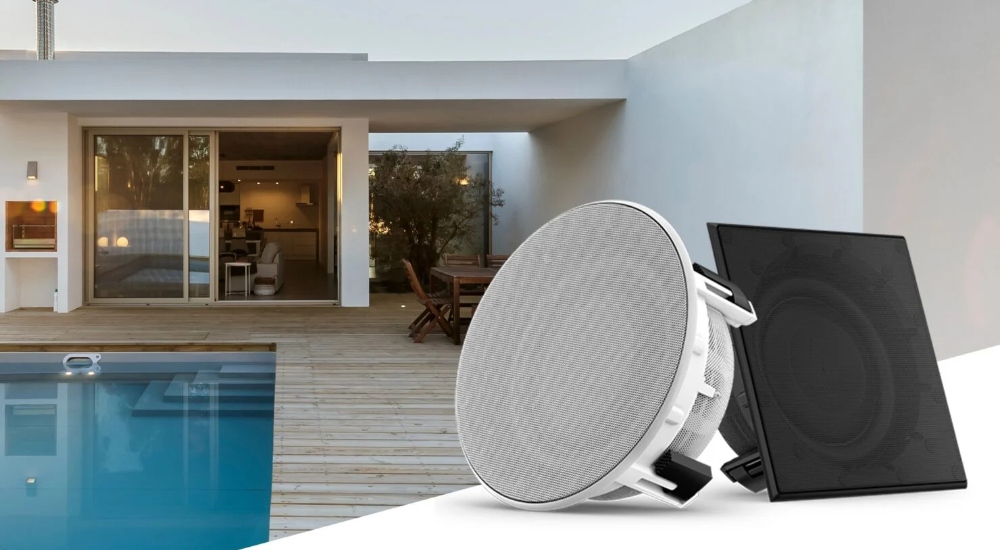
One of the best things I have seen at the CEDIA Expo so far this year is over at the Atlantic Technology booth.  They are showing an IP ready speaker for only $100 dealer.

I have been very involved in all of the standards groups for many years, but you may want to pay attention to what the IEEE 802 Audio Video Bridging task force is working on.  These Ethernet standards called AVB will enable some real progress with QoS, and packet tagging, as well as SRP or Stream Reservation Protocol.  These efforts are ongoing and the first will be up for ballot very soon.  Look for these AV streaming efforts to become published standards by Summer of 2010.

In the meantime I recommend every AV dealer consider taking networking classes given at CEDIA, or even attend the AVAD basics of networking sessions that are scheduled at each Vend-O-Palooza events.

Posted by Julie Jacobson  on  09/10  at  02:02 PM

thanks for the heads up, Michael. I’ll definitely check it out.

Why don’t you write that 802 story for us??

Posted by Wynn Smith  on  12/21  at  01:23 PM

Julie, here it is almost five years later, and… you’re still right.  We’re talking about device communication, which means we’re talking about bits on a medium.  TCP/IP gives us neither.  The medium is Ethernet, or Wi-Fi, or Z-Wave, or Zigbee, or any of dozens of mediums.  And all of the proposed QoS solutions define priority between segments, not within segments.  In other words, collision based mediums can never truly solve the problem.  And since we’re talking about device communication, we’re also talking about agreeable semantics.  To propose new protocols on TCP/IP means to build more layers on top of TCP/IP, on top of Ethernet or something else, and to fill a device with power-usage and cost beyond the reach of 95% of things that use a battery or plug into a wall socket.  Remember this acronym… CCTG.  It will do for Home Automation what USB did for the node sales market.

Page 1 of 1 comment pages
Post a comment
Name:
Email:
Choose smileys | View comment guidelines
Remember my personal information
Notify me of follow-up comments?

Sponsored Links

  About Us Customer Service Privacy Policy Contact Us Advertise With Us Dealer Services Subscribe ©2012 CE Pro
  EH Network: Electronic House Electronic House Ideas Commercial Integrator ChannelPro ProSoundWeb Church Production Worship Facilities Electronic House Expo Worship Facilities Expo