Recent News

Russound Launching Viiv Media Center with Lifeware
One of the most popular purveyors of dedicated music servers finally embraces MCE.

01.07.2007 — Media Center has arrived.

That’s a statement I haven’t made before, even when we put Vista and Media Center on the CE Pro list of Top 5 trends for 2007. But I’m making the claim now because one of the kings of custom—a purveyor of one of the most popular music servers in the custom channel—is coming out with a Vista Media Center PC incorporating Intel’s Viiv technology.

Yes, Russound has become the first of the big four manufacturers of music servers (Escient, Elan and Request are the others) to embrace the PC-based system that has been so spurned by the developers of so-called “dedicated” media systems.

The time was right, explains Jeff Kussard, vice president of strategic development for Russound. “We had experience with networking in the early days, and we learned from our mistakes,” he says, noting Russound’s acquisition in 2001 of Intellinet, perhaps the first developer of IP-enabled distributed-audio systems for the custom channel. “At that time, we expected there was a higher level of proficiency both with the manufacturers of home networking products, as well as the dealer community. That wasn’t the case then.”

It is now.

“With advances in standards and technologies like DLNA [Digital Living Network Alliance], UPnP [Universal Plug and Play] and [Intel’s] Viiv, and with Vista releasing, we felt it was the appropriate time to get into it,” he says. At the same time, he notes, traditional A/V integrators are becoming increasingly more savvy in networking and other IT functions.

Russound Music Server: In the Beginning

Introducing its Smart Media Server (SMS3) in 2004, Russound was late to the music-server game, but has managed to become the most widely used media server in the integration channel, according to a 2006 brand survey conducted by EH Publishing.

The product can supply three music streams simultaneously, with control and metadata available from any of Russound’s extensive line of touchscreens and UNO keypads, via the company’s RNET protocol.

The new Media Consoles will also include an RNET port for communicating with other Russound products. Kussard promises that the unit will offer a slew of other integration-oriented features. “It was designed purely from the perspective of traditional custom electronics pros,” he says. “What does the Russound brand and promise represent? We hear from the marketplace that dealers appreciate that our stuff just plain works. On the rare occasion that there is a problem, we provide excellent support.”

Traditional custom-oriented manufacturers and integrators alike have shied away from Media Center Edition (MCE) PCs for many reasons, including concerns about reliability, lack of user interfaces besides the television, and the difficulty of incorporating an MCE into a whole-house audio system. That and a lack of HD support besides over-the-air.

Russound can’t do anything about the last matter (although CableCard is supported in Vista Media Center), but the company says it will address many of the other issues that plague MCE. In terms of reliability, Kussard wouldn’t say exactly how Russound would do it, but he promised the company “would mitigate concerns that tend to come with PCs. We’re making a real investment there.”

Kussard hinted at something called “system recovery” and said Russound is doing “some unique things” in that area involving “self-correcting, self-diagnosing” features. “We’re making a real investment there,” he says.

On the audio-distribution front—Russound tops that list, too, on the EH brand survey—the company will offer a “strong linkage between the Media Console and our existing range of distributed-audio products,” Kussard says. “We are definitely going to come to market with an interface to the RNET world.”

The Media Consoles will include card slots for devices like radio tuners and other legacy sources.

Some of the help is coming from Exceptional Innovation, which is providing a special version of its Lifeware software for the Media Consoles. Russound has been working with EI for about a year. With an MCE running Lifeware, users can receive metadata and control the audio from UNO keypads. And it’s no easy feat to get MCE metadata on inexpensive keypads.

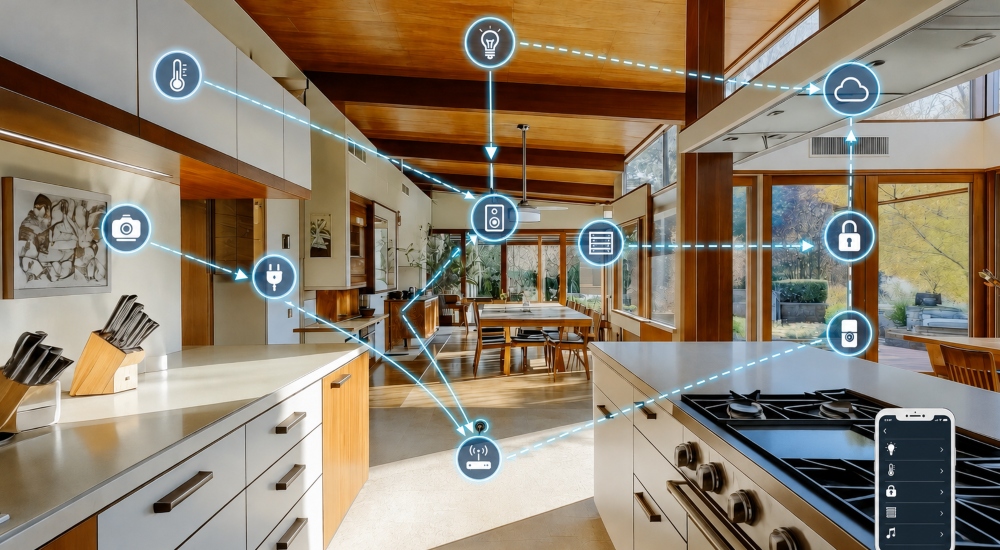
Loaded with Lifeware, the Media Consoles can control other subsystems including lighting and HVAC, but don’t expect Russound to come out with its own line of automation products anytime soon. The automation question has lingered for many years. We’ve all been wondering: Why doesn’t Russound incorporate some automation in its product line—at the very least some lighting controls?

Kussard says, “When I arrived here [Russound, in 2003], one of the first topics of conversation was: When do we move towards system integration, because people were asking if we could control lights and other devices.”

Wisely, I think, Russound decided not to go it alone. “In order to get into it and be successful, we would have to make a huge investment in creating drivers. That’s the key advantage of legacy [home-control] companies—they have a deep database of drivers and the mechanisms to build them.”

At this time, however, with Internet-oriented standards around the bend, it might seem a little silly to start building all those drivers for analog systems. DLNA, UPnP and other standards, ultimately, may “render those [database] libraries somewhat archaic,” says Kussard. So Russound waited for the standards and technologies to progress, “rather than trying to catch up in a race” against existing home-control vendors.

For its part, EI embraces the Web Services for Devices (WSD) protocol for device discovery, communications and control. Rather than creating drivers for legacy systems, EI essentially WSD-enables them through software and, if necessary a hardware bridge, allowing them to communicate with virtually any WSD-enabled system.

Kussard says that teaming a Media Center with automation software was the right approach for Russound’s entrée into the home-control biz. “It creates an opportunity for us to come to market with a whole system for control and integration,” he says. “It is another component for the Russound family and offers a strong value proposition. It becomes cost-effective and accessible, and more attractive to integrators who have typically seen themselves as home theater and distributed-audio dealers. It opens up a whole new community.”

Kussard says there will be several Lifeware options for Russound’s Media Console customers—possibly a stripped-down “teaser” version, a more robust pre-packaged system, and a customizable option.

Likewise, Russound will offer a few versions of the Media Console, with a higher-end system in the $6,000-$7,000 range, a more moderately priced system, and one very affordable system that will “still support Vista and will be Viiv compliant, but it will be light-weight,” Kussard says.

To support the line, Russound will come out with “several touchscreen-type products” and RF remote controls, Kussard says. (Sideshow enabled, perhaps?) “We recognize that the 10-foot [TV] interface isn’t the one that is going to be used 100-percent of the time.”

The interfaces will allow access not just to audio, but the other subsystems controlled by Lifeware.

Wither the SMS3?

Russound’s SMS3 system isn’t going away. “We’re not so naïve to believe that convergence is going to happen overnight. A lot of people want to stick with the tried and true.”

Even so, Kussard says the experience developing the MCE-based Media Console has provided many ideas that can be incorporated into the SMS3, so Russound will take “a good hard look at the next iteration of what the SMS3 might look like.”

Likewise, the experience developing the SMS3 in the first place has been invaluable in creating a PC-based system, Kussard says.

In Closing

The Smart Media Consoles should be available in the May/June time frame.

Russound’s getting into the Media Center business is a big deal. It is a coup for Microsoft—which actually built many integration-customization-friendly features into the Vista version of Media Center—and especially for Intel, which has been struggling to bring its Viiv message to the custom channel.

True,Audio Design Associates (ADA) and Integra were the first two custom-oriented A/V manufacturers to come out with MCE products. That was nice, and certainly an endorsement of the platform, but Russound’s reach is simply much wider.

Furthermore, Russound has truly broken the stronghold that the dedicated music server has on the custom channel. These dedicated products aren’t going to go away. I doubt even that their popularity will wane, as they are much better than MCE for distributed audio in many ways.

But Russound knows that it can’t ignore the Media Center platform. And with Russound’s lead, integrators are bound to come to the same conclusion.

At CES, Russound is in the South Hall, booth 21728, but you’ll need a special invitation to the company’s hotel suite to get a glimpse of the Media Console.

FLASHBACK: Kussard in 2002

Look what I found! Notes from an interview with Jeff Kussard in April 2002, when he was with Harman International.

Thankfully, Kussard is completely consistent between then and now, so I won’t be embarrassing him here. Agreed, it would have been much more interesting if we had a good flip-flop.

Here are some excerpts:

Whether we want to admit it or not in the traditional A/V and CE industry, we’re already knee-deep in PC technology.

The challenge for us is where media delivery becomes a commodity in the PC environment. There’s an awful lot of folks out there that aren’t comfortable with the PC for delivery of media in the home.

Rather than us [CE vs. A/V] trying to duke it out, we need to find ways to work together to leverage our core competencies ,

The consumer wants good quality media, readily accessible through a user interface that’s intuitive. If you look at the traditional TV and hi-fi world, we’ve gotten pretty good at delivering media. Anyone can walk to a hi-fi system and pretty much get what they want. Anyone can navigate a TV and be pretty satisfied.

You can’t say that about the PC, but the PC guys have all the horsepower. You need to get those two camps working together.

Compaq is making an attempt to move in this direction, but they still hang onto PC-centric sensibilities.

I just want to push a button and get my favorite radio station—I don’t want to have to navigate through all the junk.

PC manufacturers and software developers boast that their new platforms [Windows] are better than DOS, but they don’t compare it to microwaves and toasters.


Subscribe to the CE Pro Newsletter

Get the latest news, products and more delivered straight to your inbox.
This entry has been viewed 2880 times.

tags
Subscribe to the CE Pro Newsletter
Subscribe to Email Alerts
Subscribe to the newsletter today! 

tagsThis Article Tagged

tagsNews Feeds

tagsSocial Bookmark
Submit to: , Digg, Delicious, Slashdot, Reddit, MyYahoo!, Google, Technorati, Learn about social bookmarking

Comments

Post a comment

Name:

Email:

Choose smileys | View comment guidelines

Remember my personal information

Notify me of follow-up comments?

Please answer the question below:

Type the 2nd letter of the word "speaker":


Rate this article
You must be logged in to rate articles. Login or register.
  • Currently 0/5 Stars.
  • 1
  • 2
  • 3
  • 4
  • 5
Average score: 0 / Total votes: 0