SoundVision: Man on a Mission

SoundVision credits its Values, Vision and Mission statements as motivating factors in maintaining a 60/40 equipment-to-labor profitability ratio.

image

Scott Sullivan, president of Novato, Calif.-based SoundVision, engages every one of his 20 employees under a mission of super efficiency. The company is focused on maintaining a high number of billable hours.

By Jason Knott
November 13, 2008
If words had no meaning, people would never have been inspired by the eloquence of the Gettysburg Address or the Declaration of Independence.

Likewise, SoundVision in Novato, Calif., doesn't just see its company "Values," "Vision" and "Mission" declarations as words on pieces of paper.

Indeed, every employee is required to memorize the company Mission Statement, understand the meaning behind every word and use it as the guiding force for every decision they make on the job.

In fact, all 20 employees have the 54 words posted in their offices or cubicles and they all have to sign a commitment to abide by its principles -- or they cannot earn a bonus.

It's a bold statement about the passion president Scott Sullivan brings to the company on a daily basis, a passion that seems to permeate the entire company.

Unlike some custom installation firms, SoundVision has set-in-stone parameters for the profitability of every job. If the job cannot meet those parameters, the company rejects it.

Quick Stats
  • Company: SoundVision
  • Location: Novato, Calif.
  • Web site: www.svsf.com
  • Principal: Scott Sullivan
  • Years in Business: 10
  • Revenues (for 2007): $4,389,658
  • Number of Employees: 21
  • Specialties: Integrated systems in existing homes and new high-end custom homes.
  • Top Brands: Crestron, Lutron, On-Q/Legrand, Denon, SpeakerCraft, Runco
  • FYI: "Always be profitable. Never throw a bunch of money at something and try to make it up on other jobs."
Meanwhile, the company is a model of efficiency, claiming to bill as much as 80 percent of technicians' time to clients -- a remarkable percentage in this industry.

Finally, in the heart of affluent Marin County near San Francisco, the company is on the cutting edge of green technology, presenting "socially responsible" proposals to every client.

Repeatable Systems Are the Mission


This is SoundVision's Mission Statement:

Soundvision is a team of well-trained professionals whose purpose is to integrate lifestyle-enhancing technology into discriminating customers' homes. We focus on aesthetic impact, we design for intuitive operation, and our methods promote trouble-free system performance. Our goal is to provide systems and experiences that exceed expectations and result in strong referrals.

It's clear that Sullivan is a meticulous planner and inspirational leader. In fact, 10 years ago when he first sat down to form SoundVision, he realized he needed to have a clear purpose that would engage every employee.

His first step was to ask, "What is our vision?"

"I am a believer in setting goals and writing them down and creating a roadmap," he says. "We created a strategic plan, and every year we create a plan to reach those goals. Our Mission Statement is what we actually do every day. Every single employee here has our Mission Statement memorized."

In fact, he adds, "You cannot get a bonus here unless you can recite it in front of everyone."

And it's not just a matter of knowing it by rote; each sentence is discussed. "Our Mission Statement is about who we serve. It clearly defines who our client is, how we serve them and what we serve them," Sullivan says.

"It says that we are not a company that does funky, quirky jobs. So, if any employee is ever unsure about what to do in any given situation, the Mission Statement should answer it. It talks about clean design, trouble free, with minimal impact on the aesthetics of the home. The plan is for it to have a daily impact on decision-making in the company."

When Sullivan describes "funky, quirky jobs" what he really means is that SoundVision, like a lot of other dealers, has recognized the value of repeatable, sustainable installations.

According to Gene Quisisem, principal designer, completely custom systems are, in essence, "prototypes" that can be expensive to design and maintain -- and can potentially be unreliable.

"We choose not to design and install prototypes. Our systems are repeatable," he says. "To do that, we stick with a small corps of manufacturers and products that work really well together. Then, we sell it over and over again.

"We are disciplined with our clients to not talk about what they could do, but focus on what they should do. At the end of the day, they really want a system that is simple to use and very reliable."

Sullivan and Quisisem are the company's two principal designers. Meanwhile, veteran Chris Wall is the operations manager, leading installers, project managers and engineers. All the programming is done in-house.

SoundVision's focus on repetition is mirrored by the cross-training of employees, who each know every product. There are no specialists; everyone can do everything.

This allows the installation teams to be mixed up.

The company's project managers run the jobs, procure the equipment, communicate daily with the clients and manage the budget.

Even though the installation teams switch around and work for multiple project managers, Wall tries to keep the same team on a single job.

To make that interchangeability easier, the company prides itself on quality documentation in its job binders that can bring any technician up to speed on a job quickly. The binders include plans and job photos.

60% Equipment Profit Is the Vision


This is SoundVision's Vision Statement:

Our vision is to be the most organized and efficient company in the industry. We will clearly define success for each position, process and project. Our professional staff will be equipped with the documentation, tools and training they need to be successful. We will provide the best work environment, compensation and recognition to attract and retain the best people. We will provide a superior level of service and value that keeps our customers and colleagues referring their friends and clients.

The company's business model is simple: It does not seek out small projects in general, and it works only within a 30-mile radius of the office.

The business model dictates that in order to be profitable, 60 percent of its profit must come from equipment and 40 percent from labor.

"We must sell equipment to make a profit. So, we need projects that include whole-house controllers and speakers that can be marked up. It is not a sustainable model for a 20-person company like ours to do jobs that don't allow us to mark up the product and earn 60 percent of the total revenue from the equipment. Even 50-50 doesn't work," remarks Quisisem.

Therefore, SoundVision only accepts projects that allow it to earn 60 percent on equipment -- period. It qualifies all of its projects for that ratio and passes up labor-intensive jobs.

That 60-percent guide also means the company won't try to gouge clients.

"We are not going to be the cheapest, and we are not going to be the most expensive. I won't switch lines because it offers more margin than the one I am carrying. I want to make a reasonable profit," says Sullivan.

"The goal is not to maximize the profit on every job, but to maximize the customer value."

Right now, the biggest challenge facing the company is a slowdown in the pipeline of new leads. Sullivan says the phone used to ring five times a day; now the company is doing things like sending out e-mail newsletters and solidifying relationships with designers, architects and general contractors.

"The momentum has slowed, but there is still business out there," Sullivan explains. "We need to make ourselves more visible in the market to get the opportunities. We can't cherry pick the projects anymore."

Weekly, the entire company meets in its "war room" for scheduling. Not by accident, the room has three large, framed documents on the wall: The Values Statement, the Mission Statement and the Vision Statement.

In that setting, resources are aggregated and a determination is made as to who is the most appropriate to handle a particular job.

"At the end of the day, it's all about billing efficiency," Quisisem says.

"Everyone must be focused on getting a high number of billable hours. We monitor this very closely in our accounting systems. A portion of everyone's pay is calculated based on their percentage of their billable hours.

For example, a technician's goal is to bill 7 hours per day. For project managers, the goal is to bill 60 percent to 70 percent of their time.

Engineers should bill 80 percent. At the end of the year, employees can earn profit sharing. So, every employee is incentivized to focus on productivity.

"We try to control ‘wandering time,' such as inefficient research or development of projects that are not pending," Quisisem explains.

"The health of the organization is driven by the efficiency of our billing hours. We need to keep the schedule full of work, and when we do the work, we need to get paid."

One unique way the company focuses on productivity is through its "SoundVision Proud" program. Every Friday at the company-wide meeting, employees are invited to share a photo from the week's work, showing off something of which they are proud, whether it's a media jack they sold or a new Web site page that's been developed.

The program captures all those various tasks and helps SoundVision develop better instructions for future jobs. It also helps accelerate a new technician's ability to learn.

Creating a Very Green House


San Francisco, the land of many old hippies, can easily be labeled as the hub of the green movement in the U.S. and SoundVision is catering to that trend.

The company offers proposals it calls "socially responsible" (not green) to clients. Its eco-friendly focus can be personified by its latest project, an ultra-green 5,000-square-foot zero-energy home nestled on cliffs above the edge of San Francisco Bay in the upscale town of Tiburon.

The home is the poster child for the blending of high-tech low-voltage controls with line-voltage limitation.

SoundVision was brought onto the project a little late by the electrician, but was still able to design a system aimed at cutting the home's power consumption by 80 percent.

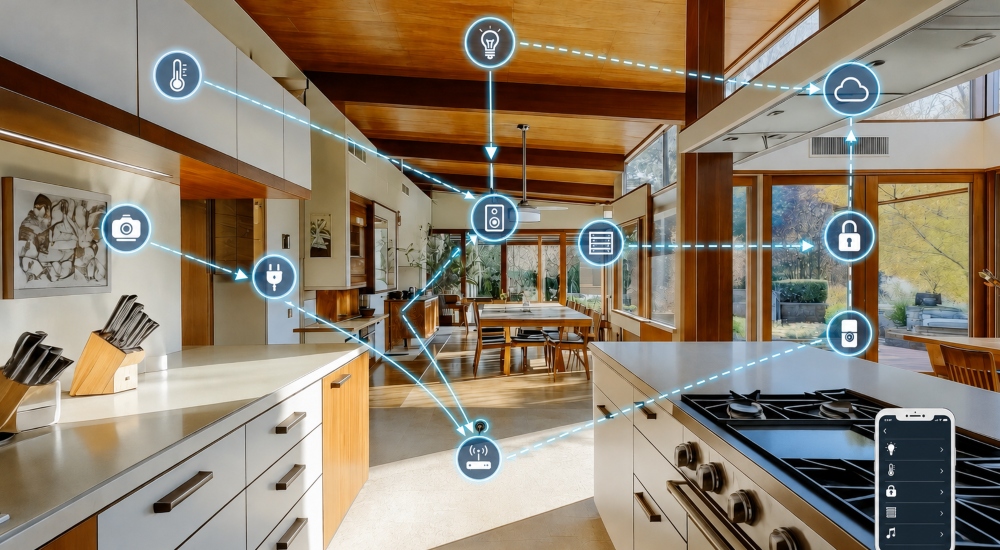
The centerpiece of the installation is a system called Resource Monitor from Agilewaves Inc. that enables the homeowner to set parameters for automatic shutoff of equipment in the home.

Integrated with Crestron whole-house controls, the system automatically actuates change to alter gas/water/electrical usage to stay within prescribed limits, giving homeowners complete automated control over his utilities with a low-voltage system.

The Resource Monitor system works using toroidal rings that are placed around line voltage circuits to measure electrical usage, which are then connected to a central processor.

With these in place, homeowners don't have to run, for example, the refrigerator from 1 a.m. to 2:30 a.m., when it won't lose a single degree of temperature if turned off.

In fact, hundreds of watts can be eliminated by cutting power to systems not in use.

Not only does the system shut down major appliances, like the refrigerator, in the middle of the night, but it also transfers the power draw from the fridge to the solar panels during peak usage times, like 2 p.m. and 4 p.m., when electricity costs more.

Quisisem estimates the system will cut the fridge's power usage by 16 percent immediately.

The Tiburon home also includes:
  • Crestron Processor
  • 3 TPS-8 Wireless Touchpanels
  • Velodyne In-Wall Speakers
  • Leon On-Wall Speakers
  • 30 Lutron Shade Controls
  • Lutron Lighting Control
  • ReQuest Server
  • Pioneer Elite 60-Inch Plasma
  • Panamax power management
The home also features a full 12-kilowatt photovoltaic system that is monitored and maintained through the Agilewaves system.

"We were lucky enough to get [Agilewaves] involved at the very end of the rough-in," Quisisem says.

"So, we were able to run the wires and make some adjustments to accommodate the details. Primarily, we needed pre-wire the low-voltage to the subpanels, rainwater cisterns, water main and gas main. The electrician didn't have to do anything different in this case."

Interestingly, SoundVision eliminated the Panasonic digital phone system from the home because of the wattage -- the PBX (private branch exchange), four wireless access points for the phones and six cordless phones amounts to 250 watts of continual draw, and there is no way to shut it off.

Instead, the homeowner decided on a single POTS line and two cordless phones that draw under 10 watts each.

The key to the Tiburon home's green systems is simplicity, Quisisem explains. "It has to be simple to use. It cannot be complicated to conserve."

Similar statements can be said of SoundVision's meticulously documented approach to management.

The company's overall vision for the future, it's mission in accomplishing that vision and the values by which it formulates that mission -- they're all at the fingertips of the SoundVision team.


Return to full story:
http://www.cepro.com/article/soundvision_man_on_a_mission/