Takeaways
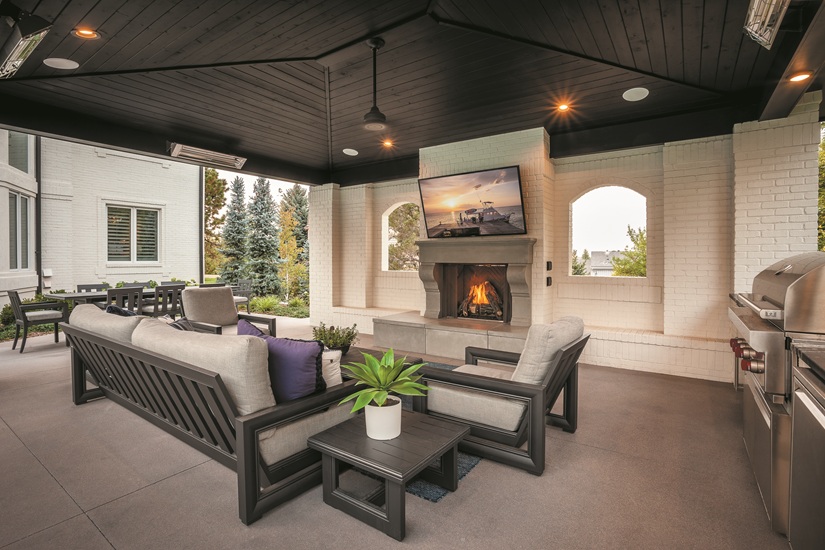
- Outdoor video systems are finding increasing representation on projects where outdoor technology is being installed.
- Three quarters of integrators now report installing outdoor access points to extend networks.
- Camera installation for security systems is shifting away from house-mounted cameras to pole-based systems.
Outdoor technology projects continue to be anchored by audio, but CE Pro’s latest research shows a broader mix of systems shaping today’s installations.
As integrators expand their approach to outdoor living spaces, video, networking and security are playing larger roles, creating more complex and higher-value projects, according to CE Pro’s 2026 Outdoor Technology Deep Dive.
Audio Remains the Foundation
Audio continues to dominate outdoor installations. The vast majority of integrators report including audio in at least 76% of their outdoor projects, with nearly 30% saying it appears in every job.
What is evolving is how those systems are designed.
“People don’t want to see the black boxes mounted to the house or the underside of a gazebo,” says Dusty Gorski of Colorado-based custom integrator ListenUp. “Sound quality is far superior if you can add free-standing speakers. Nobody wants to see a subwoofer sitting out on their deck, so to have one buried in the ground near the seating area, with landscape monitors hidden in the brush, gives you superior cosmetics and, even more importantly, far better music quality.”
That shift toward landscape-based and architectural solutions reflects both aesthetic and performance priorities, particularly in higher-end projects.
In Southern California, the demand remains consistent.
“Outdoor audio is a natural here,” says Russell Gaskamp of luxury Southern California integrator LA Techs. “Everybody wants it. I’ve got a Sonance show kit that I just take around and it basically sells itself.”
Want more outdoor technology insights? Download the 2026 CE Pro Outdoor Technology Deep Dive here!
Video Gains Momentum
While audio is nearly universal, video adoption continues to grow. Outdoor displays are now appearing in roughly 26% to 50% of projects, depending on the integrator.
Displays under 80 inches remain the most common, but pricing dynamics continue to shape purchasing decisions.
“As the prices come down, it’s easier for us to sell a quality product to clients,” Gorski says. “They’re more accepting of it because, traditionally, some of the first outdoor TVs were prohibitively expensive.”
At the higher end of the market, integrators are exploring more ambitious installations.
“The form factor you’re able to get with a video wall on the right house is a showstopper,” Gaskamp says. “I really want to sell a big video wall and stick it on the side of somebody’s cabana because I think that would be incredible.”
Projection systems remain a niche solution, with limited adoption compared to flat panels.
Networking Becomes Essential Infrastructure
Networking is now one of the most consistently deployed elements in outdoor projects. Three-quarters of integrators report frequently installing outdoor access points.
The drivers are not always obvious, but they are increasingly common.
“I think cell phone signal is getting worse somehow and more people are relying on Wi-Fi calling,” Gaskamp says. “And something else we have to do now that we didn’t always have to: if somebody drives a Tesla, we have to make sure there is a wireless access point close to that Tesla.”
As properties expand and connected devices increase, outdoor coverage is becoming a baseline expectation rather than an upgrade.
Security Extends Beyond the Home
Security systems are also becoming a standard component of outdoor projects. Nearly 60% of integrators report frequently installing outdoor cameras.
At the high end, placement strategies are evolving to balance performance and aesthetics.
“The growing trend is not to put cameras on the house anymore,” Gaskamp says. “Put cameras on poles that are less visible. It’s more aesthetically appealing, and it also gives you a better view of what’s actually happening.”
These systems often tie into broader perimeter strategies that include access control and monitoring across the property.
A More Complete Outdoor System
Taken together, these trends point to a more comprehensive approach to outdoor technology. Audio may still lead, but it is increasingly part of a larger ecosystem that includes video, connectivity and security.
For integrators, that shift creates opportunities to expand project scope and deliver more integrated solutions.
As outdoor living spaces continue to evolve, the technology stack supporting them is becoming more sophisticated and more central to the overall smart home experience.