Motorola Back in Home Automation, Acquires 4Home
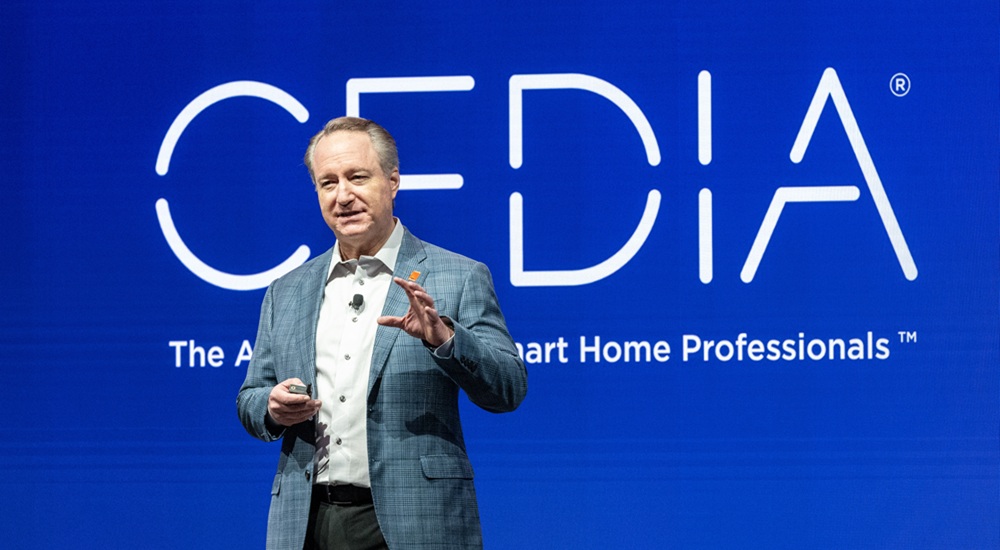
4Home founder Jim Hunter receives an Innovations Award for the ControlPoint home automation platform at CES 2007.
The acquisition is through Motorola Mobility, Inc., the mobile device division of Motorola, Inc. (NYSE: MOT).
Motorola’s earlier efforts with home control were largely through its cable modem and settop box businesses. Perhaps the mobile group will succeed where its cable cousins failed.
A press release announcing the acquisition does not go into detail about the deal or 4Home.
4Home was founded in 2002 (as NearMedia and then 4HomeMedia) by Jim Hunter, a fixture in the home automation industry. The company offers a flexible home automation platform, alternately known as ControlPoint and Fluid, for integrating the typical array of subsystems – lighting, thermostats, security, surveillance, smart grid devices, media and more – into a customizable user interface.
While 4Home has created its own proof-of-concept finished systems, it never wanted to be in the hardware business. 4Home's software is meant to be implemented by third parties in the utility, cable, telco and other service sectors.
Despite several trials with service providers, 4Home has announced few wins beyond a deal with smart-meter developer Sensus. Also, 4Home's chief investor, Verizon, has indicated it would use the technology to deliver the connected home experience via its LTE mobile communications network. Verizon also has shown 4Home software implemented in an Internet gateway.
4Home and Motorola could not be immediately reached for comment about the acquisition, terms of which were not disclosed.
Third Time a Charm for Motorola?
Motorola began its foray into home automation in 2004, when it began selling DIY kits from then-startup Xanboo. Still on the market today, Motorola Homesight comprises an Internet gateway, IP cameras, security sensors and a thermostat for basic remote monitoring and control via the Internet or smartphone – like a simplified version of iControl, uControl, MiCasa Verde (MIOS platform), Schlage or modern-day Xanboo.
Then Motorola got serious, acquiring Premise Systems in 2004, one of the original developers of IP-based home automation systems.
The intention was for Motorola to shrink the Premise OS into a board that would grace Motorola cable modems and settop boxes, providing cable companies with new perks for their customers, and new sources of recurring revenue. Would you like remote home management with your TV shows? That will be an extra $9.95 per month (which is what the Motorola Homesight system requires).
It’s the same dream that cable companies, telcos and their OEM partners continue to chase today:
- Xfinity/Comcast Home Security (vendor not yet named, but probably some combination of iControl and uControl)
- Rogers Smart Home Monitoring in Canada (with uControl, reportedly)
- Verizon (with 4Home)
- Sigma Designs (for cable boxes, with 4Home)
- Cisco/Linksys (earlier home control initiatives, now energy management)
Motorola, likewise, never did anything with Premise Systems, although die-hard fans of the open-platform, highly capable system continue to develop the software.
Subscribe to the CE Pro Newsletter
Read more Mergers and Acquisitions stories
9 Months after Acquisition, HAI Rolled into ‘Leviton Security & Automation’Internet-Direct Manufacturer Emotiva to Acquire Bob Carver, LLC
Jeremy Burkhardt Buys Soundcast, Unfazed by Nortek Non-compete
Nortek to Acquire 2Gig for $135M, Fold into Linear Security
Notable Acquisitions and Start-ups of 2012
More in Mergers and Acquisitions
Article Topics
News · Product News · Home Automation and Control · Mergers and Acquisitions ·About the Author

3 Comments (displayed in order by date/time)
lol@ Guyman.
Motorola tried to jump in before cheap&quick;&good; was possible. Thats why they failed or lost interest in the past.
Today though.. they see ADT Pulse, the iPad and android tablet and they know that they can get fast (an app) cheap (iPad or android tablet) so all they have to do is add in the good. Motorola has its ups and downs but they are good at the good. When they make a good product its usually really good. Think moto razr and DroidX.
They don’t call it the bleeding edge for nothing. There are always bodies on the side of the road as new technologies and implementations are tried out, discarded and so on. Then, the right combination is implemented at the right time, for the right price, and it sticks. These companies can’t afford to NOT try and fail until everything is right.


Motorola; the company that makes CATV boxes with no discrete on / off codes is getting into home automation - nice.