In today’s luxury homes, walls are disappearing. With the push of a button, living rooms open to patios, kitchens extend into outdoor entertainment areas, and the line between inside and out all but vanishes. Today, homeowners increasingly expect wall-less living spaces that extend beyond the confines of the interior and well into the outdoors. For integrators, this shift represents a major opportunity to deliver more immersive, whole-property experiences and increase system value for homeowners. When it comes to lighting, that shift brings a new expectation: a unified, connected experience throughout all living spaces and areas of the property, inside and out, no matter where you are standing, day or night.
Creating a cohesive living environment intelligent, automated lighting design
The challenge with this shift is that many home integration professionals still treat outdoor areas as separate environments. Interior lighting scenes often stop at the glass, and outdoor lighting control is frequently outsourced. When this happens, integrators lose control of the overall experience and give up a valuable portion of the project scope. The result is a disjointed homeowner experience where lighting feels fragmented instead of intentional, breaking the sense of continuity expected in high-end environments.
To account for the blurring of indoor and outdoor boundaries in modern homes, lighting systems should maintain a continuous visual and experiential flow, where the whole property is treated as one environment.
Lighting as a connector of spaces
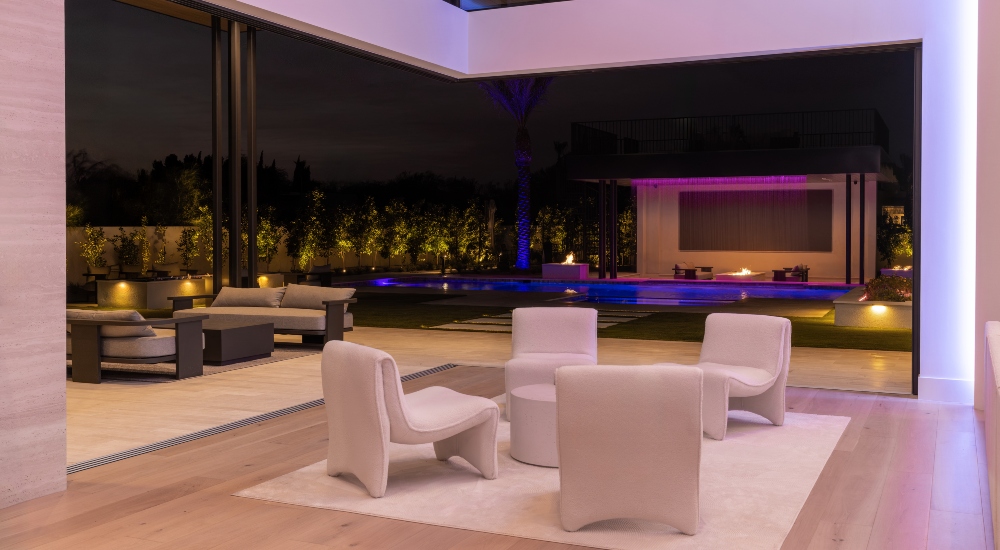
Lighting is uniquely positioned as a unifier of interior and exterior spaces as it influences mood, perception and how boundaries are experienced. When indoor and outdoor lighting are designed and controlled together, the property feels larger and more connected. The living space extends naturally beyond the walls, and the environment maintains a fluid, intentional flow and ambiance, especially at night.
Well-executed outdoor lighting pulls the eye outward, making the entire property feel like part of one cohesive living space. In contrast, poorly integrated exterior lighting can make windows feel like mirrors, visually shrinking the space and disconnecting it from the outdoors. Cohesion is essential. When outdoor and indoor lighting work together, the viewpoint goes beyond the glass, extending to all areas of the property that the homeowner can see, experience and use.
Creating a seamless indoor-outdoor flow
The key to maintaining lighting consistency is coordination. Indoor and outdoor lighting should support how homeowners actually use all areas of the space, and that means thinking in terms of zones and scenes that can span both inside and outside.
For example, a scene designed for events and parties might soften interior lighting while activating hardscape and landscape lighting outdoors. A late-night scene could dim overall lighting levels in the home while maintaining soft illumination along pathways and stairs for safety and navigation as guests exit. Finally, an early evening transition scene might balance natural light while illuminating darker areas around the property to maintain visual comfort across all environments.
From a systems perspective, this approach is familiar. When centrally controlled through smart home platforms like Control4, Crestron, or similar systems, outdoor lighting can follow the same zoning strategies, scene logic, and control interfaces that integrators already use indoors.
Hardscape lighting: forming natural extensions of the home’s design
Hardscapes like patios, seating areas, steps and pathways, outdoor kitchens and more often represent large investments in both construction and design, and they are often closely integrated with or built into the main home. Yet too often, they are left underlit or in the dark.
From a homeowner’s perspective, a lack of hardscape lighting can create a significant limitation. Without illumination, these spaces become unusable after dark the visual impact of the whole-home design gets lost.
Any time hardscape is installed without integrated lighting, the overall experience is impacted. Lighting directly supports safety for wayfinding along steps, elevation changes and pathways. It also affects the usability and perceived scale of each space. That’s why lighting should always be considered during the initial design phase. For properties where all hardscape elements are yet to be determined, a well-created outdoor lighting plan can start near the home and scale as needed over time.
Concerns about fixture visibility during the day largely diminish at night when performance matters most. By selecting the right materials, finishes, and placement, fixtures can remain discreet during the day while allowing the light to extend usability and bring the space to life at night.
Approaching outdoor comfort with indoor system designs
From a technical standpoint, integrating outdoor lighting into the broader smart home system doesn’t require reinventing the wheel. In many cases, it aligns with workflows integrators already understand, including familiar wiring approaches, consistent zoning strategies, unified control interfaces and shared scene logic across environments.
There is massive opportunity in creating intentional whole-home lighting experiences, and this is where integrators have an opportunity to lead. As the boundaries of the home expand, the job shifts from connecting systems within four walls to shaping how the entire property is experienced, day and night.
To be successful, this requires collaborating earlier with architects and landscape designers, thinking beyond individual systems to holistic environments and helping clients understand the value of extending lighting control and design outdoors. Most importantly, it’s about recognizing that the emotional impact of a home doesn’t stop at the walls.
Why this matters to integrators
The concept of the smart home has changed over time. First, it was about individual devices. Then, it became about indoor system integration. Now, it’s about seamless continuity across all areas of the property.
Homes are no longer defined by their walls, and the systems within them shouldn’t be either. Looking ahead, the projects that stand out to clients will be the ones that treat the entire property as a single, cohesive environment. With lighting projects, the most successful integrators don’t just install technology. They use the art and science of light to define and elevate all areas of the home — inside and out.
Ryan Wiliams has led FX Luminaire’s product development for over 15 years in various engineering, product management, and marketing roles. He is Lighting Certified (LC) through NCQLP and holds an MS and MBA in product development from Brigham Young University.