Lighting has far surpassed our original assumptions of it, growing from a functional add-on to a room into a critical lifestyle element that homeowners and building professionals have grown to embrace as time goes on. Central to that development is our own realization of how critical a role lighting plays in one’s perception of a space, and, sure enough integrators, whether intentionally or not, have helped promote that recognition among designers and architects via technology applications that showcase a lot of what modern research has talked about.
Integrators have increasingly leveraged lighting in tandem with home automation systems to create ambience, elevate a home’s aesthetics and enhance the overall efficiency of a space.
Lighting Technology Trends Transforming Homes in 2026
With that in mind, we have some insights from CEDIA Expo/CIX 2025, as well as some industry-leading sources, that reveal six trends set to shape residential and commercial lighting in 2026.
1. Lighting Fixtures Are Becoming Statement Pieces
A surprise trend from this year has been how much integrators have embraced the fixture side of lighting, with unique fixtures being leveraged as expressions of identity for clients.
Statement fixtures act as visual anchors in spaces ranging from boutique offices to high-end residential projects. Designers like Lindsey Adelman exemplify this trend, deploying sculptural, hand-blown glass, resin, and even 3D-printed metal components to create pieces that command attention while complementing the surrounding environment.
Other trade publications, including House Beautiful, have also reported a growing preference for oversized pendants, sculptural chandeliers, and minimalistic but striking ceiling installations that lean just a little bit more into that aspect of “truly custom” integrators are striving towards.
2. Materials Diversity Expands Creative Possibilities
Fitting into the previous trend, the range of materials available to lighting professionals has broadened dramatically. Recycled metals, hand-blown glass, organic textures and biophilic elements, have all contributed to a material palette that was once dramatically slimmer on options.
John Cullen Lighting in its own lighting trends report highlights how wood, linen, and natural fibers are being incorporated into modern fixtures to create warmth and tactility in commercial environments.
This trend also feeds into the rise of sustainable design alongside energy efficiency, offering integrators and designers both aesthetic freedom and environmentally conscious choices to pair with clients interested in better building practices.
3. Lights Are Smart, Adaptive, and Integrated
Modern smart lighting takes the usual simple fixed colors and adds to the aesthetic, comfort and ambience of a room by allowing integrators and designers to create customized scenes based on preferred colors, brightness and even health interests in the case of circadian lighting.
Exhibitors at CEDIA Expo/CIX, such as Deako and Yeelight, showcased this trend with integrated solutions that simplify control while enhancing occupant experience. AiSPIRE also had their own release with the Quartus series, fusing together their lifestyle options into a single fixture that can be easily hooked up to control systems.
4. Layered Lighting Creates Depth and Flexibility
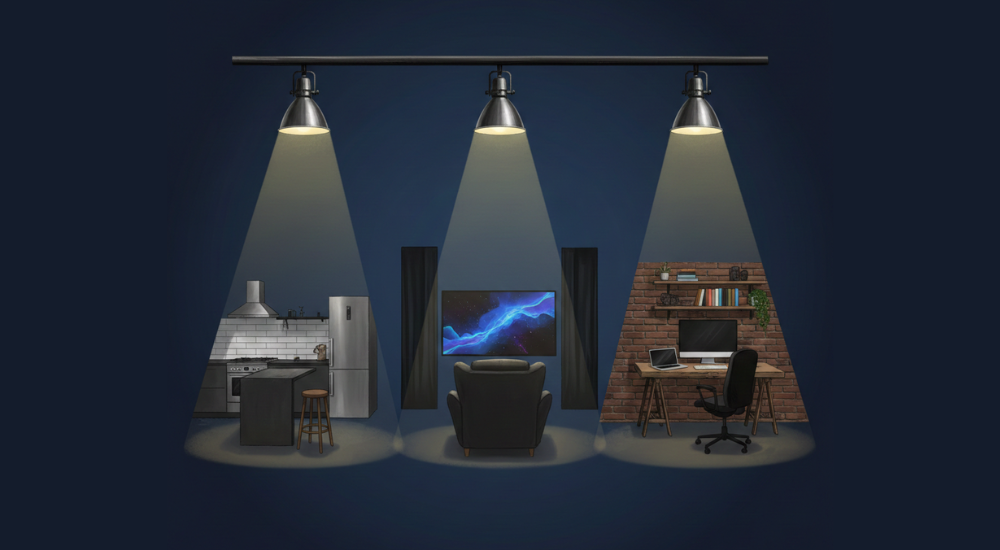
Layered lighting strategies combine ambient, task, accent and architectural lighting to achieve visual depth, functional flexibility, and mood-specific control. Gone are the days of “one and done” illumination. Under-cabinet lighting, soffit lights, recessed strips, sconces and accent fixtures are now standard tools for designers seeking to orchestrate nuanced spaces.
Bryan Hindman Electric notes that layered lighting allows integrators to respond to multiple use cases—a multifunctional media room may need bright task lighting during the day while it’s used as a home office with ambient accent lighting able to dim down in the evening for its function as a home theater.
The modularity of layered systems aligns with the broader trends of smart, adaptive lighting.
5. Energy Efficiency Is Easier and More Impactful
Modern fixtures are significantly more sustainable than their predecessors, pulling far less energy while also being much longer lasting as a result. Companies like Environmental Lights have even developed proprietary systems meant to further extend LED lifespans, meaning installations last a lot longer than what they used to.
Integrators can now also combine energy-efficient lighting with intelligent control systems to optimize usage further, playing into other trends we’ve noticed in the space, the main one being the broader push for electrical independence from the grid.
6. Seamless Integrations Make Lighting Effortless
The last decade has seen a set of broader trends towards simplification of smart home control as a whole, and lighting has certainly benefitted from this. Control interfaces have been refined and tuned across years of input while AI has made voice commands far more feasible as a means of intuitive control.
On the commercial side, you can also provide consistent lighting experiences across multiple spaces. According to Accio, the convergence of lighting with broader building automation systems is expected to accelerate, offering integrators and facility managers both operational and experiential benefits.
“We’re living through a golden age of lighting,” says Jason McGraw, Group Vice President and Show Director of CEDIA Expo/CIX.
“Designers, integrators and homeowners are creating incredible spaces and exceptional experiences in the home and in commercial environments.”