
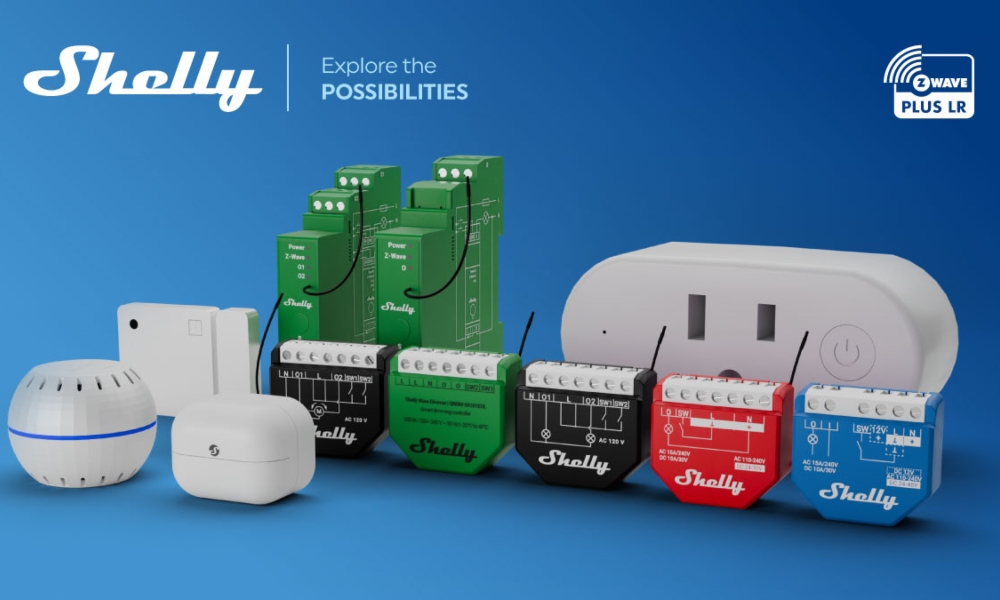
Z-Wave notched a major milestone at CES 2026, announcing that it has officially certified 125 devices under the Z-Wave Long Range wireless standard.
Z-Wave Long Range Origins
First introduced by the Z-Wave Alliance as far back as 2020, the ZWLR specification was designed to break through the traditional constraints of low-power mesh networking.
Essentially, the technology lets devices talk directly to a hub up to a theoretical distance of 1.5 miles, if there’s no impediments (i.e. walls or structures) to the signal—no repeaters or multihop routing needed.
Initial Coverage and Prospects
CE Pro reported on the early promise of ZWLR back in 2020 when the standard debuted, noting its expanded coverage and scalability beyond traditional mesh limitations — including far greater node support and more seamless coverage for peripheral devices like gate access sensors and life-safety peripherals.
The first certified ZWLR device emerged in 2022 with Universal Electronics’ Ecolink 700 Series Garage Door Controller, which, at the time, underscored both the potential and early limitations of adoption.
The Current State of Play on ZWLR
Fast-forward to CES 2026, and the ecosystem has blossomed much further. Manufacturers have since gotten security panels, door locks, thermostats, sensors, gateways and more certified with the standard.
Some recent inclusions are:
- 2GIG GC Touch Security Panel, which brings integrated Z-Wave 800 Series and ZWLR connectivity to residential and light-commercial security installs.
- Alfred DB1 Pro Smart Door Lock, with modular connectivity options including ZWLR for extended range.
- Smart Rent Alloy Fusion Gen 3, merging hub, thermostat and ZWLR connectivity into a single control surface.
- Home Assistant Connect ZWA-2, a high-gain adapter optimized for long-distance links.
- ULTRALOQ Bolt Z-Wave, a smart lock built on Silicon Labs’ ZG28 platform with strong encryption and extended reach.
- Shelly Wave Series, bringing relays, sensors, and smart plugs with long-range performance to broad use cases.
What’s Changed?
Some major enhancements that have been made to the standard over the years include enabling higher node counts per network, enhanced battery life on sensors and continued compatibility within existing Z-Wave ecosystems.
Why It Matters Now
For years, Z-Wave’s mesh networking suited security and home automation projects where devices were clustered within typical residential footprints.
However, as soon as you tried to push that mesh into yards, across buildings or in sprawling multifamily properties, coverage gaps and repeaters became unavoidable.
Considering ZWLR devices operate in a star topology, meaning they require compatible hubs and controller firmware that support ZWLR inclusion, the limiting factor was always going to be adoption on the side of the manufacturers.
However, as more companies ship ZWLR-ready products and controllers, what was once a limiting factor is now giving away to a broader ecosystem, allowing projects that once required RF planning, repeaters and signal boosters to service devices in fringe areas to explore alternative long-range communications as an option.
Final Thoughts
Expect this trend to accelerate through 2026, not just with Z-Wave but on other standards as well, as Zigbee introduced its own long-range communication protocol late last year.





