
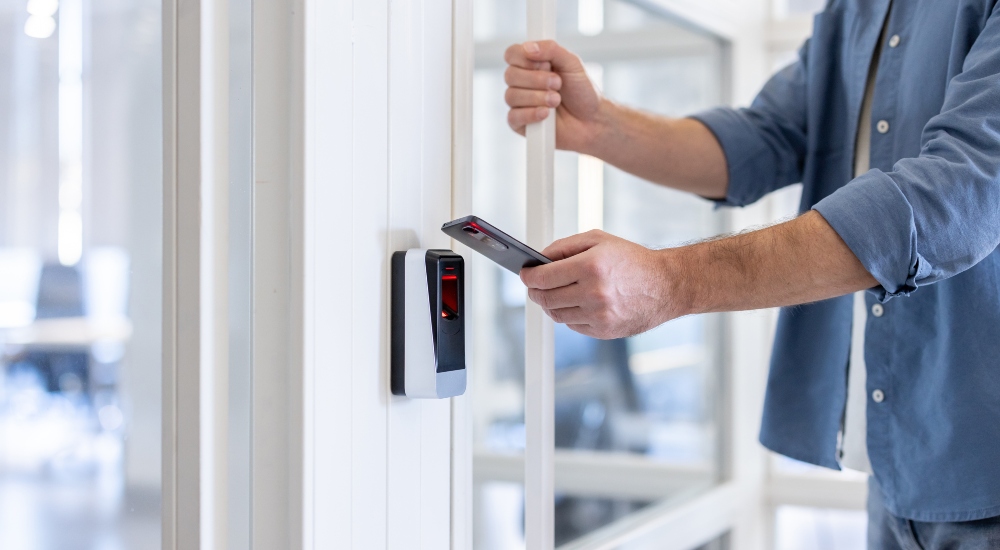
The Connectivity Standards Alliance (CSA) has officially released its Aliro 1.0 specification, which the CSA is hoping will add new levels of interoperability across the varied access control ecosystems currently being used in single and multifamily residential homes (MDUs).
The initiative follows the CSA’s broader push toward interoperable ecosystems, which previously produced the Matter smart home standard.
What is Aliro?
Announced in November 2023, the Aliro 1.0 specification is defined as a communication protocol with a common credential meant to facilitate interoperability between mobile devices, wearable and access control readers. The end goal is, through the adoption of certified devices, to enable consistent experience across all connected hardware.
Put simply, Aliro is a universal standard akin to Matter designed for digital keys. The intent of having them act as a unified system of unlocking for smart locks, with Aliro providing a single communication protocol for everyone to follow, instead of having each brand come up with its own proprietary solution.
How Does it Work?
Aliro uses asymmetric cryptography (otherwise known as public-key cryptography) to unlock devices. A public key used for encryption and verification is held on the unlocking device (say a wearable or mobile device) while a private key used for decryption and signing is held on the locking device (in this case, a smart lock).
These interactions between devices are conducted over wireless communication channels, with Aliro supporting Near Field Communication (NFC), Bluetooth Low Energy (Bluetooth LE) and Bluetooth LE plus Ultra-Wideband (UWB) as means of communication.
Levels of Differentiation
What the CSA hopes will set Aliro apart from other initiatives is the broad support from its members and participating technology partners.
“By connecting the access control industry directly to leading mobile wallet ecosystems, [Aliro] delivers a secure, frictionless experience that goes well beyond the front door,” explained Tobin Richardson, President and CEO, Connectivity Standards Alliance.
The initiative unifies a global collective of over 220 Member companies from lock manufacturers to silicon vendors and mobile platform leaders with the standard already having confirmed commitment from some of the most widely used mobile wallet ecosystems from Apple, Google, and Samsung.
Companies like ASSA ABLOY and Infineon Technologies AG, as well as the mobile wallet providers, provided technologies and expertise towards enabling the Aliro 1.0 specification and are expected to be some of the first to achieve full certification among others such as Kwikset, Nuki and Aqara (who has recently been making inroads with the custom integration (CI) channel).
Future Updates
With the release of 1.0, the CSA aims to maintain Aliro as a living standard that will be updated, much in the same way Matter has been over the years, to keep the standard abreast of real-world use cases.
According to the CSA, the coalition is already looking toward future phases to integrate upcoming market and ecosystem requirements, such as secure key sharing, while maintaining backward compatibility to ensure that current implementations are not compromised as the technology matures.
To ensure global reliability, Aliro also includes a comprehensive certification program and supporting test suites managed through Authorized Test Labs.
Key Takeaways for Integrators
On the client side, the standard is built around providing more consistent, secure experience, with two big benefits being consistency and personal security.
Because of the way the encryption approach works, only the holder of the private key (the lock) can read it. Additionally, because the encryption occurs over Bluetooth and NFC channels, functionality is not tied to a wireless network, thus allowing the locks and keys to function, even in absence of a network connection.
On the install side, custom integrators stand to benefit through easier setup and more efficient troubleshooting across devices from multiple hardware providers thanks to the standardized approach. Additionally, keys can be easily exchanged for faster, bulk encryption in environments like multifamily residences.
Availability and More Information
As with the initial launch of Matter, companies must first incorporate the Aliro standard into their devices to achieve certification, meaning that, despite the standard being released, Aliro cannot yet be widely used by installers or consumers.
Manufacturers (specifically lock manufacturers) are in the process of incorporating Aliro into their products, which, once fully certified, will be represented by a “works with Aliro”-type moniker as part of its device specifications.
To get a better understanding of Aliro, readers can download the specification document for the 1.0 standard directly from the Connectivity Standards Alliance.





