
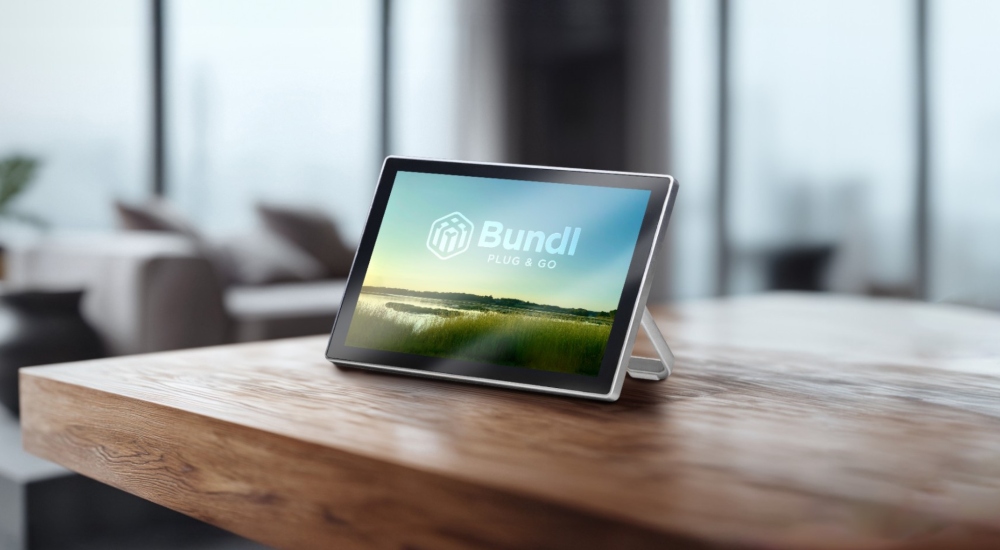
Startup Bundl is striking out with a very disruptive goal: taking what once required a custom integrator and thousands of dollars in labor and condensing into a DIY package installable by homeowners that still provides at the same high-end experience one would expect from hiring a professional.
Why This Matters to Integrators
While Bundl’s kit offerings don’t go so far as to target whole-home projects for disruption, they do aim for another major component of an integrator’s business: media rooms (a category of custom integration that has seen a remarkable resurgence in interest in recent years, making it a prime category for businesses like Bundl to capitalize on). Specifically, the company highlights “120-inch home theaters, immersive gaming suites, creative studios [and] seamless hybrid meeting spaces” in its press release, though no kits currently exist for home theaters on the company’s website.
What Comes in a Bundl Kit
According to Bundl, each kit includes curated devices, touchscreens, accessories, cables, and setup instructions. These products, the company says comprise “the same trusted brands powering enterprise boardrooms, military and government agencies, hospitals and studios.”
The company website currently has its Push Go kit for meeting rooms available with five separate packages ranging from simple to “Pro-Level” plug and play systems. To get an idea of what comes in one of these kits, the highest-level offering in the Push Go meeting room kit features:
- 1 PureLink iCON-T10 Tabletop Touchscreen Controller
- 1 PureLink iCON-E1 Control Expander
- 1 NICGIGA 16-Port PoE Network Switch
- 1 PureLink PS-610 6×1 HDMI/USB-C 4K60 Presentation Switcher
- 1 PureLink VIP-CAM-30-20X HD PTZ Camera
- 1 PureLink DIO-AMP150 Dante 150W Class D Amplifier with DSP
- 1 PureLink RoomView-110W Wall-Mount Room Scheduling Touchscreen
- 1 USB-C Power Injector
- And a full Cabling Kit
Bundl Says It’s Seeking to Redefine Consumer Expectations
The stated goal of Bundl is to “take the world of professional-grade control/automation and audio/video technology” and deliver it in a package that can easily be replicated by everyday consumers.
“We’re giving everyday consumers the ability to build the rooms they used to only see on YouTube tours and tech blogs,” said a Bundl spokesperson commenting on the company’s debut offering. “Your dream home theater, your content studio, your enterprise-level meeting room—these should be attainable, not aspirational.”
But How Big is the Market for DIY Disruption in CI?
Discussions of whether DIY solutions will eat integrators’ lunches have been going on for nearly a decade at this point with co-founder of EH Publishing and founding editor for CE Pro Julie Jacobson expressing her concerns on DIY as far back as 2016, citing increasing capabilities in automation and plug-and-play solutions (such as those being offered by Bundl) posing a problem there.
Jacobson’s view on the matter then looked at it from the perspective of consumers who simply want to avoid the hassle of scheduling and interfacing with contractors as much as possible, to the point where they’re willing to shoulder the burden of installation if it means they can work on the project on their own terms.
The “Do-It-For-Me” Client
Of course, this envisions a single type of consumer, as, in other discussions on DIY, many integrators working in the luxury channel find that clients are far more willing to spend the extra money for professional installation as, when faced with the decision to do it themselves, those clients would rather buy back their time for other activities.
The reality of it is that the CI industry is split between the lower end and the higher end of firms, with there being a clear defining line at the $1 million in revenue mark, meaning that, in all likelihood, both types of consumers are currently being served by integrators.
Silver Linings
A Parks Associates study conducted in October 2025 found that 29% of consumers who attempted to install a DIY smart home system themselves later ended up approaching a professional to deliver on the results. Still: that’s assumedly 71% of consumers who embarked on a DIY solution were subsequently lost as a potential client.
Key Takeaways
As general consumer interest in smart spaces grows, the tech-savvy nature of incoming generations in combination with increasing labor costs do provide very real risk factors when it comes to integrators in specific revenue brackets losing customers to DIY. Think of all the extra revenue companies like Walmart and Costco are making now as customers pulling in six-figure salaries switch to them over cost concerns.
Specifics are sparse on how Bundl’s approach might capture that audience, especially as it relates to the home theater segment—as right now no explanation of process or product is available to the public on that specific category—however, the potential for disruption by DIY is still very real, especially as you look at the lower end of the industry where project sizes dwindle, client income ranges tighten and general priorities shift.





