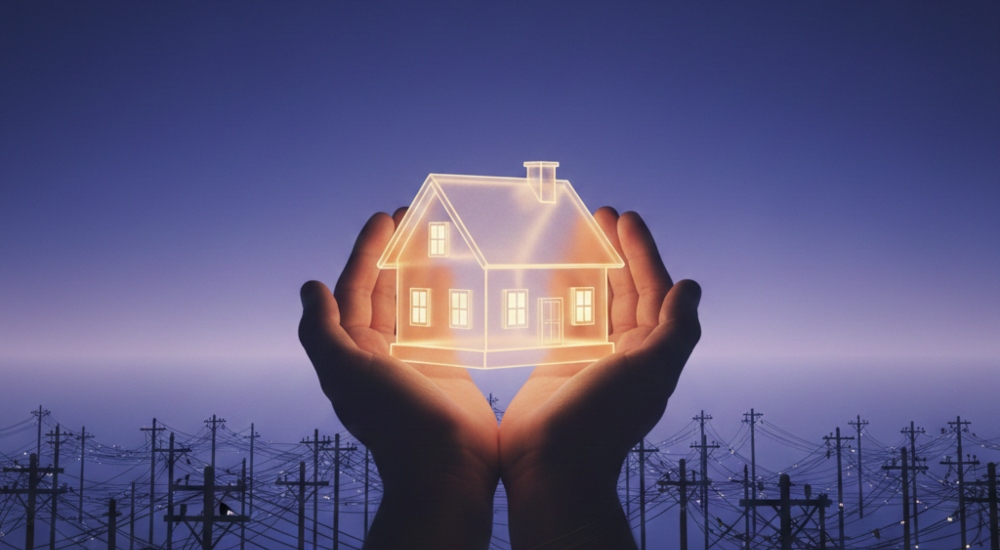
Energy independence for homes really hit its stride in 2025, becoming a more tangible reality (and desire) from homeowners. From smart monitoring services helping shape consumption behaviors to smart energy management systems helping run net-zero homes, innovations in energy and power are reshaping what a home can do.
What Is Energy Independence?
For context, when we say “energy independence,” we’re talking about a home’s ability to produce, manage and store its own energy in a way that minimizes dependence on the electrical grid, ideally allowing it to disconnect from the grid entirely, but those remain rare cases.
To paint a bigger picture, this usually consists of generating electricity (often via solar), storing it for later with a home battery system and then leveraging smart energy management systems to automate usage. Think some of the net-zero homes we’ve posted on CE Pro in recent years.
Why Energy Independence Took Off in 2025
During talks at CEDIA Expo/CIX 2025, leaders in the energy category pointed out one main trend that really pushed homeowners to seek energy independence: the growing cost of energy usage. Utility bills skyrocketed this year, far outpacing regular inflation and being one of the core drivers of overall inflation, despite prices dropping elsewhere in the economy. The reason? Well, there’s two, though one is definitely throwing its weight around more than the other:
- In the lightweight division, automotive electrification has pushed demand a little higher. Adoption rates cratered earlier this year, but recently, ownership of EVs just crept past 5%.
- In the heavyweight division, AI datacenter growth has been chewing through regional energy supply capacity, leading to increased grid security concerns as projects aimed at increasing energy generation have come nowhere near to matching the pace at which these centers are being built.
Additionally, shifting sustainability priorities means that, in some cases, the types of energy sources being looked at need an additional ramp-up in production in order to be able to meet those demands. These factors have made local autonomy look more attractive than ever.
Meanwhile, against this backdrop, technologies that once seemed niche are rapidly gaining ground (think residential solar and battery storage).
The 10 Trends Driving Residential Energy Independence in 2026
Based on how we’ve seen the topic of energy independence develop throughout 2025, these are the trends we’re expecting to see shape and drive the conversation throughout 2026.
1. Net-Zero Homes
A net-zero home produces as much energy as it consumes over a year, and with the right steps being taken on both the technology and design side, a home could even potentially become net-positive.
While costly and outside of the budget of the average American, luxury clients–the likes of which integrators more commonly service–have shown increasing interest in these types of home, being able to foot the bill for the systems that support energy independence in general.
Quite a few net-zero homes have won CE Pro‘s annual Home of the Year Awards the past few rounds, but outside of that, architectural marvels like the Solar Umbrella Home out in Venice, CA exemplify the extremes energy independence can be pushed towards. And that’s without the use of smart tech integrators have access to.
2. Solar Panel Integration
Solar photovoltaic (PV) systems are a quintessential component when it comes to gaining energy independence as, currently, they remain the only widely available consumer option when it comes to home energy generation. Efficiencies will only get a home so far when the power goes out, as, even with a large capacity battery, it would require some significant sacrifices to comfort in order to get energy reserves to last more than a few days without generating any additional energy to refill what gets used.
A boon further pushing their adoption in 2026 is the fact that these panels continue to grow more efficient and affordable. With increased production capacity and declining module costs, distributed solar power is projected to play a larger role in residential energy supplies–especially when paired with smart energy systems.
Additionally, major players in the CI channel, like Savant, are finding it easier to partner with solar companies, making it consequently easier for integrators to partner with solar providers and, ideally, taking out some of the headache when it comes to dealing with the ins and outs of that particular industry.
3. Battery Storage Growth
Like solar panels, batteries are foundational to resilient, net-zero homes. Emerging technologies like sodium-ion and solid-state batteries promise enhanced safety and cost performance, enabling dynamic energy management and longer backup durations. AI-enabled storage systems can forecast usage, optimize charging and enhance self-consumption from solar.
Past that, battery systems connect into another vital aspect of smart home security and longevity: power management. While not present in all battery systems, storage units like those produced by RoseWater Energy provide additional power conditioning to help prevent damage to sensitive electronics from energy entering into the system. Additionally, the act of converting a battery’s direct current (DC) energy to a home’s alternating current (AC) provides a baked-in method of power conditioning for any devices pulling from battery power.
4. Advances in Building Materials
Better insulation, high-performance glass and cool roofing are making it easier for homes to maintain comfortable indoor environments with less energy input, which in turn helps magnify the impact of any renewable generation and storage systems in place.
5. Heat Pumps
Heat pump technology has matured into a cornerstone of energy-efficient homes. Heat pumps move heat instead of generating it, delivering 3–5 times more heating energy than the electricity they consume, while also providing cooling.
In the Northeast, for instance, ground temperatures stabilize around 45-55 degrees Fahrenheit, meaning that a geothermal heat pump can reliably heat or warm a home, regardless of the season. Outside the Northeast, however, air-based heat pumps can do a suitable job, with mini splits becoming a more common retrofit option for heating and cooling homes.
The IEA forecasts steep growth in heat pump installations, reinforcing their role in reducing overall home energy demand.
6. Better Appliances
While modern appliances are dramatically more efficient than their predecessors, it’s developments in energy management systems that now allow integrators to really tap into them in ways that consumer-grade connected home ecosystems having been striving towards for a while now (i.e. allowing the home to make usage decisions based on individual appliances).
It isn’t quite like having your fridge tell your oven when to turn on and off, but when combined with smart energy management systems, appliances can be cycled on and off depending upon energy draw and whether or not the home is currently pulling from battery energy. Maybe one day with AI we’ll get to that level of communication between devices, but for now, this advancement helps homeowners make a little bit more from renewable generation.
7. Efficient Lighting
LED lighting and advanced dimming controls have transformed residential lighting into one of the most efficient (and, for integrators: profitable) aspects of a home’s energy profile. They consume a fraction of the electricity once required by incandescent or fluorescent system, but more than that, simple, in-demand automations like motion activation and circadian scheduling all contribute to the equation of energy efficiency already.
8. Comfort-Focused Design
Architects and designers are increasingly treating energy performance as a core dimension to maintaining a home’s comfort. From regional vernacular design principles to cutting-edge passive techniques, design decisions now shape both form and function in crafting energy-aware homes.
The best way of viewing this is how lighting control plays into lighting. Lighting can make a comfy, feeling space, but lighting control can take it the extra mile of customization. Energy efficient systems, allow homeowners to dial in the perfect level of comfort into their environments without having to worry about whether or not they’re going to take a massive hit to the paycheck. Additionally, during outages, this makes it so homeowners don’t have to forgo creature comforts in fear of running out the battery.
If architects and designers are emphasizing comfort, the HVAC unit plays a vital role in that, and making sure it runs as optimally as possible is a critical piece of the equation to lasting comfort in the home.
9. Shading
Once manual and passive, shading is now easily automated with plenty of retrofit designs that can easily be further optimized by smart controls. Even before today, integrators like Smart PNW have leveraged aspects of design and energy to differentiate their shading business from among competitors in the region.
Responsive shading reduces cooling loads in summer and maximizes solar gain in winter, improving comfort while trimming energy use.
10. Smart Home Technology
Finally—the thread that ties all these aspects together—smart home technology can automate lighting and HVAC, control the shading and now optimize energy flows based on real-time data. AI-driven orchestration across solar, battery and appliance loads boosts efficiency and enables homeowners to reduce grid reliance with minimal hands-on effort.
Newer innovations from the likes of Savant can even go so far as to help redistribute energy to subsections of a grid (such as a neighborhood) allowing groups of homes to gain energy independence from the broader grid while being able to support one another.
The Role of Systems Integrators
“Energy is a conversation for every new build, upgrade, and purchase,” notes Jason McGraw, Show Director of CEDIA Expo/CIX. “And systems integrators are increasingly critical to that conversation.”
Professional systems integrators play a pivotal role in making homes smarter, safer and more efficient by unifying solar, storage, HVAC, and automation, which, in turn helps homeowners realize both energy independence and resilience.
Manufacturers Helping Push Energy Independence
Three companies shaping the future of residential energy management were among the standout exhibitors at CEDIA Expo/CIX this year:
- Airzone offers advanced HVAC control technologies that significantly reduce household energy consumption through intelligent zoning and climate optimization.
- Infratech enhances whole-home efficiency and comfort with its precision electric heating control systems, built to deliver warmth while minimizing wasted energy.
- And Shelly provides a suite of highly adaptable, energy-efficient automation and control solutions that integrate with leading professional smart-home ecosystems, enabling homeowners to monitor better, manage and reduce energy consumption.
Where to Learn More About Energy Solutions
Publications that cover the broader smart home landscape (like CE Pro) can help on the technology side while architecture and design magazines like Archdaily, Dezeen, and Designboom can cover the other half of the equation.
Events such as CEDIA Expo/CIX provide industry-specific opportunities for integrators to learn more about developments in energy independence while exploring products.
There’s also Intersolar & Energy Storage North America, Solar & Energy Storage Summit and Clean Energy Expo for shows that tap into the very specific product category.