

For more than two decades, Stealth Acoustics has focused on advancing architectural audio solutions that deliver high-performance sound without visible technology. Designed to install directly behind finished wall and ceiling surfaces, Stealth’s invisible loudspeakers allow integrators to embed audio into the structure of a home while preserving clean sightlines and design intent.
“Think Stealth First” is becoming the way integrators around the world approach offering “invisible” solutions to their clients and they are leading with invisible, not just using it when they need to. What many don’t realize is that installation is not dramatically different from a traditional in-wall or in-ceiling speaker, except for one key difference: once finished, there’s nothing to look at. Designers love it. Architects appreciate it. End users just hear great sound.
The company encourages integrators to ask end users the question, “would you like visible or invisible speakers”? That is usually met with a puzzled face, but opens an entirely new conversation about the project. Stealth also loves the fact that other manufacturers have entered the category, and it is a “high tide raises all ships” scenario. This is good for the industry and helps integrators provide elegant, design-oriented results for their clients.
At the center of the company’s portfolio is its LineaRadiance series of invisible speakers. Handcrafted in the U.S., LineaRadiance models feature reengineered drivers, integrated back boxes, and redesigned crossovers intended to deliver sound quality comparable to traditional visible loudspeakers. A modular design approach, including recently introduced 24-inch models, provides flexibility for distributed audio, surround sound, and high-performance residential applications.
The company’s approach of prioritizing performance without visual compromise sets the stage for this Seattle-area restoration project, where invisible audio played a central role in preserving the home’s aesthetic vision while delivering immersive sound.
Applying Invisible Audio in a Design-Driven Home
A homeowner in a prestigious Seattle, Washington neighborhood set out to restore a family home while integrating an audio system that would not disrupt the residence’s fairytale-inspired aesthetic. The project required a solution that could deliver high-quality sound while remaining completely hidden, preserving the visual integrity of the space.
Traditional loudspeakers were not a viable option for the project, as visible grilles and other design “giveaways” would have conflicted with the home’s architecture and interior design. The challenge was to find a speaker solution capable of providing exceptional audio performance without compromising the visual environment.
Collaboration and System Design
Image/Stealth Acoustics
Working closely with the architectural firm on the project, Beemer Smart Home identified Stealth Acoustics‘ invisible speakers as the most suitable solution. The speakers were designed to be installed behind finished surfaces, allowing them to disappear entirely into the walls and ceilings.
To achieve a seamless finish, the speakers were covered with Italian limestone plaster. However, the weight and density of the plaster introduced a new concern: the heavy finish had the potential to reduce audio performance if not properly addressed.
Testing Two Installation Methods
To determine the best approach, Beemer Smart Home evaluated two possible installation methods. The first option involved plastering only around the edges of the speakers and color-matching the limestone plaster with paint. The second option involved fully plastering over the entire speaker surface and then calibrating the system to compensate for the heavy finish.
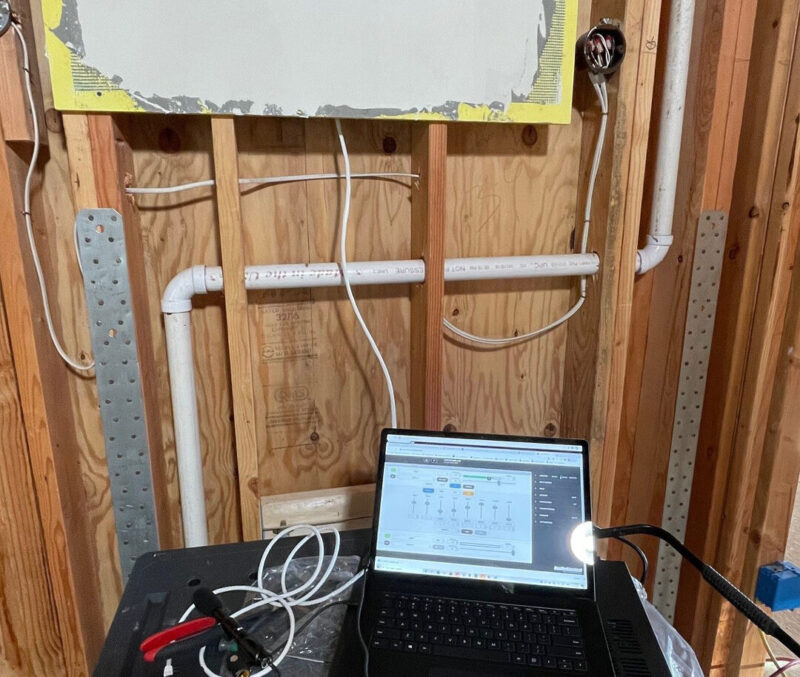
Beemer Smart Home worked with Stealth Acoustics to obtain test speakers and constructed real-world framing assemblies to simulate the final installation. Plaster was applied to replicate the proposed finished environment, allowing the team to evaluate real-world performance rather than relying solely on theoretical modeling.
Measurement and Calibration Process
Testing was conducted using an AudioControl D2800 amplifier with built-in DSP and a pink noise generator, along with an AudioControl SA-4140i SPL measurement microphone and the AudioControl MobileTools iOS application. Pink noise was generated at approximately 75 dB SPL, with the microphone positioned roughly two feet from the speaker surface.
Each speaker was measured both before and after calibration. Following extensive testing, the second installation method—fully plastering over each speaker and precisely calibrating it—was selected as the preferred solution.
Beemer Smart Home’s expertise in acoustic calibration was critical to the success of this approach. Through careful adjustments and repeated testing, the calibrated speakers delivered performance that closely matched that of non-plastered speakers throughout the home.
Final Installation and Results

Image/Stealth Acoustics
In total, Beemer Smart Home installed 34 Stealth Acoustics speakers throughout the residence, including interior spaces and covered patio areas. All speakers were finished to match the surrounding walls and ceilings.
The completed system delivered high-quality audio while preserving the home’s design vision. Music fills the space without a visible source, creating a “magical ambiance” that supports the fairytale-inspired aesthetic.
This project demonstrates how Stealth Acoustics’ invisible speaker technology can be integrated into high-end residential environments without compromising architectural and interior design goals. By embedding audio directly into the structure of the home and carefully calibrating performance, the system provides immersive sound while maintaining a clean, uncluttered visual presentation.
The result is an audio experience that feels natural and effortless, enhancing the atmosphere of the home while allowing its architecture and décor to remain the focal point.





