
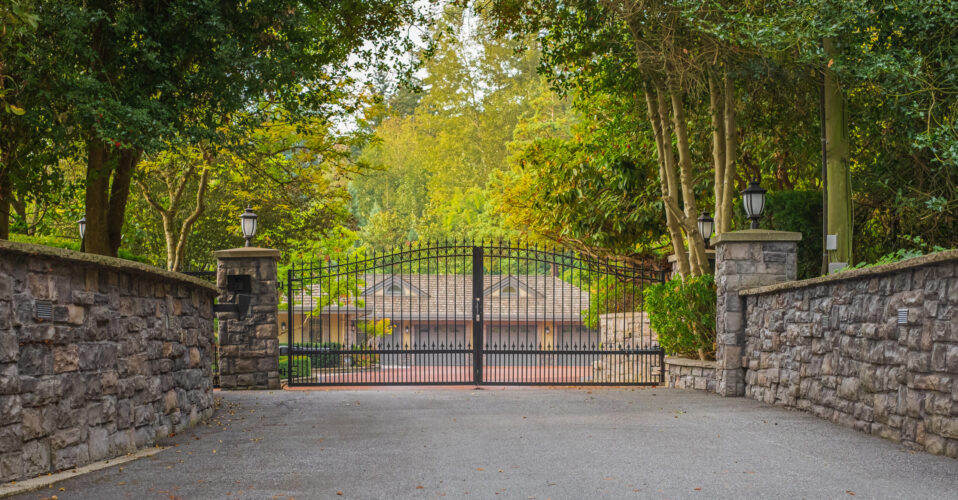
For many homes, especially larger properties and custom builds, the gate is the true first line of defense. It establishes the boundary between the public and private space, extends the protected zone beyond the front door, and sets the tone for a layered security strategy.
As homeowners seek greater control, convenience, and peace of mind, particularly in a world where security is no longer an afterthought, motorized gates are becoming an increasingly important part of the smart home ecosystem. From remote access and camera integration to seamless automation and aesthetic customization, today’s gate solutions offer far more than just simple entry control.
In this Q&A with CE Pro, Nice North America shares insights into why integrators should be discussing perimeter protection earlier in the design process, the features that matter most, and how motorized gates fit into the broader smart home ecosystem.
CE Pro: Are there certain changes in residential lifestyles/home designs that are influencing a growing need for perimeter protection (i.e., people moving out of urban areas to remote areas with more seclusion and property)?
Nice: The growing demand for layered security and convenient, remote monitoring is reshaping how perimeter protection should be designed and structured. It’s a practical response to a world where security has become a priority that goes well beyond door and window sensors or a few surveillance cameras. Modern homeowners are thinking in terms of a comprehensive security strategy—one that begins at the property line and extends far beyond the front door.
CE Pro: How do gates fit into this approach and strengthen a home’s overall security?
Nice: Gates and fencing serve as the first line of defense, extending the protected zone well beyond the walls of the home. By establishing a clear boundary, they expand and reinforce the overall security perimeter, creating a stronger, more controlled environment from the outset.
Today, motorized gates serve as more than just physical deterrents. They are fully integrated components of the smart home ecosystem, often paired with surveillance cameras, intercoms, and access control systems to deliver seamless, connected perimeter protection.
CE Pro: What are the different gate categories available to residential properties?
Nice: Residential gates are available in a variety of styles and specifications designed to accommodate varying site conditions and homeowner preferences. The most common configurations include slide and swing gates, each offered in single- or dual-leaf designs, depending on the driveway width, layout, and overall property requirements.
CE Pro: What tips can you provide to help dealers specify the proper gate solution for residential applications?
Nice: Single-family residential applications are characterized by low traffic volume, a single point of entry and exit, and an emphasis on aesthetics and smart home integration.
MDU properties require commercial-grade operators capable of handling dozens or hundreds of cycles per day. They also require more complex access control systems to manage entry credentials for residents, delivery personnel, service providers, guests, etc.
CE Pro: What are some of the other features to consider that may vary by gate: size, speed, intelligence, integration capabilities, etc.?
Nice: Proper specification starts with matching the gate operator to the size and weight of the gate itself. Undersizing an operator to reduce upfront costs can lead to premature wear, operational failure, and potential safety issues. Correct sizing ensures long-term reliability, smoother performance, and safer operation.
Gate speed is another important consideration, particularly in high-traffic or high-security environments where minimizing wait times and limiting exposure at the entry point are priorities.
Across all applications, safety is non-negotiable. Obstruction detection and protection devices, including photo eyes and contact edges, must be incorporated into the overall design to meet safety standards and protect users.
Beyond mechanical performance, today’s gate operators offer advanced features that enhance usability and resilience. Connectivity capabilities enable integration with access control, surveillance, and smart home platforms. Manual release mechanisms ensure operation during emergencies, and battery backup systems maintain functionality during power outages. Together, these features contribute to a gate system that is not only secure but intelligent, reliable, and future-ready.
CE Pro: Do integrators need to be trained to install gates? Do they work with a contractor who installs them then they program them? How does the design/installation/programming process work and what role does the integrator play?
Nice: Successful installations require close collaboration between integrators and licensed gate installers. While their scopes of work differ, both parties play an essential role in installing, configuring, and integrating the equipment to ensure the system functions properly as a unified solution.
CE Pro: Why should integrators to add gates to their product offerings?
Nice: By adding motorized gates to their offerings, dealers can expand their business while delivering a more complete security solution for the smart home. Gates represent a natural extension of existing automation and security systems. When integrated with a control platform, motorized gates can become part of a broader automation and security ecosystem.
For example, gates can trigger outdoor lighting scenes upon entry, illuminating the driveway and surrounding landscape for added safety and visibility. They can also be linked to surveillance cameras to automatically display live video when the gate is activated, while sending real-time notifications to the homeowner’s smartphone.
By tying gate operation with lighting, video surveillance, intercoms, and access control, integrators can deliver a seamless experience that enhances both convenience and security, creating a more responsive and protected environment from the perimeter inward.
CE Pro: What are the different ways that gates can be controlled? App, keypad, etc. and the pros and cons of each?
Nice: Gates can be controlled by a wide range of accessories that extend well beyond the traditional handheld transmitter. The list of available access control options—offering end users flexibility and convenience—is extensive and includes push buttons, three-button stations, wired and wireless keypads, card readers, vehicle tags, key fobs, intercoms, vehicle loops, and sensors.
Emerging technologies are further expanding these control options. Smartphone apps now enable secure remote monitoring and operation from virtually anywhere, while biometric readers add a layer of personalized access. When integrated with broader smart home control systems, these solutions transform the gate into a seamless, intelligent entry point that enhances both security and everyday convenience.





