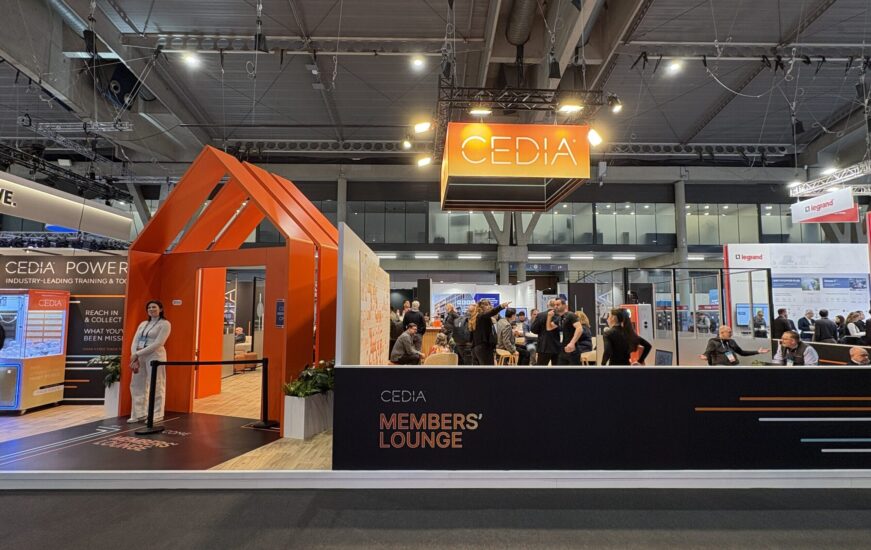
Integrated Systems Europe 2026 once again underscored the scale and momentum of the global integration industry, setting new benchmarks for attendance and show-floor footprint in Barcelona. For CEDIA, the event also served as a strategic milestone, reflecting how the association is positioning itself heading into 2026.
Speaking with CE Pro on the show floor, CEDIA CEO Daryl Friedman emphasized that ISE’s continued growth is tied to its breadth. ISE brings together residential, commercial, lighting, sound, live events and emerging technologies in a single environment. That convergence, according to Friedman, creates value for residential integrators while also exposing them to broader market forces shaping the industry.
“You’ve got so many things to see here,” Friedman said on the third day of ISE 2026, the same day the organization released its initiatives for 2026 in an email to members.
“It’s becoming a much broader focus,” Friedman said. “The residential footprint here is as large as CEDIA Expo, but there’s a lot more to see.”
Global Challenges, Shared Priorities
Friedman noted that many of the challenges facing integrators are no longer region-specific. Workforce shortages, consumer awareness, and government regulation continue to affect markets worldwide, from North America and Europe to Asia Pacific and Australia. While each region operates within its own cultural and regulatory context, the underlying pressures remain similar.
ISE, like CEDIA, launched last week a foundation to address some of these workforce development issues.
“Every community has its own culture, and every community is different, but the challenges do cross over,” Friedman said.
Those themes were echoed throughout conversations at ISE, where Friedman observed a generally optimistic outlook for 2026. After a period of economic uncertainty earlier in 2025, integrators and manufacturers appear increasingly confident as conditions stabilize and businesses adapt to shifting market realities.
“People are excited about the economy after a year of instability, especially in the first quarter,” Friedman said. “I think that has settled down and people are used to the new normal. There’s a lot of positivity about the future and 2026.”
Expanding the Definition of CEDIA
According to Friedman, CEDIA has spent recent years deliberately broadening its identity beyond CEDIA Expo. While the trade show remains a central activity, the association has increasingly focused on workforce development, advocacy, consumer awareness, and collaboration with adjacent trades.
That shift, he said, is beginning to resonate more clearly with members, as reflected in growing engagement and renewed interest in CEDIA’s broader initiatives.
“We’re having really good conversations about CEDIA and we’re seeing excitement about joining,” Friedman said.
Scaling Design and Build Engagement
One of the most significant areas of expansion for CEDIA is its design and build outreach. Friedman confirmed that the association is formalizing this effort by dedicating full-time resources to strengthening relationships between integrators and architects, designers, and builders.
The intent is to help integrators become involved earlier in projects, improve collaboration across trades, and ultimately create stronger business opportunities. Additional activations tied to this initiative are expected to be visible by the time CEDIA Expo 2026 takes place.
“We’re going to resource that much more strongly, because we think that can be a great way to connect our integrators with architects, designers and builders,” Friedman said. “When they do that and have that relationship, they can build their business off of that.”
Now, the organization is looking for someone to lead that initiative and is hiring a full-time director to oversee the design-build program in the U.S. A similar position will be filled in the U.K.
Building a Dedicated Research Function

Photo Courtesy/CEDIA
Friedman also outlined plans for a new research division at CEDIA. While the organization has historically produced annual studies and market sizing reports, the new effort is intended to deliver more frequent and specialized insights.
This expanded research capability is designed to give integrators clearer benchmarks on market growth, compensation trends, and competitive positioning, while also providing manufacturers with deeper visibility into market share and macroeconomic influences affecting the channel.
“We’re done a lot of research on the market, but now we’re going to really increase the number of data points that we can present to our integrators and manufacturers,” Friedman said. “We’ll have a more regular cadence throughout the year with specialized research.”
According to Friedman, CEDIA has two jobs: elevate the industry and give members a competitive edge.
“Having that data so integrated will help integrators know where they stand, what market segments are growing and what other companies are paying employee,” Friedman says. “For suppliers, they will know where they rank in terms of market share and how markets are growing.”
Why ISE Matters to U.S. Integrators
Although most U.S. integrators prioritize domestic events, Friedman pointed to ISE as a valuable complement, particularly for understanding the commercial sector and emerging product trends. He noted that U.S. attendance continues to rank among the largest non-European contingents at the show.
Beyond scale, Friedman highlighted the influence of European product design and presentation, suggesting that the emphasis on aesthetics seen at ISE reflects broader shifts in how technology is expected to integrate into residential and commercial environments. That design-forward approach, he said, aligns with the growing importance of collaboration between integrators and design professionals.
According to ISE data, the U.S. ranks seventh (with a 4.2% share) in terms of ISE 2026 attendees by country, beating out several European counties such as the Netherlands, Belgium, Poland, Portugal, Sweden, Switzerland, Denmark and others.
ISE also has the benefit of being earlier in the year than U.S. shows, giving integrators a head start on education and awareness of new releases before they’re even available in the U.S.
Workforce and Advocacy Remain Central
Looking ahead, Friedman identified workforce development as one of CEDIA’s most pressing priorities. As broader labor markets evolve and interest in skilled trades increases, CEDIA continues to focus on training pathways, advocacy, and formal recognition of integration as a profession.
Advocacy efforts in Washington, D.C., are also expected to expand, particularly around workforce policy, small-business concerns, and emerging technologies such as AI. Friedman indicated that demonstrating how integrated technology operates in real-world residential environments will be an increasingly important part of those conversations.
“This will be our third year going to Washington,” Friedman said, adding that the organization will be conducting a demonstration of smart home technology for lawmakers. Specifically, AI will be highlighted in ways that resonate in D.C. with national security and commerce implications.
As the association moves into 2026, Friedman’s message was consistent: elevate the profession, support members with actionable intelligence, and strengthen the role of the professional integrator within the broader smart home and built-environment ecosystem.
Comments Echo Letter to Members
In his annual message to members following CEDIA’s Annual Meeting at ISE 2026, Friedman struck many of the same themes he discussed with CE Pro on the show floor in Barcelona. He characterized 2025 as a year that began with economic uncertainty but ended with resilience, and reiterated CEDIA’s focus on elevating the professional integrator while giving members practical competitive advantages.
Education remained a central priority, with Friedman highlighting strong adoption of CEDIA’s Premium Membership, continued investment in online learning, expanded training at CEDIA Expo and ISE, and ongoing standards and recommended practices work. He also pointed to new education and regional training initiatives planned for 2026, aimed at bringing more specialized, hands-on learning closer to members.
The letter also reinforced CEDIA’s expanding role beyond the integration channel, echoing Friedman’s comments to CE Pro about deeper engagement with designers, architects, and builders, increased consumer awareness efforts, and a stronger emphasis on advocacy and workforce development. Looking ahead, Friedman positioned 2026 as a year focused on execution and long-term growth, supported by new research capabilities, expanded outreach, and continued member engagement.