
From audio and entertainment to networking and security, integration professionals manage complex installations inside the home every day. They design and install wiring systems, determine power and voltage limitations, build automation workflows, select the right products, and deploy new technologies to meet client expectations.
But when it comes to landscape and architectural lighting, many integrators still pass up the opportunity, either subcontracting it out or avoiding it altogether. They often feel like outdoor lighting is a separate trade. In reality, it uses many of the same skills as indoor setups, including wiring, control, automation, and system design. Plus, product quality and manufacturing support are now stronger than ever before, with a range of resources, training, and tools readily available.
For integrators, passing up outdoor lighting doesn’t just mean missed revenue. It also means giving up control over a key part of the homeowner experience, one that clients increasingly expect to be integrated with the rest of the smart home.
Subcontracting Leaves Profit on the Table
Integrators commonly outsource landscape lighting to third-party contractors. While this choice may feel convenient at first glance, it often introduces several challenges.
First, it reduces profit margins. It also limits control over project timelines, quality, and execution. Finally, it can lead to fragmented system integration, where outdoor lighting sits outside the home’s main control platform. This gap becomes even more visible when service and support are needed.
Homeowners increasingly want a single technology partner who understands their entire property. Lighting, both inside and out, is central to how they experience their homes. By owning outdoor lighting, integrators can capture more of each project, maintain consistent system standards, and create opportunities for long-term service and future upgrades.
The Outdoor Lighting Category Has Matured
In the past, outdoor lighting could feel unpredictable for integrators concerned about inconsistent results or having to build systems from scratch with minimal support. But with the breadth of high-quality products and manufacturer-led design resources now available, that reality has changed.
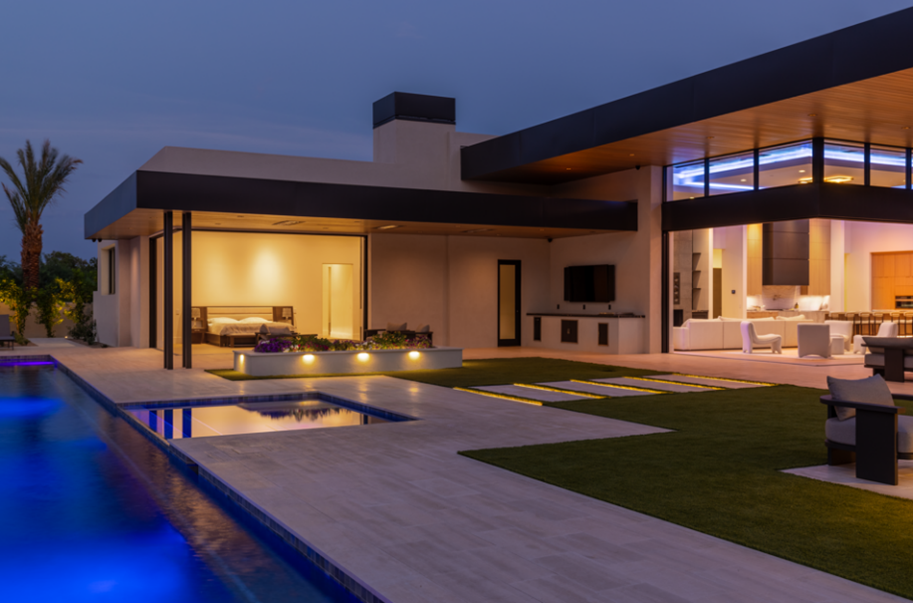
Today, outdoor lighting is defined by purpose-built fixtures engineered for durability, performance, and reliable installation. From walls and hardscapes to pathways and gardens, there are many fixtures available today that deliver the right effects in each area to expand outdoor living spaces with confidence. These fixtures use standardized wiring methods, and they can be managed with user-friendly controllers that support easy system scalability and total smart home integration.
Plus, leading lighting manufacturers now back their products with more documentation and design tools than in the past. Rather than inventing solutions for every job, integrators can rely on proven products and training resources that reduce risk and improve consistency.
A Familiar Workflow with Repeatable Principles
One of the biggest misconceptions about outdoor lighting is that it requires an entirely new skillset. In practice, the installation process uses familiar workflows. From routing and protecting cabling to calculating power loads, integrators know the core fundamentals of wiring inside the home. This also includes designing layouts that are scalable over time.
Outdoor lighting relies on similar principles: low-voltage wiring, centralized control, predictable load calculations, and consistent product placement. For example, the same strategies used to build a home’s network and control infrastructure, including standard device locations and repeatable templates, can also be applied to installing outdoor lighting controllers and fixture layouts.
Modern systems make it easy to standardize wire gauge, run length, zoning, fixture spacing, and aiming. This predictability allows integrators to build repeatable approaches while tailoring each installation to the property, just as they do for home theaters, whole-house audio, or interior lighting systems.
Modern Design Resources and Training
Another common reason that integrators skip or subcontract outdoor lighting is a perceived lack of design expertise. While proper lighting design is essential, manufacturers don’t expect integrators to become experts overnight. Support is widely available across the industry, including virtual and in-person training programs, conferences and seminars, educational videos, lighting design services, and tools that simplify design, layout, and product ordering.
At FX Luminaire, we’ve seen the most successful integrators treat outdoor lighting the same way they approach networking or control systems: by learning through repetition and building confidence one project at a time.
Confident Installations, Seamless Integration
The increased quality of modern outdoor lighting products has made the category much more accessible for integrators. Beyond specific fixture types, manufacturers offer a range of options for color temperature, beam angle, materials, and product finishes to get the right look and feel in every installation.
When it comes to control, smart home integration is fast and convenient. Modern outdoor lighting systems integrate with smart home control platforms and automation schedules. From a homeowner’s perspective, this means one control interface, one unified experience across their property, and one integrator to support it.
For the integrator, it means stronger control of the total experience and the ability to offer clients more value from inception to support. It also makes it easier to design lighting systems that support how homeowners use their property, spanning across architecture, hardscapes, outdoor living areas, gardens, and pathways.
Own the Entire Property, Not Just the Interior
For integrators evaluating new service offerings, outdoor lighting is a practical addition because it builds on familiar installation techniques supported by reliable, modern products and accessible design resources. It helps integrators increase project value and deepen client relationships while creating opportunities for ongoing service.
As the definition of a smart home continues to expand, the integrators who succeed will be the ones who take full ownership of the entire property experience, inside and out. Today, outdoor lighting is no longer a specialty trade. It’s a logical extension of indoor integration and a natural way to grow.
Ryan Williams has led FX Luminaire’s product development for over 15 years in various engineering, product management, and marketing roles. He is Lighting Certified (LC) through NCQLP and holds an MS and MBA in product development from Brigham Young University.





