
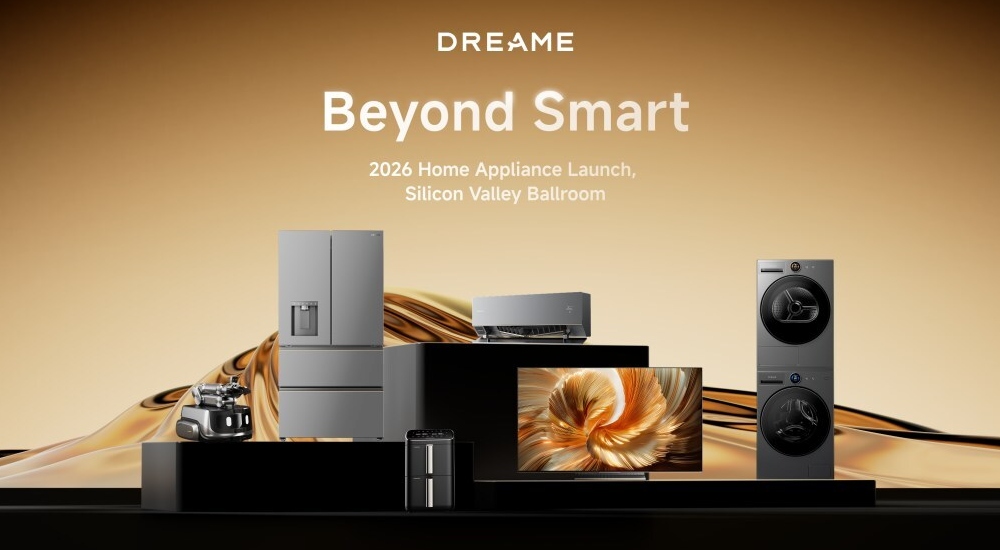
Dreame Technology (Dreame) just released a brand-new lineup of Aura Mini LED TVs alongside an interesting mix of high-end appliances and robotic home assistants. The products were announced at the company’s Beyond Smart event with limited information being given at the current moment as to the bulk of their capabilities.
What Stands out the Most: The Dreame Aura Mini-LED Series
Starting off with what most integrators will likely be interested in, the Dreame Aura TV series is a set of Mini-LED TVs that sport a range of features across the different models. Two models were announced specifically, with one being the flagship of the series, and the other being a more standard model.
- The flagship V3000 sports a proprietary “Black Crystal True Color Screen” that reduces glare while delivering peak brightness levels of 2800 nits at a 300Hz refresh rate. Sizes for this model have not yet been given.
- The S100 lacks the Black Crystral and tops out at 1000 nits of peak brightness on the 86-inch model with 144Hz refresh rate, but comes with a fully integrated soundbar system calibrated with Dolby Atmos. Other size options on the S100 include 75-, 65- and 55-inch TVs.
What’s Worth Mentioning: Dreame’s Robotic Laundry Assistant
Alongside the Aura Series, Dreame also announced a robotic assistant and air conditioner, and while information is limited, they do help point towards where home robotics might try to run as AI models become more widely available.
First up is the Roomba-like laundry assistant, which, according to Dreame, uses a multimodal AI to gradually map out its environment for movement, in addition to identifying clothes that need cleaning. The assistant then uses its robotic arm to pick up the clothing and deposit it into the washing, where it can then run the cycle before moving it over to the dryer and finishing it off there. All of this, Dreame says, is done without any user input.
The only wrinkle? The company specifically mentions it being done with its own AI-powered washer/dryer system with no specification on whether the assistant works as well with other washers or dryers. Though, given the nature of how these interactions usually take place, the safe assumption there is that no special washer/dryer equals a hamstrung assistant.
Dreame and Its Robots
Dreame describes itself a business sitting at the “intersection of high-end consumer electronics, robotics and intelligent manufacturing.” In fact, Dreame’s whole portfolio is filled more with robots than it is with TVs and other, more standard, consumer electronics.
There’s the usual suspects with robot vacuums, pool cleaners and even a mower, but the addition of the laundry robot to its catalog showcases how a company that has been deep in the home robotics category for a while is attempting to innovate through the inclusion of AI.
AI and Home Robotics
The ability for AI models to incrementally build out their data sets and operate based on new context is something that greatly benefits any robot trying to navigate a three-dimensional space. Improvements in machine vision also allow these robots to potentially engage in more sophisticated tasks than before. While the bankruptcy of iRobot may have seemed like the end of an era for home robotics (and a more futuristic vision of the smart home) AI seems to be giving the industry a second wind.
Still, there’s a lot standing in the way of a fully realized robotic home assistant. Homes are designed (generally) with people–not robots–in mind with layouts limiting the scope of what a robot might be able to do, especially as space becomes a growing premium.
Takeaways for Integrators
Among the announcements from Beyond Smart, integrators will likely want to look at the Aura TV series to see how they hold up to the competition. The robot, while interesting, better paints an image of how industry approaches to home robotics are changing in the wake of newer AI models.
Strides are being made to break robotic assistants out of the vacuum and pool cleaning niches they’ve remained in for some time, but plenty of hurdles remain. Consistency of models, complexity of tasks and the ultimate hurdle of retrofitting something into a space where it was never considered in the first place are the three big ones.
The second element is something we’ve seen solved by pairing the assistant with a proprietary unit that it’s better designed to interface with, but that brings its own set of problems integrators are likely well aware of in the form of segmented ecosystems. As the smart home industry makes strides towards these more open and fluid platforms, any type of robotic hoping to tap into the intelligence provided by such would need to be operable with a variety of devices and units.





