Theater Redesign Updates CRT System to CinemaScope
Retrofitting a home theater to support CinemaScope viewing can be lucrative.
We didn't know there really were magic mirrors until this retrofit project came along. OK, it's not really magic, but using a mirror as part of this theater redesign did provide an ace up the sleeve of installer Steven Spruell, president of TASC Design in Conroe, Texas.
Spruell had worked over the years updating the technology at a home in this Houston suburb, with additions such as Crestron and Kaleidescape systems most notably offering a big improvement for the owners. But the kicker came after Spruell took the client to CEDIA Expo 2008 in Denver, and the client saw all of the CinemaScope screen solutions that effectively get rid of the annoying black bars that appear with ultra-wide movie presentations.
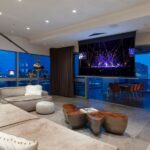
The homeowners already had a dedicated theater room, as well as a 15.5-by-11-foot dedicated projection room (which doubles for storage area) behind a 16:9 Stewart Filmscreen rear-projection screen. They were ready to upgrade.
"CinemaScope was the driving factor for them going out there," says Spruell of the CEDIA Expo trip, which also resulted in an audio upgrade. "He wasn't planning on doing audio, but we took him to the demo room for Professional Home Cinema (which TASC has a relationship with), and he said he had to have it."
But there were limitations to what Spruell could do. The screen is flanked by wing columns, which were not to be moved or aesthetically altered. TASC could do whatever it took behind the scenes, including some reconfiguration that did need to be done to modify cabinets for larger speakers, as 12-inch mains would be stacked on top of 18-inch subwoofers for each column (a 12-inch center channel was positioned under the center of the screen behind acoustic fabric).
Spruell made the most of the remaining space between the original screen and columns to max out a wider model from Stewart - the original wall opening was 107 inches wide, the new one 123 inches. He also wanted to maintain the screen height, which led to a compromise; the area was not wide enough to fit a 2.35:1 or 2.40:1 aspect ratio, but rather TASC implemented a 2.07:1 screen that still requires some masking.
The other little hurdle? Adding an anamorphic lens into the projection equation requires a throw distance longer than the 1.3x throw produced by the old CRT projector that was mounted as far against the back wall as possible. "We needed to get to a 1.7x throw on an even wider screen," says Spruell. "That left us with two choices: lengthen the room or use a mirror system. The mirror system won out."
Some installers are familiar with the nifty trick, but basically what Spruell did was mount the projector - a Digital Projection iVision - and Panamorph lens and sled near the screen and place the stand-mounted mirror about two-thirds of the way behind so there would be adequate distance to bounce the image to the screen. "All the projector settings are set for front projection, because that's what it acts like as far as the projector is concerned," Spruell says.
And when the clients pick a movie from the server, Kaleidescape already has its aspect ratio stored and signals the Crestron controls to trigger either the side masking (if it's a 16:9 movie) or top-and-bottom masking (if it's 2.35:1) to move into place. Now that's movie magic.
Spruell had worked over the years updating the technology at a home in this Houston suburb, with additions such as Crestron and Kaleidescape systems most notably offering a big improvement for the owners. But the kicker came after Spruell took the client to CEDIA Expo 2008 in Denver, and the client saw all of the CinemaScope screen solutions that effectively get rid of the annoying black bars that appear with ultra-wide movie presentations.
The homeowners already had a dedicated theater room, as well as a 15.5-by-11-foot dedicated projection room (which doubles for storage area) behind a 16:9 Stewart Filmscreen rear-projection screen. They were ready to upgrade.
"CinemaScope was the driving factor for them going out there," says Spruell of the CEDIA Expo trip, which also resulted in an audio upgrade. "He wasn't planning on doing audio, but we took him to the demo room for Professional Home Cinema (which TASC has a relationship with), and he said he had to have it."
But there were limitations to what Spruell could do. The screen is flanked by wing columns, which were not to be moved or aesthetically altered. TASC could do whatever it took behind the scenes, including some reconfiguration that did need to be done to modify cabinets for larger speakers, as 12-inch mains would be stacked on top of 18-inch subwoofers for each column (a 12-inch center channel was positioned under the center of the screen behind acoustic fabric).Spruell made the most of the remaining space between the original screen and columns to max out a wider model from Stewart - the original wall opening was 107 inches wide, the new one 123 inches. He also wanted to maintain the screen height, which led to a compromise; the area was not wide enough to fit a 2.35:1 or 2.40:1 aspect ratio, but rather TASC implemented a 2.07:1 screen that still requires some masking.
The other little hurdle? Adding an anamorphic lens into the projection equation requires a throw distance longer than the 1.3x throw produced by the old CRT projector that was mounted as far against the back wall as possible. "We needed to get to a 1.7x throw on an even wider screen," says Spruell. "That left us with two choices: lengthen the room or use a mirror system. The mirror system won out."
Some installers are familiar with the nifty trick, but basically what Spruell did was mount the projector - a Digital Projection iVision - and Panamorph lens and sled near the screen and place the stand-mounted mirror about two-thirds of the way behind so there would be adequate distance to bounce the image to the screen. "All the projector settings are set for front projection, because that's what it acts like as far as the projector is concerned," Spruell says.
And when the clients pick a movie from the server, Kaleidescape already has its aspect ratio stored and signals the Crestron controls to trigger either the side masking (if it's a 16:9 movie) or top-and-bottom masking (if it's 2.35:1) to move into place. Now that's movie magic.
Spotlight on Racks & Mounts
|
IKEA to Sell TVs & Electronics Integrated into Furniture Nortek Merges OmniMount into Ergotron Inside Sanus Systems’ CES 2012 Booth Peerless PeerAir Combines Mount with Wireless HD Streaming OmniMount Designs ActionMount Line for 3D, Exercise, Gaming Premier Mounts CMF with MagnaGuide Crimson VersaFit mount Why is There a 10-Week Wait to Buy B&O’s $85K Plasma TV? More filed in mounts |
How SnapAV Keeps Prices So Low
Review: Which Online Mount-Finder is the Best? |
Ultimate Guide
to Racks & Mounts Download this guide for a listing of flat-panel and projector mounting solutions, including motorized, fixed and tilting systems.
|
|
Presented by Sanus
|
||
Subscribe to the CE Pro Newsletter
Article Topics
News · Displays · TVs · Mounts and Lifts · Projectors and Screens · Equipment Racks · Retrofit · Home Theater · Cinemascope · Installation ·About the Author

Arlen Schweiger is managing editor of CE Pro and Commercial Integrator magazines. Arlen contributes installation features, business profiles, manufacturer news and product reviews.
1 Comments (displayed in order by date/time)
Page 1 of 1 comment pages


Click image for full-size
Click image for full size
Great job TASC.
Obviously, optics are the only way to accomplish the custom aspect ratio our created here.
I don’t know if anyone took note at CEDIA, but Projection Design, (who used to OEM the iVision DPI piece seen here I believe) has a new 2:35:1 projector with 2538x1080 resolution that does not require optics like panamorph to stretch the image out. The projector recognizes the difference between 1.78 and 2:35 and uses the extra pixels when the exist, keeping the image height constant.
May be a great fit for anyone embracing CinemaScope.
http://www.avielo.com/product-optix-superwide235.html